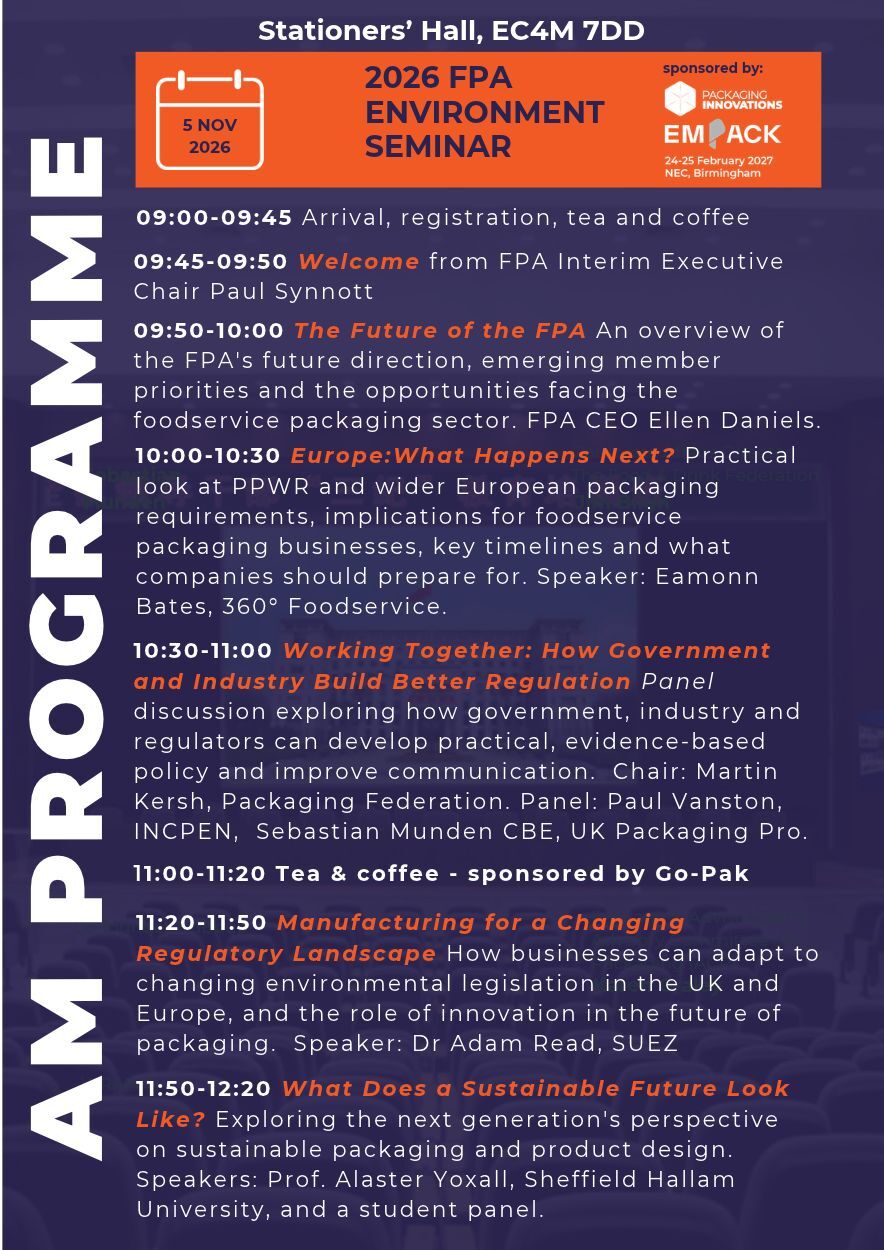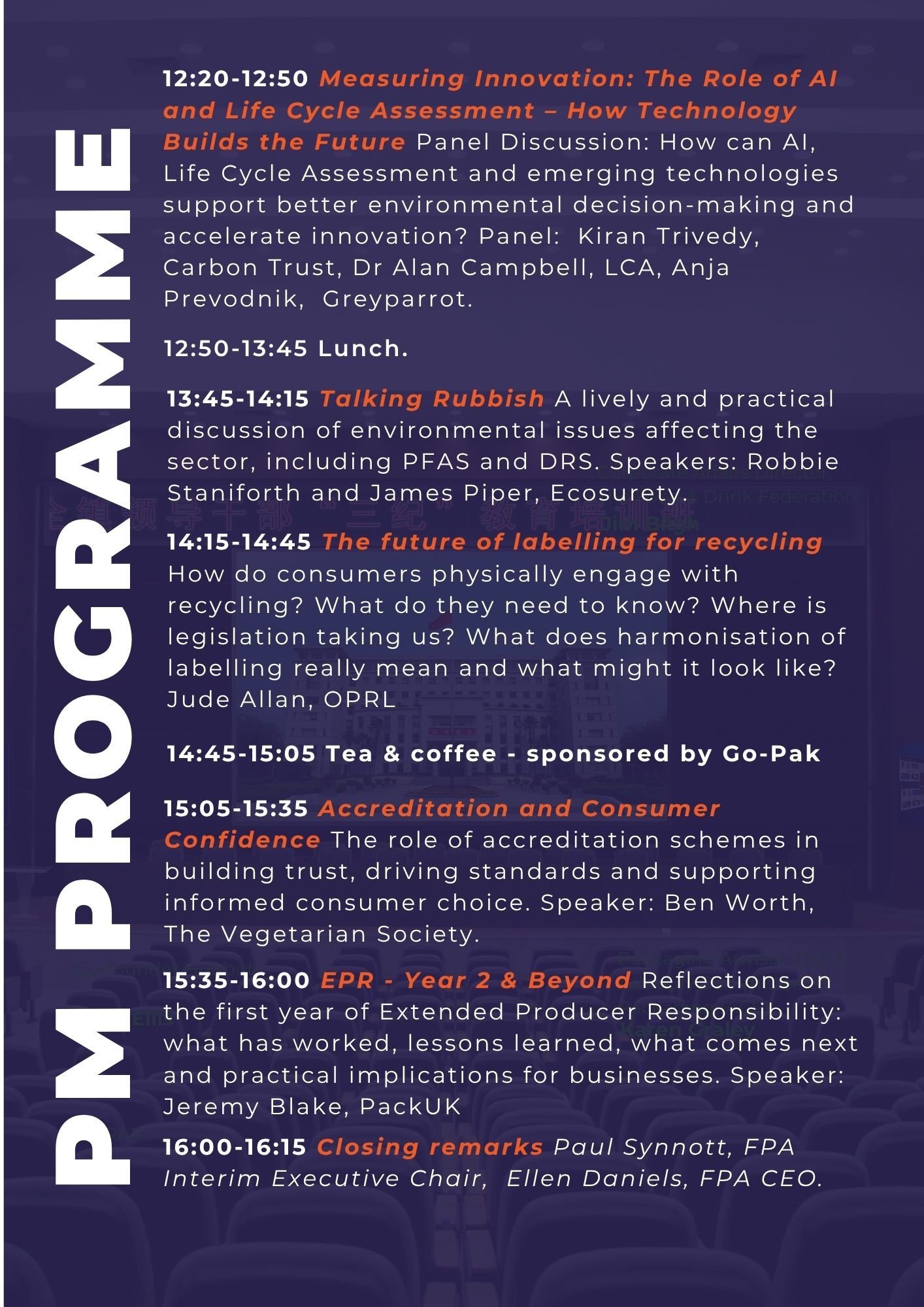
The FPA 2026 Environment Seminar brought together businesses, policymakers, technical specialists and researchers for an examination of the opportunities and challenges facing foodservice packaging. Speakers discussed the implementation of packaging reform, the evidence needed for investment, and the role of consumers in successful collection, reuse and recycling systems.
The following reports capture the main arguments, practical examples and questions raised throughout the day. They are editorial accounts of the presentations, rather than verbatim transcripts.
Opening and closing addresses
Growth and circularity in every postcode
Paul Synnott, FPA interim executive chair
Opening and closing the Seminar, Paul emphasised that environmental progress and economic growth must go hand in hand. He called for fair, proportionate and evidence-led packaging regulation, greater transparency over how producer funding delivers environmental improvements, and stronger collaboration between government and industry to support UK manufacturing, investment and circularity.
Read the full report here
The future of the FPA
Ellen Daniels, FPA chief executive
Drawing on the recent FPA member survey, Ellen set out the FPA's priorities: practical regulatory support, stronger government engagement and media visibility, and investment in future talent through the FPA's emerging Young and Emerging Professionals initiative and a new FPA sector jobs board.
Read the full report here
Policy, regulation and collaboration
Europe: What happens next?
Eamonn Bates, 360° Foodservice
The EU Packaging and Packaging Waste Regulation changes the responsibilities of manufacturers, importers, brand owners and producers, with important consequences for UK suppliers serving EU markets and Northern Ireland.
Working together: Can government and industry build better regulation?
Paul Vanston, INCPEN; Sebastian Munden CBE, UK Packaging PRO – a panel discussion chaired by Martin Kersh, Packaging Federation
A candid discussion examined the gap between consultation and collaboration, the business impact of packaging rules and how industry can help improve an operational pEPR system.
PackUK: From collecting fees to delivering results
Jeremy Blake, PackUK
Jeremy reviewed the operational first year of pEPR and the next challenge: turning producer funding into improvements across collection, sorting, reprocessing and consumer participation.
Waste management, investment and innovation
Investment, DRS and the realities of recycling
Dr Adam Read MBE, SUEZ
Adam offered an operational view of what happens after packaging enters the waste system, welcoming EPR’s potential while warning that delayed decisions and changing material flows can undermine infrastructure investment.
Consumers, design, communication and trust
Designing recycling systems around the people who use them
Professor Alaster Yoxall, Sheffield Hallam University
Sustainability involves social outcomes alongside environmental and economic performance. The presentation challenged businesses to design for what people actually do rather than what designers expect them to do.
Talking Rubbish: Making recycling understandable
Robbie Stanniforth and James Piper, Talking Rubbish
The award-winning presenters showed how humour, relatable comparisons and positive storytelling can explain specialist recycling issues without eroding public confidence.
The future of recycling labels
Jude Allan, OPRL
Proposed European harmonised labels could simplify cross-border packaging over time but complicate the transition for brands, manufacturers and consumers.
Green claims and certification under scrutiny
Ben Worth, Vegetarian Society
The EU Empowering Consumers for the Green Transition rules make the substantiation of environmental claims, the presentation of certification marks and the approval of artwork important across the packaging supply chain.
Measuring innovation: The role of AI and life cycle assessment
Anja Prevodnik, Greyparrot; Kiran Trivedy, The Carbon Trust; Dr Alan Campbell, The LCA Center
Can artificial intelligence help the packaging industry make better environmental decisions? The panel explored how AI is changing life cycle assessment, carbon accounting and the measurement of waste flows. From analysing billions of objects in recycling facilities to checking the evidence behind environmental claims, the discussion highlighted significant opportunities – but also the risks of inaccurate data and automated assumptions. Their central message was clear: technology can strengthen environmental decisions, but only when its findings are tested against real products, credible evidence and expert judgment.
Read the full report here
Our thanks to our event sponsor Packaging Innovations & Empack
And also to Go-Pak for sponsoring the refreshment breaks.
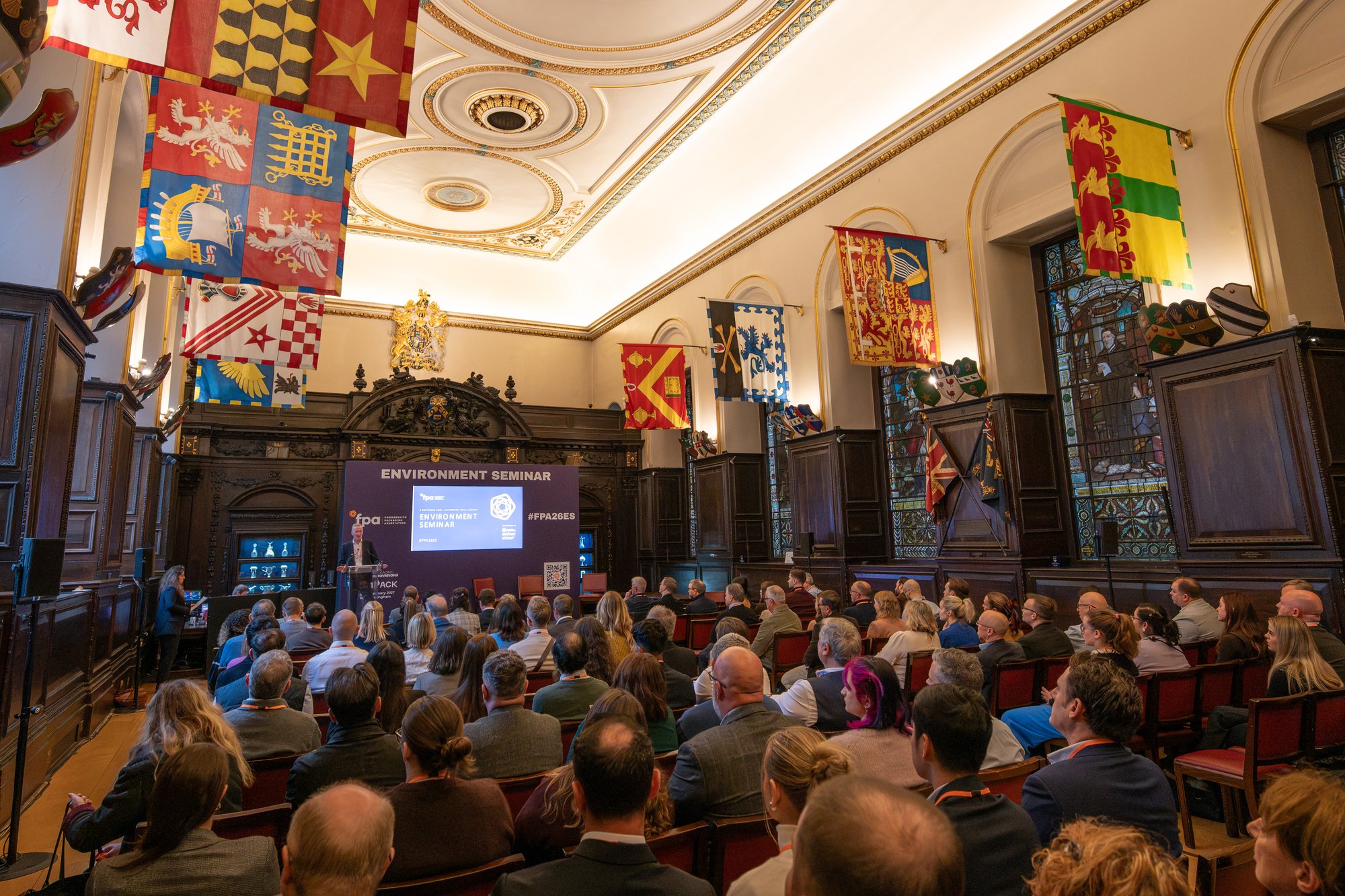
The FPA Environment Seminar brought together businesses, policymakers, technical specialists and researchers for an examination of the opportunities and challenges facing foodservice packaging. Speakers discussed the implementation of packaging reform, the evidence needed for investment, and the role of consumers in successful collection, reuse and recycling systems.
The following reports capture the main arguments, practical examples and questions raised throughout the day. They are editorial accounts of the presentations, rather than verbatim transcripts.
Opening and closing addresses
Growth and circularity in every postcode
Paul Synnott, FPA interim executive chair
Opening and closing the Seminar, Paul emphasised that environmental progress and economic growth must go hand in hand. He called for fair, proportionate and evidence-led packaging regulation, greater transparency over how producer funding delivers environmental improvements, and stronger collaboration between government and industry to support UK manufacturing, investment and circularity.
Read the full report here
The future of the FPA
Ellen Daniels, FPA chief executive – Drawing on the summer membership survey, Ellen set out the FPA's priorities: practical regulatory support, stronger government engagement and media visibility, and investment in future talent through YEPs and a new sector jobs board.
Read the full report here
Policy, regulation and collaboration
Growth and circularity in every postcode
Paul Synnott, FPA interim executive chair
Paul framed environmental progress and economic growth as complementary goals. He reiterated support for the producer-pays principle, provided fees are fair and can be shown to achieve measurable outcomes.
Read the full report here
Europe: What happens next?
Eamonn Bates, 360° Foodservice
The EU Packaging and Packaging Waste Regulation changes the responsibilities of manufacturers, importers, brand owners and producers, with important consequences for UK suppliers serving EU markets and Northern Ireland.
Working together: Can government and industry build better regulation?
Paul Vanston, INCPEN; Sebastian Munden CBE, UK Packaging PRO – a panel discussion chaired by Martin Kersh, Packaging Federation
A candid discussion examined the gap between consultation and collaboration, the business impact of packaging rules and how industry can help improve an operational pEPR system.
PackUK: From collecting fees to delivering results
Jeremy Blake, PackUK
Jeremy reviewed the operational first year of pEPR and the next challenge: turning producer funding into improvements across collection, sorting, reprocessing and consumer participation.
Waste management, investment and innovation
SUEZ: Investment, DRS and the realities of recycling
Dr Adam Read MBE, SUEZ
Adam offered an operational view of what happens after packaging enters the waste system, welcoming EPR’s potential while warning that delayed decisions and changing material flows can undermine infrastructure investment.
Consumers, design, communication and trust
Designing recycling systems around the people who use them
Professor Alaster Yoxall, Sheffield Hallam University
Sustainability involves social outcomes alongside environmental and economic performance. The presentation challenged businesses to design for what people actually do rather than what designers expect them to do.
Talking Rubbish: Making recycling understandable
Robbie Stanniforth and James Piper, Talking Rubbish
The award-winning presenters showed how humour, relatable comparisons and positive storytelling can explain specialist recycling issues without eroding public confidence.
The future of recycling labels
Jude Allan, OPRL
Proposed European harmonised labels could simplify cross-border packaging over time but complicate the transition for brands, manufacturers and consumers.
Green claims and certification under scrutiny
Ben Worth, Vegetarian Society
The EU Empowering Consumers for the Green Transition rules make the substantiation of environmental claims, the presentation of certification marks and the approval of artwork important across the packaging supply chain.
Measuring innovation: The role of AI and life cycle assessment
Anja Prevodnik, Greyparrot; Kiran Trivedy, The Carbon Trust; Dr Alan Campbell, The LCA Center
Can artificial intelligence help the packaging industry make better environmental decisions? The panel explored how AI is changing life cycle assessment, carbon accounting and the measurement of waste flows. From analysing billions of objects in recycling facilities to checking the evidence behind environmental claims, the discussion highlighted significant opportunities – but also the risks of inaccurate data and automated assumptions. Their central message was clear: technology can strengthen environmental decisions, but only when its findings are tested against real products, credible evidence and expert judgment.
Read the full report here
Our thanks to our event sponsor Packaging Innovations & Empack
#FPA26EA
And also to Go-Pak for sponsoring the refreshment breaks.