The FPA Friday Digest
01 May 2026
There are encouraging signs that we may be entering a new era of dialogue with PackUK, Defra and the Environment Agency. The recent open table discussions, alongside the establishment of regular monthly meetings between PackUK and the FPA, point to a growing willingness to engage directly with industry and to listen to the concerns being raised.
This is most welcome. Over recent months, the FPA has been clear and consistent in highlighting the unintended consequences emerging from the design and implementation of pEPR. While the principle of producer responsibility is one the industry supports, the current system risks placing disproportionate burdens on compliant businesses, while gaps in scope and enforcement continue to raise legitimate questions about fairness and effectiveness.
Constructive engagement is the only route to resolving these issues. We will continue to use every opportunity – through formal meetings, roundtables and our ongoing dialogue with officials – to ensure that the real-world impacts on businesses in our sector are properly understood. This includes pressing for greater transparency around producer registration, improved confidence in the integrity of the system’s boundaries, stronger enforcement and policing of the pEPR framework, and a clearer understanding of how costs are being distributed across the market.
We will also persist in asking members to make their voices heard locally by writing to their MPs – highlighting the impact the current system is having on businesses, jobs and investment in their constituencies remains one of the most effective ways to ensure these issues are fully understood at the heart of government.
While it is certainly reassuring to see the tone of the conversation shifting, engagement must now translate into action. Getting pEPR right is in everyone’s interest – government, local authorities, and industry alike. A fair, robust and fully functioning system is essential if we are to deliver both the desired environmental outcomes and a level playing field for UK businesses.
As always, we will continue to keep our members closely informed.
PackUK and Defra update on pEPR delivery, fees and PRN reform
Stakeholders received an update from Defra, PackUK and regulators yesterday on the ongoing rollout of pEPR, alongside reassurance that the current PRN reform consultation sits outside the remit of PackUK and the Producer Responsibility Organisation (PRO). Government confirmed the consultation is focused on tackling fraud, improving transparency and creating a more level playing field.
PackUK highlighted key delivery milestones, including completion of year-one local authority payments and publication of its operational plan, while confirming the appointment of UK Packaging Pro as the PRO from April 2026. A phased approach to delegation is planned, with PackUK retaining control of core functions such as local authority cost modelling, supported by advisory input from the PRO as the scheme develops.
On funding, government reiterated that its intervention to cover the year-one shortfall was a one-off measure and not expected to be repeated. Producer fees for year two will be updated ahead of Notices of Liability to reflect improved data, with PackUK taking steps to strengthen data assurance, refine modelling and reduce the risk of future mismatches between producer payments and local authority costs.
Regulators also confirmed that digital reporting requirements are now fully live, with tighter deadlines in place and previous flexibilities withdrawn. Businesses are advised to ensure accurate data submission via the RREPW service and to engage with updated guidance.
FPA comment: “It's good to see regulators encouraging reporting of suspected non-compliance. This underlines an increasing focus on enforcement, which will be very much welcomed by our members”.
Digital waste tracking legislation laid to tackle waste crime
Government has formally presented a Statutory Instrument to Parliament to introduce mandatory digital waste tracking, marking a major step towards creating a comprehensive, real-time system to monitor waste movements across England.
Announced by Defra, the reforms will replace the current paper-based system with a single digital platform that records the journey of waste from production through to final treatment or disposal. The legislation places a legal duty on all parties handling waste – including producers, carriers, brokers and processors – to record and share data through this central system, creating a full audit trail intended to improve transparency and regulatory oversight.
Ministers have positioned the move as “game-changing” in the fight against waste crime, aiming to clamp down on illegal dumping and rogue operators while supporting more effective enforcement.
Industry and regulatory stakeholders have broadly welcomed the move, noting the potential for better data quality and improved compliance. However, concerns remain around implementation timelines, system readiness and the administrative burden on businesses, particularly smaller operators. Questions have also been raised about how effectively the data will be monitored and enforced in practice.
The rollout is expected to be phased, with further detail to follow on timing and onboarding requirements. A voluntary beta version of the system is already live, signalling the start of practical implementation and giving businesses an early opportunity to familiarise themselves with new reporting requirements ahead of mandatory adoption.
FPA comment: “For the packaging and wider waste sector, the reforms signal a shift towards greater digital accountability – placing increased emphasis on traceability, compliance and robust enforcement across the system”.
MPs call for stronger, precautionary approach to PFAS risks
A new report from the Environmental Audit Committee is urging the government to adopt a more precautionary and coordinated national response to per- and polyfluoroalkyl substances (PFAS), citing growing concerns over their persistence in the environment and potential risks to human health. The Committee argues that current policy does not go far enough in preventing contamination or addressing legacy pollution.
Among its key recommendations, the report calls for a phase-out of all non-essential uses of PFAS from 2027, aligning broadly with proposals being developed in the EU, where restrictions on PFAS in food-contact packaging are due to take effect from August 2026. It also advocates applying the polluter-pays principle to fund clean-up efforts, establishing a dedicated remediation fund for affected communities, and expanding the UK’s capacity to safely destroy PFAS through high-temperature incineration.
The report comes amid growing pressure from campaign groups, which argue there is “no place” for PFAS in a circular packaging system, warning that their persistence risks contaminating recycling streams and undermining the integrity of reuse and recycling models. This adds to mounting calls for tighter restrictions and clearer phase-out timelines.
The Committee is critical of the government’s current approach, arguing that it places too much emphasis on monitoring rather than prevention and remediation. While ministers maintain that “decisive action” is already underway, MPs warn that without stronger upstream controls, the scale and cost of future contamination could escalate significantly.
FPA comment: "The Committee's report adds to mounting regulatory pressure around the use of PFAS in food-contact materials, with implications for material selection, supply chains and compliance strategies. It also signals a potential tightening of policy direction in the UK, bringing it closer to emerging EU restrictions”.
Flat 20p deposit confirmed for UK-wide DRS from 2027
A flat 20p deposit on single-use drinks containers has been confirmed for the UK’s Deposit Return Scheme (DRS), due to launch in October 2027. Scheme administrator Exchange for Change said the single rate will apply across all in-scope materials – plastic bottles and metal cans – aiming to simplify the system and improve return rates.
The decision provides long-awaited clarity for industry, but has also prompted concerns about potential unintended consequences. Some stakeholders warn that a fixed-rate deposit could disproportionately affect metal drink cans. Historic analysis from the Aluminium Packaging Recycling Organisation suggests that deposit costs on multipacks could be significantly higher for cans than for equivalent volumes in plastic bottles, raising questions about whether the approach could inadvertently increase plastic use if consumers switch to larger plastic bottles in search of better value.
Exchange for Change has also published further detail on scheme design, including material specifications setting out requirements for container dimensions, labelling and barcode compatibility with reverse vending machines. Producers will be required to register products ahead of launch, while proposals have also been outlined to support smaller retailers, including potential exemptions from hosting return points and a targeted grant scheme of up to £6,000 per site for reverse vending infrastructure.
The announcement marks a significant step forward for the long-delayed scheme, but attention now turns to implementation, including interoperability across the UK, final scope decisions and how the system will integrate with wider reforms such as pEPR.
FPA comment: “As with EPR, the focus now shifts from design to delivery, with industry calling for greater detail on timelines, infrastructure and enforcement to ensure the system operates effectively from day one".
Hospitality closures average three per day as cost pressures intensify
New data reported by The Caterer highlights a challenging start to the year for the UK hospitality sector, with an average of three venues closing each day during the first quarter of 2026, as soaring costs continue to squeeze margins across the industry.
Businesses across restaurants, pubs and cafés are grappling with a combination of higher wage bills, increased National Insurance contributions and broader inflationary pressures, alongside subdued footfall in some areas.
While some operators have been able to adapt through pricing or efficiency measures, the impact is being felt most acutely by smaller independent businesses, with insolvencies expected to rise further as cost pressures intensify.
Industry commentators warn that the pace of closures reflects deeper structural strain rather than short-term volatility, with ongoing cost increases and cautious consumer spending continuing to weigh on trading conditions. The figures add to growing evidence that parts of the sector remain in a fragile position despite pockets of resilience.
FPA comment: “This trend highlights continued pressure on a key customer base, reinforcing concerns about demand, pricing sensitivity and the cumulative impact of regulatory and cost burdens across the value chain”.
New OEP chair signals continued scrutiny of environmental delivery
Government has named Helen Ghosh as its preferred candidate to chair the Office for Environmental Protection (OEP), the independent body responsible for holding public authorities to account on environmental law and commitments.
Ghosh is a former Permanent Secretary at Department for Environment, Food and Rural Affairs and most recently served as Director General of the National Trust, bringing extensive experience across environmental policy, regulation and delivery. Her appointment has been endorsed by the EFRA and Environmental Audit committees, although they have stressed the need for the OEP to strengthen relationships with stakeholders.
While the OEP does not set policy, its role in scrutinising delivery is likely to keep pressure on key reforms – including pEPR and wider waste and resource measures – particularly as implementation challenges and enforcement expectations come into sharper focus.
NEWS FROM EUROPE
Pressure builds on PPWR compliance as industry faces implementation reality
Momentum continues to build across Europe as businesses prepare for the practical implications of the EU’s Packaging and Packaging Waste Regulation (PPWR), with increasing emphasis on compliance, material choices and market access. Industry commentary suggests a shift from high-level policy debate to the operational realities of meeting recyclability, substance and documentation requirements.
A growing theme is the tightening expectation that non-compliant packaging will simply not be permitted on the EU market, reinforcing the direction of travel towards stricter enforcement. This is driving renewed focus on data, supply chain transparency and evidence to support claims around recyclability and material composition.
The evolving landscape is also sharpening commercial pressures, as businesses weigh the cost and complexity of reformulation, redesign and supplier changes against regulatory risk. For UK-based companies supplying into Europe, the message is increasingly clear: alignment with PPWR requirements will be essential to maintain market access.
FPA comment: “This adds to the wider picture of an increasingly complex regulatory landscape, where companies must navigate overlapping, and in some cases diverging, frameworks across EPR, DRS and broader sustainability requirements”.
EXTERNAL EVENTS
FPA partners with leading packaging sustainability event
The FPA is pleased to be partnering with the 2026 Packaging News Sustainability & Impact Summit and Awards, taking place at the Kia Oval on Tuesday 14 July.
Bringing together experts from across the value chain, the event will explore key themes including regulatory developments, material innovation and the practical challenges of delivering more sustainable packaging solutions in a rapidly evolving policy landscape.
As a partner, the FPA is supporting efforts to ensure that the foodservice packaging sector is represented within these discussions – particularly as businesses navigate the introduction of EPR, DRS and wider environmental requirements.
The event provides a valuable opportunity for members to engage directly with policymakers, industry leaders and technical experts, and to gain insight into how emerging frameworks are likely to impact packaging design, operations and compliance.
Further details, including agenda and registration, can be accessed via the event website
Stakeholder Engagement Forums – April to July dates
Dates and links to the next tranche of Circular Economy Stakeholder Forum meetings. No registration is required, the Microsoft Teams link accompanying each forum will provide direct access to that meeting.
Defra recommends individuals wishing to attend save each link to their calendars. No reminders will be sent.
May Forum – Tuesday 5 May 14:30 to 16:00 Link to access forum
June Forum – Tuesday 2 June: 14:30 to 16:00 Link to access forum
July Forum – Tuesday 7 July: 14:30 to 16:00 Link to access forum
FPA NEWS AND EVENTS
Confidential input requested
Businesses with concerns about how pEPR is operating in practice – including issues relating to scope, competition, enforcement or unintended consequences, are invited to share their experiences in confidence with the FPA. We also welcome intelligence on potential gaps in scope, market distortions or suspected avoidance behaviours, which can be shared in confidence.
This insight is invaluable in helping us build an accurate picture of how the system is functioning on the ground and in ensuring that industry concerns are effectively represented in our ongoing engagement with Defra, PackUK and the Environment Agency.
Please contact Mike Revell, the executive chair directly via mikerevell@foodservicepackaging.org.uk. All information will be handled sensitively and used to inform our evidence base and policy discussions.
FPA Annual Golf & Activities Day
Thursday 11 June
FPA members, colleagues and customers are invited to join us on Thursday 11 June for the FPA’s ever-popular annual Golf and Activities Day, taking place at the stunning Breadsall Priory Country Club, near Derby.
Whether you opt for the 18-hole Golf Day or the lively ‘Quintessentially English’ Activities Day – featuring everything from axe-throwing and welly wanging to croquet, tug-of-war and even duck herding – it’s set to be a fantastic day of relaxed networking with your guests and industry peers.
We are grateful to our sponsors for supporting the event: South Staffordshire Paper Products Ltd (Longest Drive), Conglom International (Nearest the Pin), and Paragon (Activities), whose contributions help make the day possible.
With strong interest already, we encourage you to secure your place if you haven't already. The day concludes with prize-giving and an evening barbecue, providing the perfect opportunity to unwind and continue conversations.
Pricing, the full itinerary and booking details can be accessed via this link.
FPA in the media
Packaging Insights: Foodservice packaging moves toward 'verified sustainability' with fiberization and recyclability. Read more here
Essential reading
Defra: Game-changing digital tracking takes fight to rogue waste traders. Read more here
The Grocer: Simpler Recycling is a business opportunity, not a burden (opinion piece). Read more here
Packaging News: Glass recyclability – cutting through ratings confusion. Read more here
letsrecycle.com: Frustration grows as Circular Economy Growth Plan delays continue. Read more here
Circular: Digital Waste Tracking legislation laid in parliament. Read more here
Food Chain Magazine: “1,000 tonnes of microplastics enter food from packaging every year”, report finds. Read more here
QSR: Hospitality sector contracts as inflation drives wave of closures in Q1. Read more here
Packaging Dive: Containerboard production charts steepest decline in years in Q1. Read more here
CSW: Government should merge more small public bodies, Public Accounts Committee report urges. Read more here
Food Navigator: Consumer caution throws global packaging into turmoil. Read more here
Packaging Dive: EPR budgeting conversations – advice from the frontlines. Read more here
letsrecycle.com: Deposit Return Schemes – a lot of deposit but what's the return?. Read more here
Quote of the week and post of the week
Esther Carter from PackUK in an interview with let'srecycle.com responding to the question 'How do you navigate strong and conflicting stakeholder views?'
"I’m becoming very familiar with strong and conflicting stakeholder views! We spend a lot of time in conversations where one group of stakeholders will feel very passionately one way, and a different group of stakeholders will feel the complete reverse. They’ll both be pushing for pretty much opposite outcomes, which can be difficult to navigate".
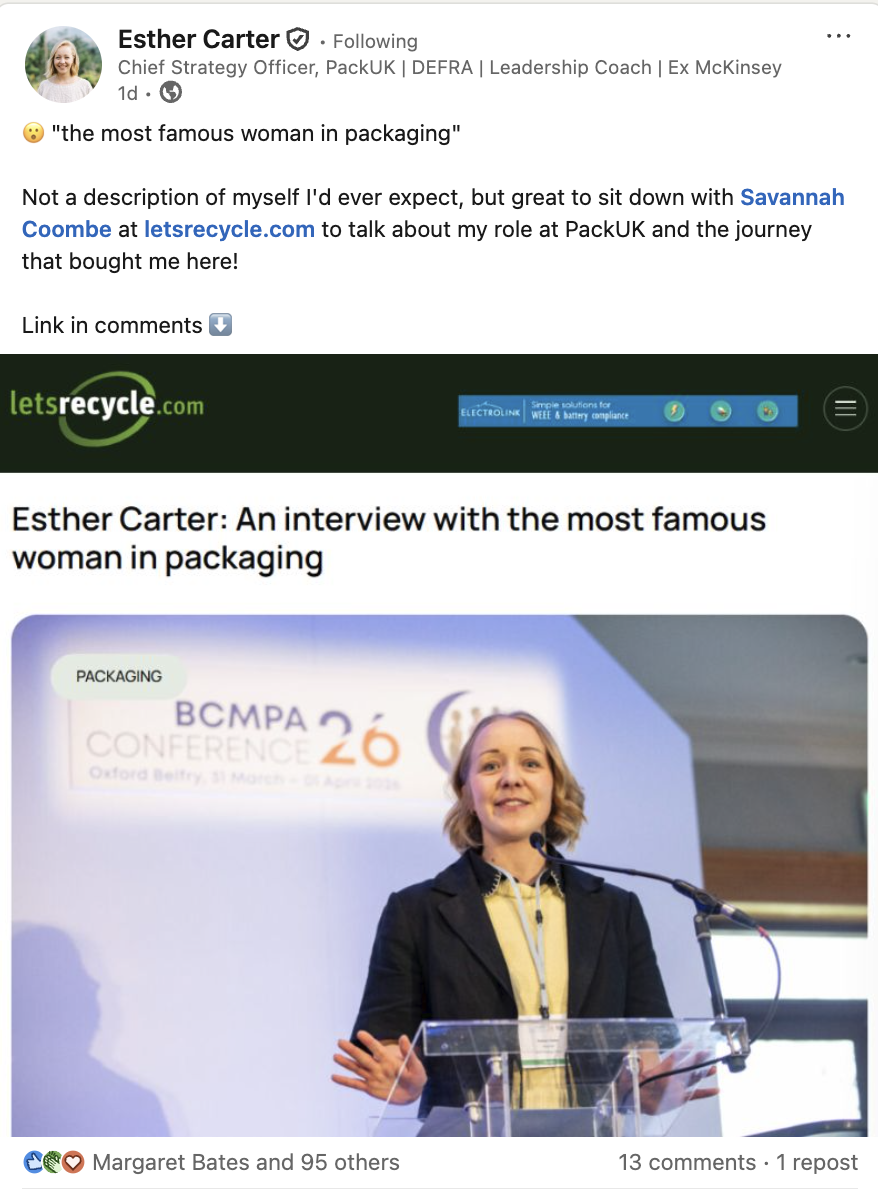
Click on the image above to access and / or comment on this post
Do you know a business that should join the FPA?
The Foodservice Packaging Association represents the interests of its members at all levels and works hard to ensure its members are better represented, better informed and better connected.
FPA members receive early sight of this Digest on Thursday evenings, prior to distribution each Friday morning, and can view an archive of previous Digests within their FPA Dashboards or via this link