The FPA Friday Digest
05 June 2026
In this week's FPA Friday Digest ...
Before turning to this week's policy and industry developments, the FPA Board is delighted to formally welcome Ellen Daniels, who joined us on Monday as the Foodservice Packaging Association's first CEO.
Board members were delighted by the calibre of candidates attracted to the role, reflecting both the importance of the issues facing our sector and the growing influence of the association. We are grateful to all those who participated in the process and shared their ideas for the future of the FPA. We are confident Ellen brings the leadership, experience and strategic vision required to take forward the association's recently agreed strategic plan.
Ellen joins the FPA at an important time for both the sector and the association. With major regulatory reforms now moving from policy development into implementation, and with the association's recently agreed strategic plan providing a clear direction for the years ahead, the FPA team looks forward to working with Ellen as we implement the next chapter of the FPA's development. We wish her every success in the role and thank all those who supported the recruitment and transition process.
Moving on to this week's Digest, the content reflects the pace of change currently affecting our sector.
The debate around pEPR is increasingly extending beyond the packaging sector itself, with politicians, manufacturers and national newspapers now openly debating the impact of the reforms on inflation, household costs and industrial competitiveness. However, recent comments from Defra make clear that government intends to proceed with pEPR as planned, despite these concerns and the growing industry debate around costs, implementation and scheme operation.
While the FPA recognises the need for certainty as businesses prepare for the years ahead, implementation should not signal the end of the conversation.
As more operational data becomes available and the practical impacts of the reforms become clearer, it is important that industry experience continues to inform policy development. The FPA remains committed to constructive engagement with Defra, PackUK, regulators and other stakeholders to help ensure the system delivers its intended environmental outcomes while remaining practical, proportionate and effective for the businesses funding it.
The FPA will continue to represent members' views, share evidence where concerns arise and work collaboratively with policymakers to support the successful long-term delivery of the UK's packaging reforms.
Alongside these developments, we also cover growing national scrutiny of pEPR costs and scheme operation, the latest implementation updates from Defra, PackUK and the Environment Agency, progress towards the launch of the Deposit Return Scheme, and a range of wider UK and international developments affecting the packaging sector.
National media shines spotlight on pEPR cost pressures and scheme integrity
Concerns over the cost and fairness of the UK's packaging Extended Producer Responsibility (pEPR) regime have reached the national media, with food and drink manufacturers warning that rising compliance costs could place additional pressure on businesses and consumers.
Reporting in The Times focused primarily on the impact of pEPR fees on glass packaging users, with industry representatives arguing that the new system risks increasing costs across the supply chain at a time when many businesses are already facing significant financial pressures.
The coverage also revisited wider questions around the operation of the scheme, including the £63 million funding shortfall identified during the first year of implementation and concerns that some businesses may remain outside the system due to the current reporting thresholds.
While much of the public debate to date has focused on the level of fees being charged, attention is increasingly turning towards the issue of scheme integrity and whether all obligated producers are being captured consistently.
These questions have become particularly important as producers prepare for future years of the scheme, with PackUK expected to recover more than £1.5 billion annually through pEPR payments.
FPA comment: "For the packaging sector, the issue is not simply the overall cost of the scheme, but confidence that obligations are being applied fairly and consistently across the market. As implementation continues, industry stakeholders are likely to seek greater transparency around producer registration, reporting thresholds and compliance activity to ensure costs are shared equitably among all obligated businesses".
Defra insists pEPR remains on track despite mounting industry concerns
Government has defended its decision to proceed with modulated pEPR fees from 2026/27 and rejected alls to delay implementation until local authority collection and recycling systems are able to demonstrate improved performance.
The response follows comments made by Defra at this week's Circular Economy Joint Stakeholder Engagement Forum, where officials reiterated that pEPR will proceed as planned despite growing industry concern over scheme costs and increasing media scrutiny.
Responding separately to parliamentary questions, Environment Minister Baroness Hayman of Ullock confirmed that fee modulation will be introduced as required under the Packaging Regulations, with more recyclable packaging attracting lower fees and less recyclable packaging attracting higher charges.
The minister also rejected suggestions that modulation should be viewed in isolation, arguing that pEPR forms part of a wider package of reforms alongside Simpler Recycling and the Deposit Return Scheme. Defra said pEPR funding has already begun flowing to local authorities to support collection improvements and help deliver consistent recycling services.
The statements follow recent national media coverage highlighting concerns from manufacturers and producers about the potential financial impact of pEPR, alongside wider questions about scheme operation, producer registration and reporting thresholds.
Defra's position provides the clearest indication yet that ministers are not currently considering any fundamental changes to the scheme's design or implementation timetable.
At the recent UK Soft Drinks conference Defra's director of circular economy described pEPR as an opportunity to deliver a 'generational shift' in UK recycling performance and reiterated government's belief that the scheme will drive long-term improvements in collection systems, recycling infrastructure and material quality.
FPA comment: "Government's response highlights the extent to which pEPR, Simpler Recycling and DRS are now being treated as interconnected reforms. As implementation progresses, it will be important that industry can clearly see how improvements in collection systems, recyclability assessments and recycling outcomes are linked, and whether the expected environmental benefits are being realised in practice".
PackUK confirms delayed publication of Notices of Liability
PackUK has confirmed that Notices of Liability (NoLs) and local authority payment information will not be published in June as previously anticipated and will now be published "as soon as possible" – stating that the revised timetable reflects a desire to improve the sequencing of key outputs and support greater system stability and transparency.
PackUK also indicated that, over time, earlier reporting deadlines may be introduced to allow Notices of Liability and local authority payment information to be prepared and published more efficiently in future years.
The delay is likely to be disappointing for producers seeking greater clarity over their obligations and how pEPR funding is being distributed. Notices of Liability are a key component of the new system, providing businesses with visibility of the costs they are expected to bear under the packaging reforms.
The FPA will continue to monitor developments and share further updates with members as soon as additional information becomes available.
FPA comment: "While industry will understand the importance of accuracy and robust processes, timely publication of Notices of Liability is essential to support business planning and maintain confidence in the system. As packaging reforms move into the delivery phase, producers will increasingly look for clear timelines, predictable outputs and timely access to the information needed to understand and manage their compliance obligations".
Other updates from this week's Defra forum
During the latest Circular Economy Joint Stakeholder Engagement Forum, in addition to government's insistence that pEPR is proceeding as planned and confirmation re delays to NoLs, the session also covered the Environment Agency's progress on compliance (see last week's Friday Digest for a fuller overview), plus a series of implementation updates from Defra, PackUK and the EA, offering further insight into the next stages of pEPR.
Among the key announcements was confirmation that the next iteration of the Recyclability Assessment Methodology (RAM 2027) remains on track for publication in July 2026. PackUK said the revised methodology is intended to provide producers with greater clarity and confidence, while signalling the direction of future recyclability assessments. Importantly, RAM 1.1 will continue to apply for the current 2025/26 reporting year.
Further updates were provided on the newly established UK Packaging Producer Responsibility Organisation (PRO), which is now operational and increasing staffing capacity ahead of the gradual transfer of responsibilities from PackUK. While no formal functions have yet been delegated, early priorities are expected to include recyclability modulation, citizen behaviour change initiatives and future development of the RAM framework.
Officials also confirmed that work continues on future local authority payment modelling and PackUK highlighted examples of how pEPR funding is already being used by local authorities. Cardiff Council has invested in dedicated recycling communications officers to support behaviour change programmes, while Antrim and Newtown Abbey Borough Council has expanded kerbside recycling services using pEPR funding to procure additional vehicles and containers.
Alongside the packaging updates, Defra outlined reforms designed to strengthen oversight of waste carriers, brokers and dealers. Proposed changes are expected to introduce tougher enforcement measures and brink parts of the current system within the wider Environmental Permitting framework. Subject to legislation, and following a transition period, the new system could come into force during 2027.
The EA also reiterated its ongoing focus on tackling non-compliance and bringing obligated producers into the system, while HMRC reminded stakeholders that its consultation on certification requirements for mechanically recycled plastic under the Plastic Packaging Tax remains open until 10 August 2026. The HMRC consultation can be accessed via this link
FPA comment: "Businesses have invested considerable time, resource and planning effort in preparing for pEPR. As implementation accelerates, certainty becomes increasingly valuable. The focus now should be on ensuring the scheme delivers the outcomes it was designed to achieve, while providing the transparency, accountability and reliable information needed to maintain confidence among those funding it. The updates provided by Defra, PackUK and the Environment Agency are welcome, but industry will continue to look for clear timelines, predictable outputs and evidence that the reforms are delivering the intended environmental benefits in practice".
Exchange for Change proposes retail handling fee for DRS
Deposit Return Scheme (DRS) operator Exchange for Change has announced the initial handling fee structure that will apply to retailers participating in the scheme when it launches across England, Northern Ireland and Scotland in October 2027.
The fees will vary according to the type of return point operated. Retailers accepting containers manually will receive 3p per container, while those operating reverse vending machines (RVMs) will receive a tiered payment structure based on return volumes.
- Tier 1: 5p per container, up to 225,000 in-scope items returned annually.
- Tier 2: 1.3p per container, for annual in-scope returns in excess of 225,000.
Exchange for Change estimates that the arrangements equate to an average handling fee of approximately 2.69p per container across the network.
According to Exchange for Change, the fee structure has been designed to reflect the diverse nature of UK retailers – which includes large supermarket groups, convenience chains, franchised operations and independent retailers.
However, retailer representatives have questioned whether the proposed fees will fully cover the costs of operating return points, particularly for businesses investing in reverse vending machines.
The Association of Convenience Stores (ACS) said its modelling suggests that the fixed costs associated with operating an RVM could exceed £10,000 per year. Based on those assumptions, a retailer would need to process around 208,000 containers annually to break even.
The issue of retailer compensation was one of the most contested aspects of Scotland's previous DRS proposals, making the publication of handling fees a significant milestone in preparations for the 2027 launch.
Exchange for Change has suggested that retailers handling more than 2,000 containers per week should consider an RVM due to the practical challenges of manual returns. However, ACS argues that stores processing between 2,000 and 4,000 containers per week could face a financial shortfall under the proposed arrangements.
The announcement follows recent confirmation that Exchange for Change intends to establish a £60 million support fund for smaller retailers required to host reverse vending machines, with grants of up to £6,000 per site available over a three-year period.
Retailers and representative bodies have consistently argued that participation in the scheme should be cost-neutral and that reimbursement levels must reflect the true costs of collecting, storing and processing returned containers.
FPA comment: "With just under 18 months remaining before implementation, the publication of the proposed handling fee provides greater certainty for retailers, producers and equipment suppliers as planning for the scheme accelerates. The effectiveness of the proposed fee structure will ultimately be judged by whether it enables retailers of all sizes to participate in the scheme on a financially sustainable basis".
Government declines to provide cumulative assessment of packaging policy costs to businesses
Government has declined to provide a combined assessment of the financial impact of packaging-related policies on food and drink businesses, following a parliamentary question on the cumulative effects of packaging Extended Producer Responsibility (pEPR), the Plastic Packaging Tax (PPT) and the Packaging Recovery Note (PRN) system.
Responding to a question from Lord Sharpe of Epsom, Environment Minister Baroness Hayman of Ullock referred to Defra's existing pEPR impact assessment, which estimated an overall inflationary impact of approximately 0.07%, but noted that the assessment was not sector-specific.
The minister also highlighted that the PRN/PERN system generated £322 million in revenue during 2025 and that HMRC's evaluation of the Plastic Packaging Tax remains ongoing, with conclusions expected later this year.
While the response provided information on each policy individually, it did not include an assessment of their combined impact on food and drink manufacturers and suppliers.
The exchange reflects growing parliamentary interest in the wider economic implications of packaging reforms as pEPR, the PPT and the PRN system continue to operate alongside one another.
FPA comment: "Businesses experience regulatory costs cumulatively rather than individually. As packaging policy becomes increasingly complex, there is value in understanding how different measures interact and the overall impact they have on competitiveness, investment decisions and consumer prices. A clearer picture of cumulative costs would help inform future policy development and implementation".
Chicken and ethnic food concepts continue to drive foodservice growth
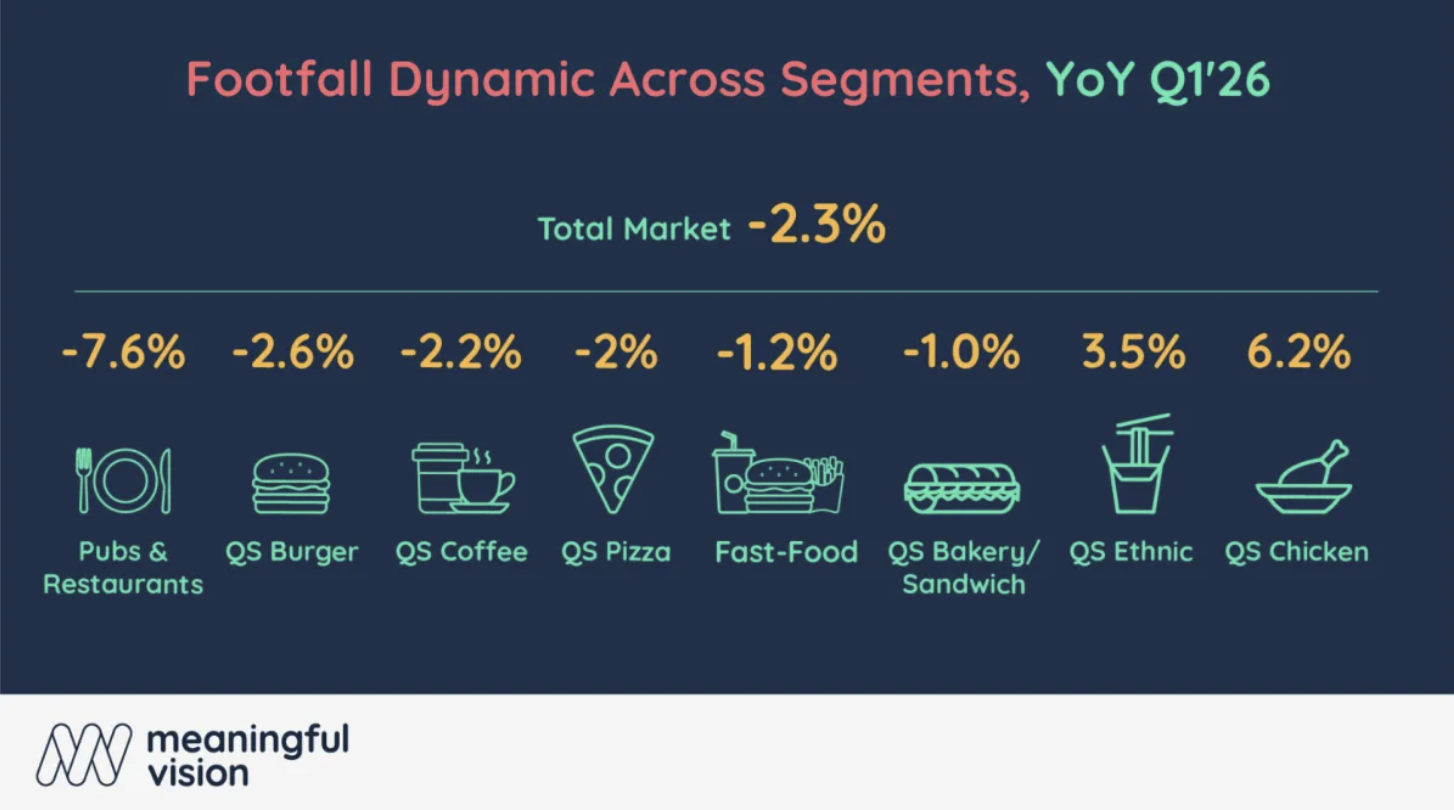
Chicken and ethnic food concepts were the only major quick service restaurant categories to record growth during the first quarter of 2026, according to new research from Meaningful Vision.
While overall UK foodservice traffic fell by 2.3% year on year, visits to chicken operators increased by 6.2% and ethnic food concepts recorded growth of 3.5%. In contrast, traffic declined across most other foodservice categories.
The sharpest decline was recorded by pubs and restaurants, where customer traffic fell by 7.6%, continuing a trend seen throughout 2025.
The research provides further evidence that demand remains strongest in areas of the market where convenience, portability and off-premise consumption continue to play an important role, reinforcing longer-term trends that have shaped packaging requirements across the sector.
FPA comment: "This trend is significant for foodservice packaging because many of the fastest-growing formats are also among the most packaging-intensive, particularly within takeaway, delivery and food-to-go channels".
Government issues guidance as preparations begin for future UK-EU SPS agreement
Defra has issued new information to help businesses prepare for a future Sanitary and Phytosanitary (SPS) Agreement between the UK and European Union, signalling the next stage in efforts to reduce trade friction affecting food and agricultural products.
In a written ministerial statement to Parliament, Defra confirmed that preparations are continuing while negotiations with the EU progress. Businesses have been encouraged to review current processes and monitor further guidance as details of the agreement emerge.
The proposed SPS agreement forms part of the wider UK-EU reset announced earlier this year and is intended to simplify the movement of agri-food products by reducing the need for certain checks, certifications and administrative requirements.
While significant detail remains to be agreed, the publication of business readiness information indicates that government departments are beginning to move from negotiation towards implementation planning.
FPA comment: "The agreement could have indirect benefits for the foodservice packaging sector through improved supply chain efficiency, particularly for companies supplying food manufacturers, distributors and hospitality operators trading with EU markets".
NEWS FROM EUROPE
EU begins implementing PPWR restrictions on single-use foodservice packaging
The European Union will begin enforcing new restrictions on certain single-use packaging formats used in dine-in hospitality settings from August, marking one of the first visible implementation stages of the Packaging and Packaging Waste Regulation (PPWR).
Among the measures is a ban on single-use condiment sachets provided to customers eating on-site in restaurants, cafés and other hospitality venues. The restrictions are intended to reduce packaging waste and encourage the use of reusable or refill-based alternatives where practical.
The restrictions apply to dine-in consumption and do not generally extend to takeaway or delivery formats, reflecting the regulation's focus on reducing avoidable single-use packaging where reuse alternatives are considered viable.
The development is likely to be closely watched by packaging manufacturers, hospitality operators and brand owners as further PPWR requirements are introduced over the coming years, including provisions relating to recyclability, packaging minimisation and reuse systems.
FPA comment: "While the measures apply within the EU, they provide an early indication of how PPWR requirements are beginning to move from legislation into operational reality for foodservice businesses and their suppliers".
INTERNATIONAL STORIES
California's landmark packaging reforms move into delivery phase
California's ambitious pEPR programme has entered a significant new phase, with businesses now navigating the practical realities of compliance, reporting and implementation.
The state's SB54 legislation is widely regarded as one of the most far-reaching packaging reform programmes globally, combining producer responsibility obligations with packaging reduction targets and requirements designed to improve recyclability and recycling outcomes.
The publication of California's final regulations has already prompted legal challenges from environmental organisations, highlighting the extent to which implementation details are now becoming a focus of scrutiny as EPR systems move from legislation into practice.
Recent developments have seen producers working to meet reporting deadlines while industry groups continue to raise concerns about implementation costs, administrative complexity and the challenges associated with collecting and validating packaging data.
The experience is being closely watched by policymakers and businesses around the world because many of the issues now emerging in California mirror those encountered in other jurisdictions introducing major packaging reforms. Questions around data quality, reporting requirements, producer obligations and operational readiness are becoming increasingly important as schemes move from policy design into day-to-day delivery.
While supporters argue the reforms are necessary to reduce waste and accelerate progress towards a more circular economy, the latest developments underline the importance of practical implementation and the need for regulatory systems that are both effective and workable for participating businesses.
FPA comment: "As packaging reforms continue to evolve internationally, California's experience is likely to provide valuable lessons for governments, producers and scheme administrators".
Maine becomes first US state to introduce a vape EPR scheme
Maine has become the first US state to approve an Extended Producer Responsibility (EPR) programme specifically covering electronic cigarettes and vaping devices.
The legislation will require producers to fund the collection and management of discarded vape products, with policymakers citing growing concerns around waste, littering, battery safety and environmental impacts.
While the measure is focused on vaping products, it represents another example of producer responsibility being extended into new product categories beyond packaging. Similar approaches are already being applied internationally to products including batteries, textiles, electrical goods and mattresses.
FPA comment: "This highlights the continuing global trend towards greater producer responsibility as governments seek new ways to fund waste management and support circular economy objectives".
EXTERNAL EVENTS AND PARTNER NEWS
View the 2026 Sustainability & Impact Award finalists
The finalists for this year's Packaging Sustainability & Impact Awards showcase some of the most innovative and impactful sustainability initiatives from across the packaging value chain.
The awards, organised by Packaging News, recognise excellence in areas including circular economy innovation, packaging design, recycling, reuse, material development and environmental leadership. The shortlist highlights the breadth of activity taking place across the sector as businesses continue to respond to evolving sustainability expectations and regulatory requirements.
As a proud sponsor of the awards programme, the Foodservice Packaging Association is pleased to support an event that celebrates innovation, collaboration and best practice across the packaging industry.
The winners will be announced at the Packaging Sustainability & Impact Summit & Awards, taking place at the Kia Oval on 14 July. The event provides an excellent opportunity to hear from industry leaders, explore the latest sustainability developments and network with professionals from across the packaging supply chain.
We congratulate all finalists on their achievement and wish them the very best of luck. The full list and details about attending the awards can be viewed here
Date change for July Stakeholder Engagement Forum
Please note that the date to the next Circular Economy Stakeholder Forum meeting has changed from 07 July to 14 July.
No registration is required, the Microsoft Teams link accompanying each forum will provide direct access to that meeting. Stakeholders are advised to check future communications for updated joining details in the event that the original link supplied below fails to work for the new date.
July Forum – Tuesday 14 July: 14:30 to 16:00 Link to access forum
FPA NEWS AND EVENTS
Confidential input requested
Businesses with concerns about how pEPR is operating in practice – including issues relating to scope, competition, enforcement or unintended consequences, are invited to share their experiences in confidence with the FPA. We also welcome intelligence on potential gaps in scope, market distortions or suspected avoidance behaviours, which can be shared in confidence.
This insight is invaluable in helping us build an accurate picture of how the system is functioning on the ground and in ensuring that industry concerns are effectively represented in our ongoing engagement with Defra, PackUK and the Environment Agency.
Please contact the compliance team directly via compliance@foodservicepackaging.org.uk. All information will be handled sensitively and used to inform our evidence base and policy discussions.
FPA in the news
Packaging World: FPA appoints new chief executive officer
Packaging News: FPA appoints new chief executive officer
Packaging Scotland: Foodservice Packaging Association appoints first ever CEO
Eco-Plastics in Packaging: Foodservice Packaging Association hires first-even chief executive
Essential reading
The Grocer: Deposit return scheme handling fees for retailers announced. Read more here
Packaging News: EPR to spur on 'generational shift in recycling' in the UK. Read more here
Business Green: UK waste firms urge government to introduce a deposit return scheme for vapes. Read more here
Packaging Digest: Gen Z's role in sustainable packaging evolution. Read more here
The Critic: Excessive producer responsibility – virtue-signalling policies are picking the pockets of consumers. Read more here
Circular: AI, automation and welcoming a new dawn of recycling innovation. Read more here
Packaging Gateway: Global Packaging EPR enters a phase of clearer rules and reduced uncertainty. Read more here
Waste Dive: Maine becomes first state to enact EPR for vapes. Read more here
Business Green: UK waste firms urge government to introduce a deposit return scheme for vapes. Read more here
Aluminium International Today: Alupro unveils sustainable aluminium manifesto. Read more here
The Grocer: Hospitality wants a VAT cut. But so does everyone else. Read more here
Packaging Strategies: How GLP-1 is reshaping food packaging. Read more here
Quote of the week and post of the week
Ellen Daniels, the FPA's first CEO:
“The FPA has an important role to play in ensuring members’ voices are heard, supporting informed and evidence-based policy development, and championing the essential contribution that foodservice packaging businesses make to the wider economy and society. I look forward to working closely with the FPA Board, members and stakeholders to build on the strong foundations already in place and to help deliver the association’s strategic priorities in the years ahead".
Ellen Daniels, CEO at the Foodservice Packaging Association (FPA) on LinkedIn | ellen-daniels-3b831279
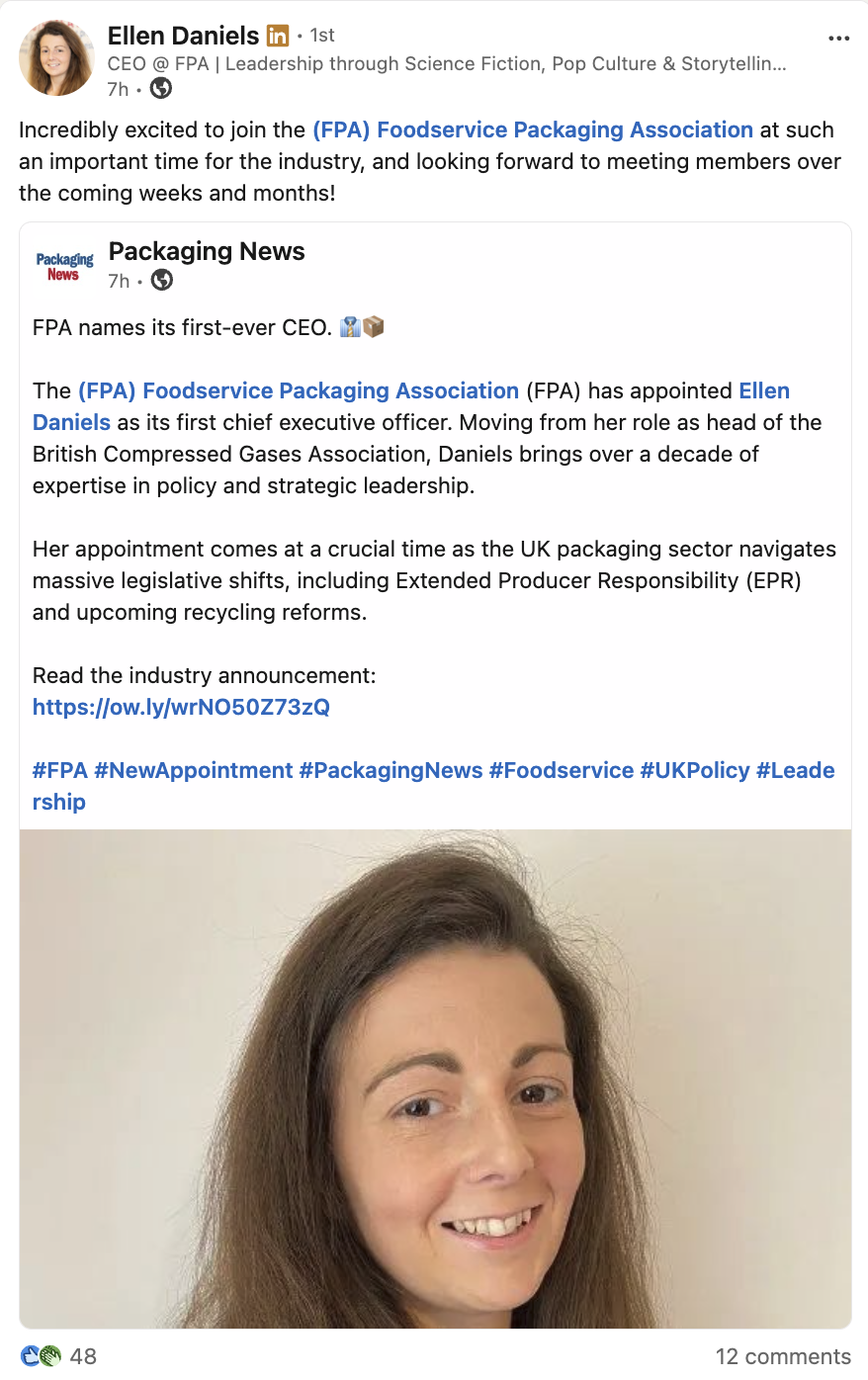
Click on the image above to access and / or comment on this post
Do you know a business that should join the FPA?
The Foodservice Packaging Association represents the interests of its members at all levels and works hard to ensure its members are better represented, better informed and better connected.
FPA members receive early sight of this Digest on Thursday evenings, prior to distribution each Friday morning, and can view an archive of previous Digests within their FPA Dashboards or via this link