The FPA Friday Digest
06 February 2026
This week marks an important moment in the FPA's ongoing engagement with government as packaging EPR moves into a more critical phase.
I was pleased to be contacted by officials at Defra with an invitation to establish regular monthly meetings between the FPA and PackUK. As EPR implementation accelerates and decisions begin to harden, consistent dialogue with those responsible for delivery will be essential.
The FPA has confirmed its intention to take part in these meetings, with board colleagues Justin Turquet and Adrian Pratt joining me to ensure that the practical realities facing foodservice packaging manufacturers, distributors and importers are clearly understood.
We have asked for dates to be scheduled well in advance, recognising the importance of continuity and preparedness as policy timelines tighten.
This invitation reflects the FPA’s position as a key stakeholder in the EPR process – but more crucially, it creates a structured opportunity to challenge assumptions, raise member concerns and influence how policy works in practice, not just on paper.
As you’ll see throughout this week’s Digest, from pEPR developments in Wales to PFAS, fast-food expansion pressures and recycling system strain, the common thread is implementation. Engagement at this level is not optional – it is essential if outcomes are to be workable, proportionate and evidence-based.
Wales consults on expanding pEPR to 'on-the-go' and littered packaging waste
“While pEPR operates on a UK-wide basis, Wales’s approach is widely seen as a potential forerunner for future policy direction elsewhere in the UK, particularly as governments look to address litter costs and packaging waste more comprehensively”.
The Welsh Government has launched a 12-week consultation on proposals to extend the scope of packaging Extended Producer Responsibility (pEPR) to include littered and street-binned packaging waste.
The consultation explores how producers could be made financially responsible for packaging disposed of in public bins or discarded in public spaces – costs currently borne largely by local authorities. The move reinforces Wales’s long-standing commitment to applying the polluter pays principle across the full lifecycle of packaging.
The Producer Responsibility Obligations Regulations 2024 were laid to apply across England, Scotland, Northern Ireland and Wales, but implementation details – especially around nation-specific responsibilities and data reporting – are subject to coordination between UK and devolved administrations.
Scotland has been actively engaged in pEPR discussions, with organisations such as Zero Waste Scotland supporting the Scottish Government's work on EPR and its interaction with broader circular economy goals in Scotland.
Stakeholders – including producers, compliance schemes, local authorities and environmental organisations – are encouraged to respond to the consultation before the 24 April 2026 deadline. Following that, the Welsh Government will review responses and consider next steps for implementation, including potential regulatory changes to ensure producers contribute to the costs of managing littered and 'on-the-go' packaging waste.
The draft regulatory impact assessment can be accessed via this link. To respond to the consultation, click on the button below.
Government publishes plan to tackle 'forever chemicals'
“We are already seeing contrasting messages emerge around PFAS, with examples of brands publicly claiming to have developed alternatives that deliver equivalent performance without PFAS, and in some cases companies are choosing to absorb higher costs in the interests of customers and society. That narrative, however, risks creating an assumption that technically viable, affordable PFAS-free alternatives exist across all applications – including packaging – when that is not the case.
"This is why expectation-setting now is critical. If government assumes alternatives are available unless told otherwise, policy risks running ahead of technology. Given that the presence of PFAS is ubiquitous, achieving products that are genuinely PFAS-free, including from non-intentionally added sources within raw materials and processing systems, is a far tougher challenge and, in the majority of cases, not yet technically possible.
"For many packaging formats, achieving ‘no intentionally added PFAS’ is a more realistic and deliverable objective, supported by evidence, which would hopefully also help differentiate compliant UK producers' products from imports where these types of claims cannot be substantiated”.
Government has published its first dedicated PFAS Plan, setting out a coordinated framework to better understand, monitor and reduce risks from PFAS – often referred to as ‘forever chemicals’ – across the supply chain.
Measures include expanded environmental monitoring, new guidance for regulators and industry, work on legacy contamination, and a planned consultation later in 2026 on introducing a statutory PFAS limit in England’s drinking water regulations.
Significantly for the packaging sector, the plan confirms testing of food packaging items – including microwave popcorn bags and pizza boxes – to trace the presence of PFAS and inform potential future regulatory action.
The full government announcement can be read here and Emma Hardy's statement to the House about the PFAS Plan is available to view via this link
Defra updates packaging data guidance ahead of EPR reporting deadline
“With pEPR now in its delivery phase, clear expectations on data reporting are essential. This guidance update is timely, but it also highlights the complexity that producers now face – from weighting and classification to nation of sale and self-managed waste evidence. Coupled with recent feedback from councils struggling to deliver uniform recycling collections, it underscores that administrative readiness across both government and industry will be just as important as accurate data”.
Defra and the Environment Agency have this week updated their official guidance Packaging data: what to collect for extended producer responsibility (EPR) to reflect important changes for obligated organisations.
The guidance reinforces the data categories producers must collect and report – including activity, material, weight and recyclability data – and details how it will be used to calculate EPR recycling obligations and waste disposal fees.
It also updates reporting expectations, such as the treatment of nation of sale data and self-managed organisation waste, and reflects Regulatory Position Statements from the regulators in England, Scotland, Wales and Northern Ireland.
While the broad structure of data collection has been in place for some time, the 2026 update clarifies some technical requirements and ensures the guidance is aligned with actual reporting and enforcement practices ahead of the 01 April 2026 second-half data submission deadline for most producers.
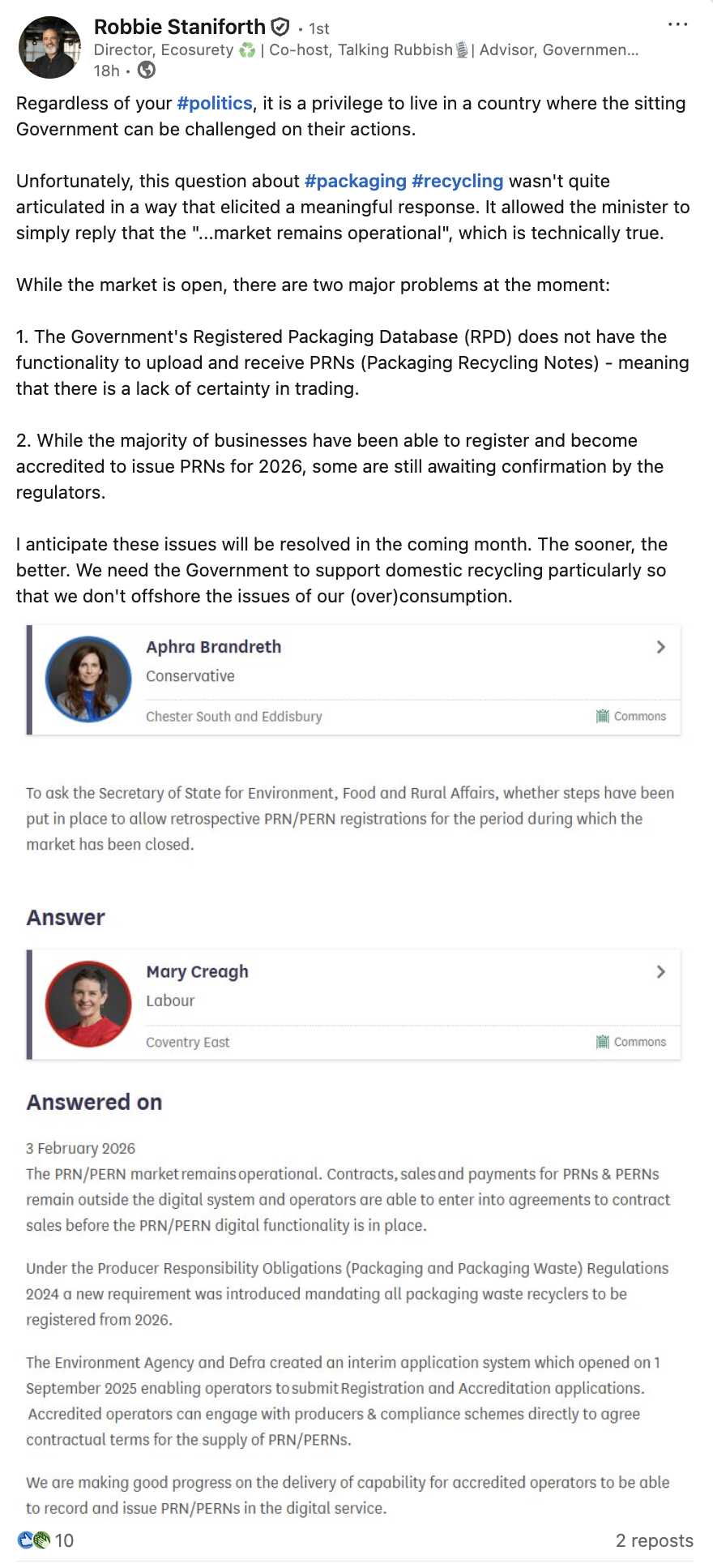
PRN/PERN digital service delayed again as Defra puts interim measures in place
“This applies across all four UK nations, so the disruption is being felt widely. It’s also another reminder that delivery risk is now the biggest challenge for reforms – whether it’s EPR data systems, digital waste tracking, Simpler Recycling readiness, or the growing complexity of material and chemical expectations such as PFAS. Members don’t need perfection overnight, but they do need clarity, workable interim arrangements and a realistic timetable that reflects operational reality”.
Defra has issued an update on the rollout of the new Record Reprocessed or Exported Packaging Waste (RRPW) digital service, confirming that the system will not be ready in February as previously planned and will require further development.
Stakeholders had been told the service would be unavailable for issuing Packaging Waste Recycling Notes (PRNs) and Packaging Waste Export Recycling Notes (PERNs) in January, with functionality expected from February. Defra has now apologised for the disruption and said it recognises the impact on businesses, adding that interim measures are being developed as a priority to keep disruption “as brief as we can”.
Defra also confirmed PRN/PERN contracts, sales and payments remain outside the digital system, and operators can still enter agreements in advance of digital functionality. The ability for reprocessors and exporters to issue 2025 PRNs/PERNs (including December waste) will continue on the existing NPWD service until the end of January 2026.
Businesses needing support have been directed to contact Defra via EPRCustomerService@defra.gov.uk. Defra says it will provide regular updates as interim arrangements are finalised.
Environment Agency introduces hourly fees for Simpler Recycling non-compliance
"If businesses face time-based charges for non-compliance, will the same approach apply to local authorities that are unable to deliver on Simpler Recycling requirements, albeit for households rather than for businesses. Fairness and proportionality in enforcement will be critical if confidence in the system as a whole is to be maintained”.
The Environment Agency has confirmed it will introduce hourly charges for regulatory intervention where businesses fail to comply with Simpler Recycling requirements.
According to the new guidance the charges will apply where the Environment Agency needs to investigate or take enforcement action relating to non-compliance, with fees calculated based on the time spent by regulators. The move is intended to recover costs and encourage compliance as new recycling collection requirements come into force.
Defra urges reporting of Simpler Recycling non-compliance
Defra is encouraging businesses and the public to report workplaces with more than 10 full-time employees that are failing to comply with Simpler Recycling requirements.
Since 2025, workplaces in England with at least 10 full-time employees have been required to separate key recyclable materials – including dry recyclables and food waste – in line with Simpler Recycling rules.
The Environment Agency has confirmed it will use reported intelligence alongside its own monitoring to identify non-compliance and prioritise regulatory action.
Reports can be submitted directly via the EA’s online reporting service for waste and recycling breaches, allowing concerns about non-compliant workplaces to be logged quickly and confidentially.
The emphasis on reporting comes alongside the Agency’s move to introduce hourly cost-recovery charges where regulatory intervention is required, increasing the financial and reputational risks associated with non-compliance.
UK metals recycling sector faces wave of closures
The UK metals recycling sector is experiencing a sharp rise in closures, liquidations and consolidations, prompting growing concern that it may be heading down a similar path to plastics recycling, which has faced ongoing financial pressure in recent years.
Recent casualties include Unimetals, Enablelink, Acetech Metals, H Ripley & Co and CF Booth, with industry sources warning that further closures may follow in 2026.
Operators point to rising operating costs, including energy prices, labour costs, compliance burdens and commodity price volatility. However, many in the sector argue these pressures have been compounded by a collapse in domestic steel demand, following blast furnace closures and the slow transition to electric arc furnaces. This has left recyclers increasingly reliant on export markets, where payment delays, trade friction and high logistics costs are placing further strain on cashflow.
The British Metals Recycling Association has warned that potential restrictions on scrap metal exports could significantly worsen conditions, risking the loss of processing capacity before demand from new 'green steel' facilities returns.
From classrooms to code – behaviour change and digital tracking converge on waste reform
Two developments this week highlight how the UK’s approach to waste and recycling is evolving, combining behaviour change in households with greater system-wide transparency through digital reporting.
In terms of public engagement, thousands of UK primary school pupils are taking part in the 'Hidden Treasure Hunt', a national initiative supported by Currys and education charity Wastebuster, encouraging families to recycle unused electrical items stored in drawers at home. The scheme responds to evidence from 'Recycle Your Electricals' that the average UK household contains around 30 unused electrical items, many of which contain valuable materials such as copper, lithium and gold – as well as batteries, which are increasingly being linked to rising fire risks in waste systems.
At the other end of the system, Defra has confirmed its timeline for rolling out mandatory digital waste tracking across England, following years of policy development. The new system will require waste movements to be recorded digitally, replacing fragmented paper-based processes and improving oversight of how waste, including packaging and electricals, moves through the economy.
Defra says digital tracking will strengthen compliance, reduce waste crime and provide regulators with better data on waste flows, while also supporting longer-term reforms linked to circular economy policy and extended producer responsibility.
Together, the two initiatives illustrate how effective waste reform depends on both ends of the chain: households understanding what to recycle and why, and regulators having the data needed to ensure materials are managed properly once they enter the system.
NEWS FROM EUROPE
EU packaging rules progress as EFSA evidence gathering concludes
“EU packaging reforms remain important for businesses that export or operate internationally. The PPWR’s uniform standards on recyclability, labelling and sustainability performance will influence design expectations and supply chain requirements, and the closing of scientific evidence gathering confirms that the EU compliance timetable is now set. This shifts the focus from 'when' to 'how' businesses prepare for compliance".
Progress continues on the European Union’s Packaging and Packaging Waste Regulation (PPWR) ahead of its full application in August 2026, with the European Food Safety Authority (EFSA) closing its data call on technical evidence. This step moves the regime from broad consultation towards focused scientific assessment of recycled content, material safety and essential performance criteria, laying groundwork for enforceable EU-wide requirements that will apply to all businesses placing packaging on the EU market, including exports.
EXTERNAL EVENTS
Less than a week to go to Packaging Innovations ... and the FPA's AGM
The FPA team is very much looking forward to catching up with many of you next week at the NEC. You can find us in the Foodservice Packaging Zone, at stand H70 throughout the event. FPA members will already have received their invitations to the FPA AGM, which will take place in a private room close to the exhibition hall from 9:00 a.m. next Thursday.
Dr Alan Campbell, director of The LCA Centre and expert on all things policy focused, will once again be making himself available on the FPA stand at designated times to answer informal 'walk-on' questions.
Dr Campbell will also be providing practical guidance to FPA members through pre-booked one-to-one appointments. Please email Lisa to save your slot.
And if you haven't booked your ticket yet, please do so as our guests using the link in the button below. FPA members will already have received their invitations to the FPA AGM, which takes place within a private room during the exhibition from 9:00 a.m. next Thursday.
And if you haven't booked your ticket yet, please do so as our guests using the link in the button below.
Stakeholder Engagement Forums – February to July dates
Dates and links to the next tranche of Circular Economy Stakeholder Forum meetings. No registration is required, the Microsoft Teams link accompanying each forum will provide direct access to that meeting.
Defra recommends individuals wishing to attend save each link to their calendars. No reminders will be sent.
March Forum – Tuesday 3 March: 14:30 to 16:00 Link to access forum
April Forum – Tuesday 7 April: 14:30 to 16:00 Link to access forum
May Forum – Tuesday 5 May 14:30 to 16:00 Link to access forum
June Forum – Tuesday 2 June: 14:30 to 16:00 Link to access forum
July Forum – Tuesday 7 July: 14:30 to 16:00 Link to access forum
FPA NEWS
FPA 2026 Awards: have you booked your tickets yet?
With just four weeks to go, momentum is building fast ahead of this year’s Awards, and with finalists now informed, we’re already seeing the start of a last-minute rush for tickets and accommodation.
Tickets are selling quickly as finalists secure their places, and demand is only set to increase as we head into the final countdown. If you’re planning to attend, now is the moment to book!
Members are also reminded that a limited allocation of hotel rooms at a special event rate is currently being held. Once released, availability, and prices, cannot be guaranteed.
Don’t leave it too late. Secure your tickets, lock in your room, and make sure you're at The Grand on 05 March – with Matt Lucas hosting and plenty of entertainment planned, it's sure to be a fun-packed evening!
Essential reading
Letsrecycle.com: Government unveils first PFAS plan to tackle forever chemicals. Read more here
The Guardian: Environmentalists decry 'crushingly disappointing' PFAS action plan for UK. Read more here
MRW: Welsh Government proposes extension of workplace recycling. Read more here
Circular: Welsh recycling rates climb to 68.4% in 2024-25 following the introduction of new workplace recycling reforms. Read more here
Shropshire Star: Weekly food waste collection not achievable by April says cash-strapped council. Read more here
BBC: Households in Leeds will not receive a fourth household waste bin, the city council has confirmed. Read more here
Circular: King's estate denies responsibility for clearing large scale illegal waste site. Read more here
Letsrecycle.com: Opinion – '2026 investment trends in waste, recycling and the circular economy'. Read more here
WPI Today: New approach to plastic recycling – WPI chemical engineering researchers co-author study. Read more here
Interplas Insights: Does plastic need better PR?. Read more here
Packaging News: Wales consults on expanding pEPR charges to litter and public bins. Read more here
QSR: Fast-food expansion masks 1% visit drop. Read more here
Packaging News: Packaging in 2026 – Californian EPR change will have global impact. Read more here
Quote of the week and post of the week
Jane Muncke, MD of the Food Packaging Forum and a toxicologist specialising in food contact chemicals:
“The term ‘non-intentionally added substances’ is misleading, because it suggests these chemicals are accidental or unavoidable, when in reality they are often foreseeable by-products of materials, additives or manufacturing processes. This framing risks obscuring responsibility rather than improving chemical safety".
Join the FPA
The Foodservice Packaging Association represents the interests of its members at all levels and works hard to ensure its members are better represented, better informed and better connected.
FPA members receive early sight of this Digest at 6:15 a.m. each Friday morning.
Interested in joining the FPA?