FPA Friday Digest – 09 January 2026
Introduction by FPA executive chair Mike Revell
A very Happy New Year to all FPA members and other FPA Friday Digest readers!
There is no doubt that 2026 is already shaping up to be a challenging year on many fronts. With increased EPR rate fees announced in December, rising business rates and NI contributions for hospitality businesses, and the continued cycle of new and evolving environmental legislation, our sector once again faces a demanding year ahead.
Against this backdrop, the FPA has a number of important projects in the pipeline, and I would like to highlight some of the key actions we will be proposing in the coming months.
Our AGM will take place on 12 February at Packaging Innovations & Empack, where we will be sharing announcements on the future structure of the FPA. Alongside this we are developing the association's first FPA Product Accreditation Scheme, progressing the recruitment of a new FPA CEO, and preparing to publish the new FPA Constitution.
2026 is set to be a busy year for the association, and it it's anything like 2025, there will be no shortage of work to do. These initial initiatives represent an important step forward in strengthening the FPA and ensuring the association continues to support and represent members effectively.
This week's Digest gives us the opportunity to reflect on 2025, complete with an FPA quote pulled from each issue. It was a year that brought its own challenges, but also demonstrated the resilience, collaboration and commitment of our members and the industry as a whole.
Thank you, as always, for your continued support. I look forward to working with you throughout 2026.
P.S. FPA members wanting to revisit any individual issues of the FPA Friday Digest can do so by following the link below – if you're not already logged in to the FPA Member Hub you will be prompted to do so.
Not already an FPA member? What are you waiting for! Here's a reminder of all the great benefits of FPA membership your company and employees can enjoy. We hope to be able to welcome you to the FPA network in the coming weeks.
2025 in review
January
"Adding red tape puts a brake on business growth, but differs from regulations which exist to ensure fair and equal trading. Erosion of the latter must be resisted in the bid to grow the economy."
In January we set the foundation for the year ahead, focusing on aligning regulation with real-world practices and setting realistic expectations. Our content covered the evolving shape of packaging EPR, early clarity on illustrative base fees, and updates to the Recyclability Assessment Methodology (RAM), while warning against the potential of packaging being double-charged. Alongside this, we hailed the beginning of the Glasgow cup reuse scheme, and provided market context for hospitality and foodservice packaging, calling for realism around data quality, system capacity and the pace of reform.
February
“The reality is that EPR costs are landing at a time when businesses are already under severe pressure, and without clarity or proper controls there is a real risk that the system will damage, rather than support, the market it is meant to improve.”
February saw a noticeable shift in tone, as we moved policy discussions from preparation to growing concern about cost, confidence and deliverability. This was reinforced by comments from FPA AGM attendees and visitors to our stand in the increasingly popular Foodservice Packaging Zone at Packaging Innovations & Empack. We highlighted the rising unease across retail, hospitality and manufacturing about EPR affordability, market disruption, and the burden of compliance. At the same time, we questioned consumer understanding of recycling systems and the operational implications for foodservice packaging used away from home.
March
“Innovation and collaboration are no longer optional. They are essential if businesses are to navigate the scale and pace of regulatory change now facing the sector.”
As always, March featured our annual FPA Awards and celebrated the product innovations and individual achievements of our members. Other issues focused on implementation readiness and sector engagement. Discussions reinforced the importance of collaboration across the supply chain and the role of practical experience in shaping workable policy. We also continued to examine RAM application, signalling that assessment outcomes would become increasingly influential in both commercial and design decision-making.
April
“Recyclability in theory is meaningless unless it reflects what is actually collected, sorted and recycled in the real world.”
In April our editorial centred on definitions, evidence and claims, reflecting the growing scrutiny around what recyclability means in practice and the confusion around fibre-based composite packaging. Our commentary emphasised the risks of inconsistency between guidance, collections and on-pack messaging, and emphasised the importance of robust data, defensible evidence and realistic assumptions as EPR and RAM moved closer to operational reality.
May
“Without accurate data and realistic assumptions, EPR risks distorting markets rather than delivering the environmental outcomes government intends.”
May’s Digest was dominated by cost interpretation and market impact, as attention turned to how EPR fees might influence material choices, investment decisions and supply-chain dynamics. Content explored the implications of tonnage-based fees, potential market distortion, and the importance of scenario modelling to understand exposure and risk across different packaging formats.
June
“Back-of-house realities matter just as much as on-pack design when it comes to recycling performance.”
During June we shared coverage of our Golf & Activities Day and celebrated award wins by FPA members at the Environmental Packaging Awards and their contributions during the Environmental Packaging Live Summit. Digest commentary during the month reinforced concerns about delivery and system performance, with content focusing on recycling infrastructure capacity, sorting quality, and the practical limits of existing collection systems to help FPA members assess whether policy expectations aligned with their operational reality, particularly for complex and contaminated foodservice packaging formats.
July
“There is a growing danger that material switching is being driven by perception rather than evidence, storing up regulatory and technical problems for the future."
In July we highlighted the intensifying debate around material switching, fibre substitution and reuse. Our editorial challenged simplistic narratives and stressed the need to consider behavioural factors, technical constraints and unintended consequences. Reuse systems and cup initiatives featured prominently and we emphasised the need for clear evidence rather than assumption.
August
“Material switching without proper scrutiny risks simply transferring environmental and regulatory problems from one place to another.”
August saw us adopting a more reflective and analytical tone, using the quieter holiday period to examine material risk, regulatory exposure and longer-term strategy. Our content explored issues such as barrier technologies, chemical compliance and international policy signals, encouraging our members to pause and reassess decisions made under pressure earlier in the year.
September
“Early engagement with recyclability assessments exposes risk long before fees and invoices make those risks unavoidable.”
In September we reverted to practical preparedness and scrutiny, with coverage focusing on RAM case studies, audit readiness, and the distinction between controlled and uncontrolled packaging systems, helping members prepare for increasing operational and financial consequences as packaging reforms became embedded.
October
“Despite a high level of collaboration with the FPA, government seems to have failed to recognise the subtle differences in our supply chains, and instead has placed a highly complex administrative burden on our industry – it's like the Wild West out there!"
Attendees at October's FPA Environment Seminar, hailed it as the 'best one yet, and the final Digest of the month focused on the discussions there, leading on our plea to Defra minister Mary Creagh for a de minimis review. In other issues we emphasised the widening gap between policy ambition and practical delivery, with content highlighting the challenges around enforcement capacity and clarity of guidance and consistency. We also drew attention to wider European developments likely to influence UK foodservice packaging supply chains.
November
“Closed-loop systems only work where there is genuine control, clear accountability and robust evidence.”
During November we warned members about the bogus EPR invoices purporting to come from PackUK and reviewed the implications of the Autumn Budget on Plastic Tax. Other commentary featured planning, resilience and risk management, encouraging FPA members to look ahead to 2026, focusing on scenario modelling, closed-loop opportunities, recycling market stability, and the need for credible evidence to support compliance and claims.
December
“Until there is sufficient domestic recycling capacity and confidence in the system, businesses will continue to face uncertainty, cost pressure and a lack of meaningful control over outcomes.”
In December we shared a year-end overview and reality check, drawing together previous themes of cost uncertainty, recycling market fragility and infrastructure under-investment. The month’s content reinforced the importance of realism, robust systems and confidence in delivery, and identified the challenges and priorities that would carry through to 2026.
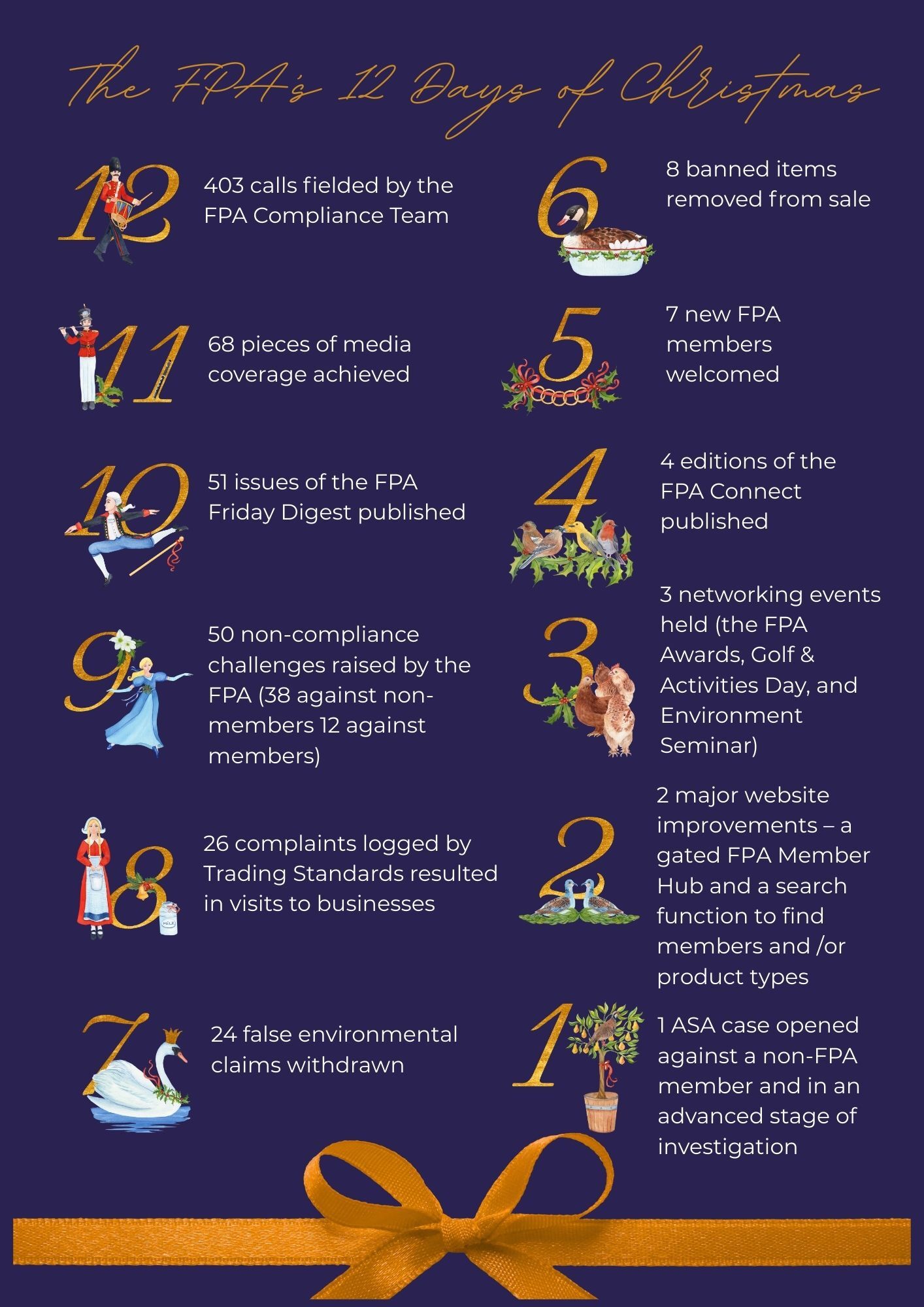
And finally ... some notable FPA achievements during 2025
Join the FPA
The Foodservice Packaging Association represents the interests of its members at all levels and works hard to ensure its members are better represented, better informed and better connected.
FPA members receive early sight of this Digest at 6:15 a.m. each Friday morning.
Interested in joining the FPA?