The FPA Friday Digest
12 June 2026
In this week's FPA Friday Digest ...
Over the past few years, much of the debate around packaging policy has focused on what reforms should look like. Increasingly, however, the conversation is shifting towards a more practical question: how do we make these systems work effectively in the real world?
This week's developments provide a good illustration of that transition. UK Packaging PRO has begun outlining its early priorities, including engagement on the Recyclability Assessment Methodology (RAM), which will play an important role in shaping future packaging design and fee outcomes. Meanwhile, the Deposit Return Scheme continues to move closer to implementation, with further clarity on retailer obligations, technical specifications and the future management of collected materials.
Elsewhere, the launch of a global reuse symbol reflects the growing emphasis being placed on reuse systems alongside recycling, while developments in Europe and North America demonstrate that policymakers continue to grapple with the challenge of balancing environmental ambition with practical delivery and affordability.
As implementation gathers pace, businesses need more than policy announcements. They need certainty, transparency and clear guidance delivered sufficiently far in advance to enable informed investment and operational planning. Whether the issue is EPR, DRS, recyclability assessments or future packaging requirements under PPWR, confidence in the system will depend not only on the quality of the policy but also on the quality of its execution.
The coming months are likely to be defined less by new legislation and more by the practical decisions that will determine how these reforms operate in practice. Ensuring those decisions are evidence-based, proportionate and developed with meaningful industry engagement will be critical to achieving the environmental outcomes policymakers, businesses and consumers all want to see.
UK Packaging Pro confirms early priorities
The UK Packaging Producer Responsibility Organisation (UK Packaging PRO) has published its first newsletter since being appointed to support the delivery of pEPR.
The update confirms that the organisation has formally established its board and governance arrangements and is now working with PackUK on the phased delegation of responsibilities within the pEPR system.
Among its early priorities, UK Packaging PRO said it intends to support industry engagement on key technical areas, including the modelling of the Recyclability Assessment Methodology (RAM), which will play an increasingly important role in determining future fee modulation arrangements.
The organisation also highlighted recent engagement activities bringing together producers and local authorities to explore how packaging design decisions influence collection and recycling outcomes. UK Packaging PRO said its focus remains on helping create an efficient and effective system capable of delivering higher recycling rates across the UK.
FPA comment: "The FPA welcomes UK Packaging PRO's commitment to engaging industry on key technical areas, particularly the Recyclability Assessment Methodology (RAM). As modulation fees begin to play a greater role within the pEPR system, it is essential that producers have confidence in how packaging is assessed, how fees are determined and how evidence requirements are applied. Ongoing transparency, meaningful engagement and the provision of clear guidance well in advance of any significant changes will be critical to building trust in the system and delivering the environmental outcomes that EPR is intended to achieve".
EPR costs raised during parliamentary debate about high street businesses
EPR featured in a Westminster Hall debate on support for high street businesses, with MPs highlighting the cumulative impact of rising business costs on retailers, hospitality operators and SMEs.
During the debate, Conservative MP Gagan Mohindra cited a local wine merchant that reported incurring £240,000 in EPR costs during the first year of the scheme, alongside approximately £15,000 in administrative and compliance costs. He argued that businesses were facing "death by a thousand cuts" from a combination of taxation, regulation and rising operating expenses.
Elsewhere in the debate, packaging-related costs were referenced alongside business rates, employment taxes and energy costs as part of wider concerns about UK business competitiveness.
While the discussion did not result in any new policy announcements relating to packaging regulation, it reflects the growing prominence of EPR within broader parliamentary discussions about the costs facing businesses and the potential impact on investment, employment and growth.
FPA comment: "The discussion reflects the growing prominence of EPR within broader parliamentary discussions about the costs facing businesses and the potential impact on investment, employment and growth".
Campaigners warn rising EfW costs could offset Scottish EPR gains
Campaigners have warned the environmental benefits expected from EPR in Scotland could be undermined by rising energy-from-waste (EfW) costs unless greater emphasis is placed on waste prevention, reuse and high-quality recycling.
The concerns follow analysis suggesting increasing reliance on EfW infrastructure and associated costs could absorb much of the financial and environmental progress expected from packaging reforms. Critics argue that while EPR is designed to incentivise better packaging design and improve recycling outcomes, significant volumes of material continue to flow into residual waste streams destined for incineration.
The debate comes as Scotland continues to pursue ambitious circular economy objectives alongside the introduction of EPR and a future Deposit Return Scheme. Campaigners contend unless policies are aligned to reduce residual waste generation, the costs associated with treating non-recyclable waste could continue to rise, placing pressure on local authorities and potentially diluting some of the intended benefits of producer responsibility reforms.
Supporters of EPR argue the reforms should help drive improved collection systems, increased recycling rates and greater producer accountability over time. They point to the substantial funding being transferred from producers to local authorities as evidence that the system is designed to support long-term improvements in waste management infrastructure.
FPA comment: "This highlights a wider challenge facing policymakers across the UK: ensuring packaging reforms, recycling investments and residual waste policies work together to deliver genuine circular economy outcomes rather than simply shifting costs between different parts of the system".
Global alliance launches universal symbol for reusable packaging

A coalition of businesses, governments, NGOs and reuse operators has unveiled a new global symbol designed to identify reusable packaging and reuse systems worldwide.
The initiative, led by PR3: The Global Alliance to Advance Reuse, aims to create a universally recognised visual marker for reuse, similar to the role the Mobius Loop recycling symbol has played for recycling over the past several decades. The winning design was selected from 236 submissions across 29 countries and tested with consumers in 17 countries before being adopted.
The symbol is intended for use on reusable packaging, collection infrastructure and associated communications. Supporters argue that while consumers have become familiar with recycling logos, there is currently no widely recognised symbol to identify reuse systems. They believe a common identifier could help improve consumer understanding, participation and confidence as reuse schemes become more widespread.
Importantly, use of the symbol will be linked to standards designed to ensure that packaging forms part of a genuine reuse system, including collection, transport, sorting, washing and redistribution processes. Advocates say this will help prevent greenwashing and provide greater assurance that packaging labelled as reusable is supported by the infrastructure needed to enable repeated use.
The launch comes as policymakers increasingly focus on reuse as part of wider efforts to reduce packaging waste. Under the EU Packaging and Packaging Waste Regulation (PPWR), reuse targets and labelling requirements are expected to play an increasingly prominent role, while a number of governments are exploring measures to encourage reusable packaging systems alongside recycling infrastructure.
The coalition behind the symbol hopes it will eventually achieve a level of recognition comparable to the recycling logo, helping to normalise reuse systems and encourage greater consumer participation over time.
FPA comment: "This reflects the growing policy emphasis on moving higher up the waste hierarchy, with reuse increasingly being positioned as a complement to, rather than a replacement for, recycling".
DRS plans advance as retailer support package and exemptions unveiled
Hot on the heels of the announcement about the initial handling fee structure for participating retailers, Exchange for Change has now announced expanded retailer exemption criteria, a new grant support package and the publication of technical specifications for in-scope drinks containers.
The Deposit Management Organisation has confirmed that additional retailers will be able to apply for exemptions from operating return points, including urban stores with a sales area between 100m² and 199m² and rural retailers below 200m². Further exemptions may also be granted where there are site access constraints, utility limitations, proximity to another return point or restrictions associated with heritage and listed buildings.
To support implementation, Exchange for Change has also launched a £60m fund to help small independent retailers install reverse vending machines, with grants of up to £6,000 available per site.
Alongside these announcements, Exchange for Change has published a detailed material specification document for the UK DRS, covering product identification, barcode requirements and container recognition standards, and providing producers with greater clarity on packaging requirements ahead of the scheme's launch.
Separately, Defra used a Parliamentary Question to provide further clarification on how materials collected through DRS will be managed. Responding to questions about aluminium and other materials, Circular Economy Minister Mary Creagh said the reforms are intended to improve material quality, support investment in recycling infrastructure and increase demand for recyclates.
Exchange for Change will be responsible for ensuring materials collected through the scheme are recycled. Defra also confirmed DRS regulations include a 'right of first refusal', giving producers the opportunity to purchase collected material at market value before it is sold elsewhere. Defra said the measure is intended to encourage the use of recycled content and support domestic recycling markets.
In a further sign that attention is increasingly turning towards delivery, the Scottish Grocers' Federation has ruled out legal action against the scheme, stating that its focus is now on helping ensure successful implementation.
Meanwhile, industry groups in Wales continue to seek greater clarity on implementation arrangements, including the appointment of a scheme administrator and the ongoing integration of Wales' glass-inclusive approach with wider UK DRS plans.
FPA comment: "The package of announcements provides useful additional detail on how the scheme will operate in practice. Defra's confirmation of a 'right of first refusal' mechanism is particularly welcome as it offers greater clarity over how valuable materials may be retained within UK recycling markets. As attention increasingly turns to implementation, businesses will also need clear guidance and sufficient lead times to ensure packaging, systems and operational processes are ready for launch".
Alan Lovell steps down as EA chair
Government has announced Environment Agency chair Alan Lovell will step down later this year following the completion of his term.
Lovell has led the EA since 2022, overseeing a period of significant change across the waste and resources sector, including the development and implementation of EPR, Simpler Recycling reforms and wider efforts to tackle waste crime and improve environmental regulation.
The EA has confirmed preparations are under way to recruit a successor, with the appointment expected to shape the organisation's direction as it assumes an increasingly prominent role in the delivery of packaging EPR, producer compliance, Simpler Recycling and wider circular economy reforms.
The transition comes during a period of significant change for the waste and resources sector, with industry stakeholders likely to take a close interest in the priorities of the next EA chair.
Research highlights need for greater plastics recycling investment
New research has highlighted the scale of investment required to expand the UK's plastics recycling infrastructure and support the transition to a more circular economy.
The findings suggest that further investment in collection, sorting and reprocessing capacity will be needed if the UK is to maximise the value of recyclable materials, increase the availability of recycled content and reduce reliance on overseas markets.
The report comes as packaging reforms including EPR, Simpler Recycling and the DRS are expected to increase the quality and quantity of material available for recycling. Industry stakeholders have repeatedly argued that policy reforms must be accompanied by investment in domestic recycling infrastructure if the UK is to capture the full economic and environmental benefits of a circular economy.
FPA comment: "The research adds to a growing debate about how best to ensure that valuable recyclable materials are retained within UK supply chains and converted into new products and packaging".
NEWS FROM EUROPE
European Commission confirms PPWR recyclability requirements remain on 2030 timetable
The European Commission has clarified that packaging recyclability requirements under the Packaging and Packaging Waste Regulation (PPWR) will not apply from August 2026, confirming that the previously announced 2030 implementation timetable remains unchanged.
The clarification follows confusion arising from earlier Commission guidance, which some stakeholders interpreted as suggesting that certain recyclability requirements could apply much sooner. An updated Commission Notice published on 5 June confirms manufacturers will continue to comply with the existing Packaging and Packaging Waste Directive (PPWD) requirements until the PPWR design-for-recycling provisions come into force.
The update provides greater certainty for packaging manufacturers and users planning for the transition to PPWR, particularly in relation to recyclability assessments and packaging formats that may not currently meet future design-for-recycling criteria.
Industry representatives attending recent meetings with European Commission officials reported that there is currently no indication that the PPWR will be reopened, that major changes will be made to the agreed legislation, or that implementation dates will be postponed. While some refinements are expected through future delegated and implementing acts, the overall direction of travel remains unchanged.
Work continues on several key PPWR measures, including recyclability assessment methodologies, recycled content calculation rules, reuse target implementation, packaging labelling requirements and restrictions on certain packaging formats. Discussions are also ongoing regarding PFAS restrictions, where stakeholders continue to seek greater clarity ahead of the first compliance deadlines in August 2026.
The clarification will be welcomed by businesses seeking certainty over compliance timelines and investment decisions as preparations for PPWR implementation continue.
FPA comment: "Confirmation that the PPWR recyclability requirements remain on the originally anticipated timetable provides welcome certainty for businesses planning packaging development programmes and investment decisions. While significant work remains to clarify the detail of a number of delegated and implementing activities, maintaining a clear and predictable implementation pathway is essential if businesses are to prepare effectively for the changes ahead".
European Commission withdraws objection to German packaging law
The European Commission has withdrawn its detailed opinion on proposed amendments to Germany’s Packaging Act, removing a potential obstacle to the legislation’s progress and signalling greater confidence that national measures can coexist with the EU’s new Packaging and Packaging Waste Regulation (PPWR).
The Commission had previously raised concerns that some of Germany’s proposals could create barriers within the EU single market or overlap with requirements being introduced through PPWR. However, following discussions with German authorities, the Commission has now withdrawn its formal objection.
The amendments include measures intended to strengthen reusable packaging systems and improve the collection and recycling of packaging waste. The move is being viewed by some observers as an indication that member states may retain scope to introduce additional national requirements, provided these are compatible with wider EU legislation.
The development comes as governments across Europe begin implementing PPWR and considering how existing national packaging rules will interact with the new framework. While PPWR aims to harmonise packaging requirements across the EU, tensions remain between the desire for a consistent single market and individual countries’ ambitions to pursue more advanced environmental measures.
FPA comment: "The decision highlights the continuing need for packaging producers and distributors operating across multiple European markets to monitor both EU-wide requirements and evolving national legislation. The interaction between PPWR and country-specific packaging laws is likely to remain an important compliance consideration as implementation progresses over the coming years".
INTERNATIONAL STORIES
Legal challenge launched against California's landmark packaging EPR regulations
A coalition of environmental groups has filed a legal challenge against California's recently finalised regulations implementing the state's landmark packaging EPR law, opening a new chapter in the debate over how packaging reforms should be delivered.
The lawsuit argues that elements of the regulations adopted under California's SB 54 legislation are inconsistent with the intent of the original law and could weaken environmental outcomes. Among the concerns raised are provisions relating to chemical recycling and exemptions that campaigners believe could allow certain materials to avoid stricter requirements.
California's EPR programme is one of the most ambitious packaging reforms introduced in the United States, combining producer responsibility obligations with packaging reduction, recyclability and recycled content objectives. The regulations were finalised earlier this year following an extensive consultation process involving industry, environmental organisations and public authorities.
Supporters of the regulations argue they provide a practical framework for implementation and offer businesses the certainty needed to begin preparing for compliance. However, campaigners contend that several provisions risk undermining the state's broader circular economy ambitions and have asked the courts to review the rules.
The case adds California to a growing list of jurisdictions where packaging EPR programmes are facing legal scrutiny. Similar disputes have emerged elsewhere in the United States as policymakers, industry and environmental groups debate the balance between environmental ambition, technical feasibility and economic impact.
For packaging businesses operating internationally, the challenge highlights the continuing evolution of EPR policy and the possibility that implementation frameworks may be amended even after legislation has been approved. The outcome could influence future packaging policy discussions well beyond California as other states consider their own producer responsibility programmes.
FPA comment: "For packaging businesses operating internationally, the challenge highlights the continuing evolution of EPR policy and the possibility that implementation frameworks may be amended even after legislation has been approved. The outcome could influence future packaging policy discussions well beyond California as other states consider their own producer responsibility programmes".
New York packaging EPR bill stalls despite years of revisions
Efforts to introduce a packaging EPR scheme in New York appear to have stalled have stalled once again after lawmakers failed to secure sufficient support before the end of the state's legislative session.
The proposed Packaging Reduction and Recycling Infrastructure Act would have required packaging producers to fund the collection, sorting and recycling of packaging waste, while also introducing packaging reduction targets, recycled content requirements and restrictions on certain materials. Supporters argued the legislation would help modernise New York's recycling system and reduce the financial burden on local authorities.
However, despite undergoing numerous revisions and amendments over recent years, the bill failed to gain the backing needed to progress through the State Assembly. Opponents raised concerns about potential impacts on consumer prices, business costs and supply chains, as well as the complexity of some of the packaging reduction and material-specific requirements.
The setback highlights the increasingly contested nature of packaging policy debates in the United States. While several states, including California, Colorado, Oregon, Minnesota and Maine, have already enacted packaging EPR legislation, proposals elsewhere continue to face significant political and commercial scrutiny.
Industry groups welcomed the decision, arguing that despite numerous amendments the legislation remained overly complex and failed to adequately recognise the role of emerging recycling technologies. Opponents also warned of potential impacts on product affordability and supply chain resilience.
FPA comment: "For packaging producers operating internationally, the development serves as a reminder that regulatory approaches continue to diverge significantly between jurisdictions, even where there is broad agreement on the need to improve recycling performance and reduce waste".
EXTERNAL EVENTS AND PARTNER NEWS
100 days to London Packaging Week
London Packaging Week will return to Excel London on 16–17 September 2026, bringing together packaging professionals from across the FMCG, luxury, beauty and retail sectors.
This year's event will focus on 'discovery', with new features including a Design Hub powered by Pentawards, an Innovation Gallery showcasing emerging technologies and materials, a Start-Up Zone, and a Discovery Theatre featuring presentations from innovators and industry experts.
More than 90 speakers are expected to take part, including representatives from PackUK, WRAP, OPRL, PepsiCo, Suntory, Diageo and the British Beauty Council. Conference sessions will explore key themes including circularity, sustainable packaging, consumer behaviour, innovation and operational efficiency.
The exhibition will also feature leading packaging suppliers and provide a range of networking opportunities for attendees.
Arena event to consider the future of foodservice and hospitality
Arena will host its Summer Event at the Jumeirah Carlton Tower Hotel in London on 13 July 2026, bringing together industry leaders to discuss the future of foodservice and hospitality.
The event will examine how innovation, technology, AI and changing workforce expectations are reshaping the sector, alongside discussions on talent attraction, leadership development, inclusion and building resilient teams for the future.
Delegates will hear market insights from Reuben Pullan, Senior Insight Consultant at NIQ, before a panel of industry leaders explores operational efficiency, digital transformation, workforce challenges and the evolving needs of hospitality businesses.
Entry deadline extended for UK Packaging Awards
Packaging News has extended the entry deadline for the UK Packaging Awards 2026 to Friday 26 June,
With 31 categories available, the programme offers opportunities for businesses of all sizes to gain industry recognition and benchmark their work against leading organisations from across the packaging value chain.
The awards ceremony will take place on 7 October 2026 at the Hilton Park Lane, London.
Free webinar to explore latest PPWR requirements
Amcor is hosting a free webinar on 23 June 2026 at 1:00 p.m. examining the latest developments under the EU Packaging and Packaging Waste Regulation (PPWR).
Led by members of Amcor's sustainability and government affairs teams, the session will cover key compliance topics including PFAS restrictions for food packaging due to take effect from August 2026, recyclability performance requirements, minimum recycled content obligations for plastic packaging, packaging minimisation requirements and changes to EPR fee modulation.
The webinar will also explore the recently updated CEN recyclability guidelines, which are expected to play an important role in PPWR implementation, and provide practical guidance on timelines and packaging options to help businesses prepare for future requirements.
The 60-minute event is free to attend and includes an opportunity for participants to submit questions to the expert panel.
Date change for July Stakeholder Engagement Forum
Please note that the date to the next Circular Economy Stakeholder Forum meeting has changed from 07 July to 14 July.
No registration is required, the Microsoft Teams link accompanying each forum will provide direct access to that meeting. Stakeholders are advised to check future communications for updated joining details in the event that the original link supplied below fails to work for the new date.
July Forum – Tuesday 14 July: 14:30 to 16:00 Link to access forum
FPA NEWS AND EVENTS
Members brave the elements at the FPA Golf & Activities Day
Members and their guests showed admirable determination yesterday as they battled some particularly challenging weather conditions at the FPA's Annual Golf & Activities Day at Breadsall Priory Country Club in Derbyshire.
The event once again brought together members, customers and industry colleagues for a day of friendly competition, whether competing for golfing honours or taking part in a range of traditional activities including axe throwing, welly wanging, tug-of-war, croquet, boules and the ever-popular duck herding.
Persistent rain throughout the day ultimately resulted in the outdoor activities finishing earlier than planned, but spirits remained high as participants made the most of the opportunity to network and enjoy the event (the ducks in particular were in their element!).
At the time of writing, attendees were looking forward to drying off and gathering for the evening barbecue, prize giving and further networking.
The FPA would like to thank everyone who attended and persevered through the conditions, helping to ensure the day went swimmingly (pun very much intended ...). Particular thanks go to the Leisure and Activities Committee and Lisa for their hard work in organising another enjoyable event for members and their guests. While the weather may have had other ideas, it certainly didn't dampen the enthusiasm of those taking part.
Further details, photos and prize winners will be revealed in the coming days.
Confidential input requested
Businesses with concerns about how pEPR is operating in practice – including issues relating to scope, competition, enforcement or unintended consequences, are invited to share their experiences in confidence with the FPA. We also welcome intelligence on potential gaps in scope, market distortions or suspected avoidance behaviours, which can be shared in confidence.
This insight is invaluable in helping us build an accurate picture of how the system is functioning on the ground and in ensuring that industry concerns are effectively represented in our ongoing engagement with Defra, PackUK and the Environment Agency.
Please contact the compliance team directly via compliance@foodservicepackaging.org.uk. All information will be handled sensitively and used to inform our evidence base and policy discussions.
New FPA member
The FPA is delighted to welcome Bestpac UK as the association's latest FPA Manufacturer Member. To view further information please visit the company's website
FPA in the news
Public Affairs Networking: FPA appoints new chief executive officer
Essential reading
Packaging News: Packaging Schemes Forum rejects assertions of compliance schemes adding to EPR costs. Read more here
Restaurant: #VATsTheProblem campaign passes 100,000 signature mark in first five days. Read more here
Circular: How the Middle East conflict is impacting UK waste and recycling. Read more here
Green Alliance: Green Alliance appoints Mike Davis as new CEO from September. Read more here
Exchange for Change: Exchange for Change announces DRS support for retailers. Read more here
MRW: World Environment Day 2026 – UK circular economy under the spotlight. Read more here
Packaging Journal: European Label Federation, Finat, elects the first female president in its history. Read more here
Plastics News: California's EPR rules headed to court. Read more here
Packaging Dive: New York packaging EPR bill won't move forward in 2026. Read more here
The Grocer: Why food subscriptions are back on the menu. Read more here
University of Portsmouth: A new reuse symbol aims to be as recognisable as the recycling logo – and make more of a difference. Read more here
Quote of the week and post of the week
Russell Davies, CEO at Exchange for Change:
“Retailers will play a fundamental role in transforming how we increase recycling and reduce litter in every corner of the UK through the Deposit Return Scheme.
“This package of support has been developed following extensive consultation with industry and intended to help retailers of different sizes make the best choice for their business, whether that’s installing an RVM or applying for an exemption.
“Together with the Return Handling Fee, the extension to exemptions and the provision of grants for small, independent retailers is another significant milestone in our work to deliver a scheme that is fair for business and accessible and easy to use for all consumers”.
The Packaging Post on LinkedIn | @the-packaging-post
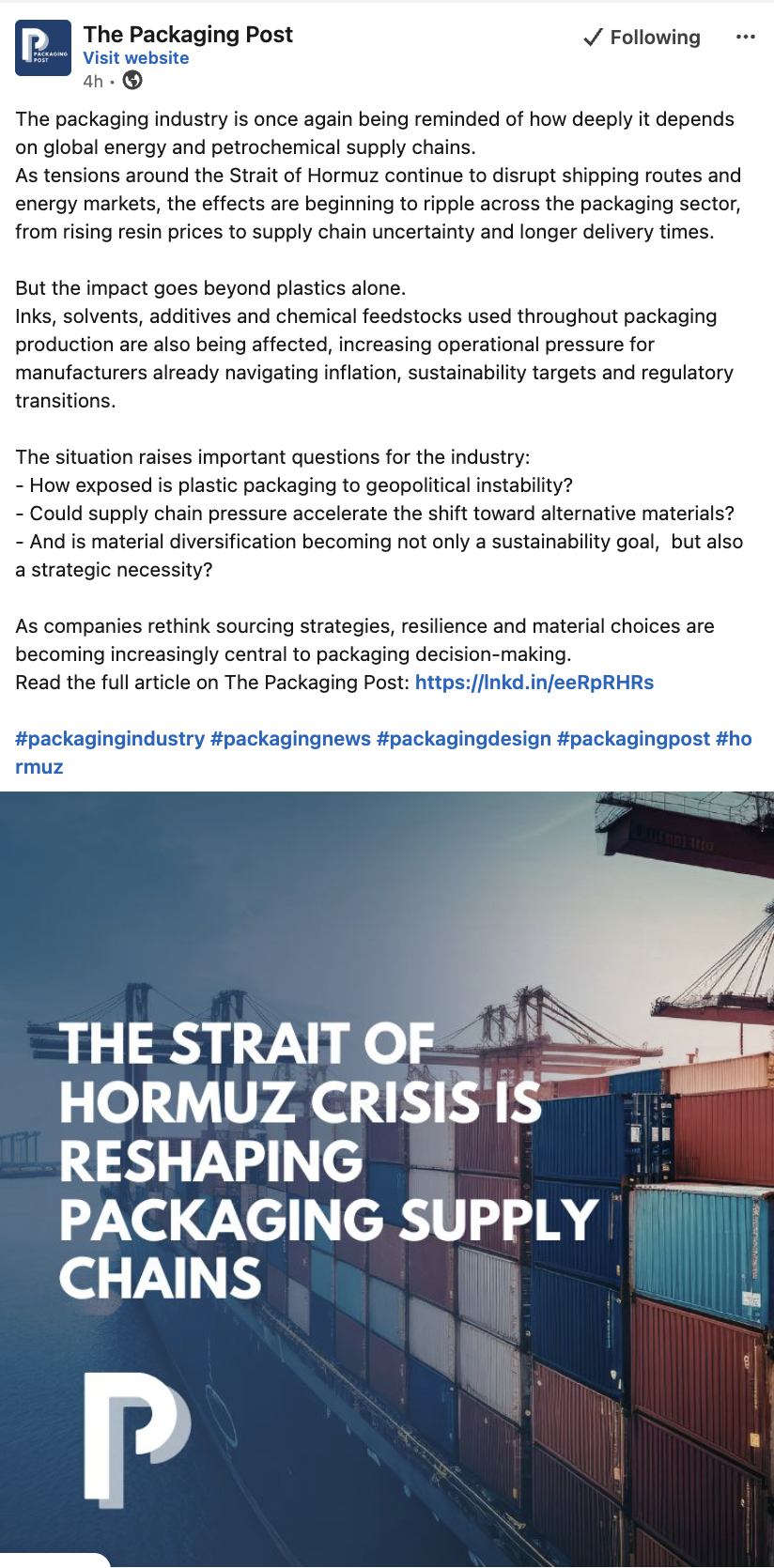
Click on the image above to access and / or comment on this post
Do you know a business that should join the FPA?
The Foodservice Packaging Association represents the interests of its members at all levels and works hard to ensure its members are better represented, better informed and better connected.
FPA members receive early sight of this Digest on Thursday evenings, prior to distribution each Friday morning, and can view an archive of previous Digests within their FPA Dashboards or via this link