The FPA Friday Digest
13 February 2026
This week’s developments on Packaging EPR raise serious questions about transparency, implementation and accountability.
Many of us first learned, via an article in The Grocer, that PackUK may need to re-issue EPR invoices to cover funding shortfalls. That this news reached industry through the trade press rather than directly from Defra or the scheme administrator is, frankly, troubling.
The issues raised are not minor administrative adjustments. They have serious commercial consequences.
For the past 18 months, packaging businesses have been forced to price in EPR without reliable information. Liability effectively began from 1 January 2024 because of the way tonnages were submitted, despite legislation formally commencing in January 2025. Yet:
- Many businesses were unaware EPR was being introduced.
- Those who were aware could not confidently adjust prices while competitors remained uninformed.
- Final fee rates were not confirmed until July 2025, rendering prior pricing little more than speculation.
Indicative plastic rates shifting from £485 per tonne to £423 per tonne within months demonstrate a level of volatility that makes forward planning impossible in a low-margin sector. Responsible businesses attempted to prepare, and in doing so, placed themselves at a structural disadvantage.
We are now told that compliant companies may face higher bills because of shortfalls linked to retrospective tonnage revisions. That outcome was entirely predictable. Companies that failed to price EPR into 2024 simply cannot absorb the costs and have sought to reduce exposure. This is not a failure of industry, it is a failure of implementation.
The current system risks:
- Penalising compliant businesses.
- Rewarding delayed or inaccurate reporting.
- Distorting competition.
- Undermining confidence in regulation.
No credible regulatory regime should operate with uncertain, fluctuating, and potentially retrospective liabilities. Businesses cannot plan, invest or grow under such conditions. We are already seeing reduced investment and heightened commercial risk as a direct consequence.
Industry now needs:
- A reset – including serious consideration of voiding. first-year invoices and restarting implementation properly.
- Reliable forward guidance.
- Protection from retrospective correction of systemic design failures.
- Meaningful engagement with affected sectors.
Consultation alone will not resolve this.
Given the seriousness of the situation, there must be clarity on who is accountable for the rollout, what risk assessments took place, what warnings were given, and what reforms are now planned.
EPR was intended to create environmental responsibility and financial transparency. Instead, its first year risks becoming a case study in how not to introduce major regulatory reform.
The FPA will continue to press for answers.
Anger erupts at Packaging Innovations as EPR shortfall controversy deepens
“The reaction at Packaging Innovations shows this is no minor technical adjustment. Confidence in EPR depends on financial transparency and credible forecasting. Without that, even well-intentioned reform risks losing industry trust”.
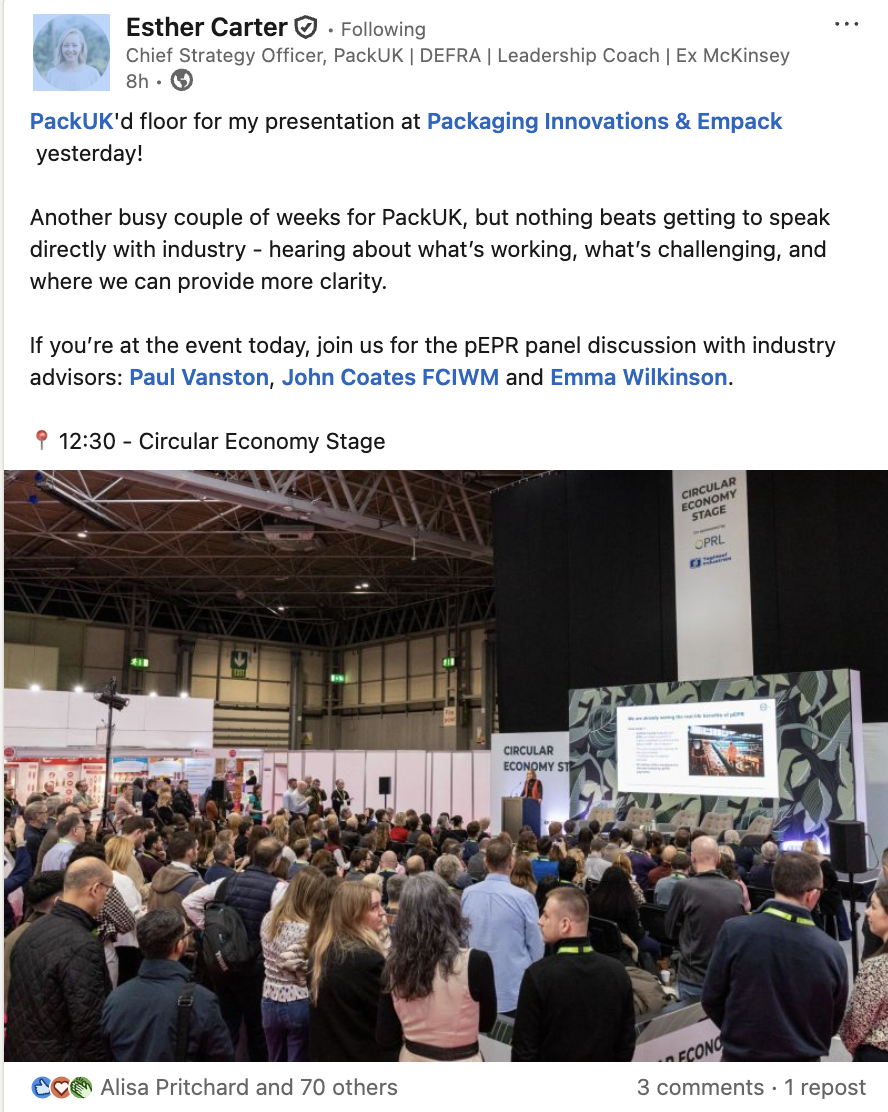
Frustration boiled over at Packaging Innovations & Empack 2026 this week as Esther Carter from PackUK faced sustained criticism over the emerging £1.4bn funding shortfall linked to the first phase of Extended Producer Responsibility (EPR). Reporting from The Grocer, described a tense atmosphere, with delegates challenging how such a significant gap between forecast and actual scheme income could materialise so early in implementation.
PackUK pointed to appeals, revised tonnage submissions and modelling assumptions as contributing factors. However, many in attendance questioned whether the original financial projections were sufficiently robust, particularly given the scale of liabilities already imposed on producers. An accompanying opinion piece, also in The Grocer characterised the situation as one of the most serious financial miscalculations to affect the packaging sector in recent years.
The concern is not confined to producers. Ecosurety, responding in Packaging News to reports that invoices may need to be reissued, stressed the importance of transparency, predictability and maintaining confidence in the system. The compliance scheme warned that retrospective adjustments risk destabilising business planning and could erode trust at a critical stage in EPR’s rollout.
For companies that have already incorporated EPR costs into pricing and contracts, the possibility of recalculated liabilities compounds commercial uncertainty. With recyclability assessments and reporting deadlines continuing, the episode raises wider questions about governance, oversight and the resilience of the modelling underpinning the scheme.
New guidance on EPR merger an ownership changes
“Legal clarity around mergers and ownership transitions is crucial, particularly as consolidation accelerates in packaging and FMCG”.
On 10 February Defra published new guidance for packaging EPR, covering mergers, acquisitions and brand ownership changes. Under the updated rules, if two registered producers merge, the resulting entity inherits the larger status for the year and the following year, and must register accordingly, with packaging tonnage aggregated for liability calculations.
This update fills a gap in the administrative framework, clarifying how EPR responsibilities transfer when brands change hands. The guidance also outlines registration deadlines and conditions when acquiring packaging businesses, providing greater certainty for rising M&A activity in the sector.
The decision effectively pauses the next stage of Wales’ single-use plastics reform programme, which has been closely watched by packaging manufacturers, distributors and hospitality operators across the UK. While Phase 1 bans have already reshaped parts of the Welsh market, Phase 2 would further tighten restrictions, particularly affecting foodservice formats and certain lightweight plastic carrier bags.
For businesses operating across England and Wales, the delay introduces a temporary divergence in regulatory momentum. Some suppliers had already begun transitioning away from the affected products in anticipation of implementation. The postponement may offer short-term breathing space, but it also prolongs uncertainty for those balancing stock management, procurement decisions and cross-border compliance planning.
The Welsh Government has indicated that further updates on revised timelines will be published in due course. The Written Statement, published on 11 February, can be read here
Wales delays phase 2 single-use plastic bans until after the 2026 Senedd elections
“Regulatory certainty is as important as regulatory ambition. Businesses can adapt to change, but only when timelines are clear and stable. Delays, while sometimes necessary, inevitably extend planning uncertainty for suppliers serving the Welsh market”.
Huw Irranca-Davies, Deputy First Minister and Cabinet Secretary for Climate Change and Rural Affairs in the Welsh Government, has confirmed that the remaining 'Phase 2' bans under Environmental Protection (Single-use Plastic Products) (Wales) Act 2023 will not be introduced before the Senedd elections in May 2026.
The delayed measures cover three product categories: plastic single-use carrier bags, polystyrene lids for cups and takeaway food containers, and oxo-degradable plastic products. A Written Ministerial Statement issued on 11 February 2026 explains that revised implementation timescales will follow in due course.
The decision effectively pauses the next stage of Wales’ single-use plastics reform programme, which has been closely watched by packaging manufacturers, distributors and hospitality operators across the UK. While Phase 1 bans have already reshaped parts of the Welsh market, Phase 2 would further tighten restrictions, particularly affecting foodservice formats and certain lightweight plastic carrier bags.
For businesses operating across England and Wales, the delay introduces a temporary divergence in regulatory momentum. Some suppliers had already begun transitioning away from the affected products in anticipation of implementation. The postponement may offer short-term breathing space, but it also prolongs uncertainty for those balancing stock management, procurement decisions and cross-border compliance planning.
The Welsh Government has indicated that further updates on revised timelines will be published in due course. The Written Statement, published on 11 February, can be read here
Government approves wider use of recycled plastic in food packaging
“Greater clarity on the use of recycled plastics in food packaging is a welcome step. The key now is ensuring that collection, sorting and reprocessing capacity can keep pace with demand”.
Government has approved the use of additional recycled plastics in food packaging applications, marking a significant step forward for circular economy ambitions. An article published in Packaging Gateway yesterday highlights that the decision expands the scope for recycled polymer use in food-contact materials, subject to safety and quality standards.
The move is intended to accelerate uptake of food-grade recycled content and reduce reliance on virgin polymer, aligning with broader sustainability objectives and industry demand for clearer regulatory pathways. For packaging manufacturers and converters, the approval provides greater certainty around investment in recycling infrastructure and food-safe reprocessing technologies.
However, scaling supply to meet anticipated demand remains a challenge. Food-grade recycled plastics require stringent sorting, decontamination and traceability processes, and capacity constraints could limit short-term availability. With recycled content increasingly tied to both regulatory compliance and brand commitments, the balance between ambition and infrastructure capability will be closely watched.
Hospitality sector faces cumulative impact of packaging reforms
Trade bodies including UKHospitality and the British Beer and Pub Association have continued to warn of mounting cost pressures across pubs, restaurants and catering businesses, citing inflation, energy volatility and rising employment costs. Against this backdrop, a new wave of environmental regulation is now adding further operational and financial complexity for hospitality operators.
The rollout of EPR, Deposit Return Schemes and Simpler Recycling reforms will directly affect waste handling, packaging procurement and reporting obligations across the sector. While many hospitality businesses are not themselves obligated EPR producers, they are exposed to cost pass-through from suppliers and need to adapt to new waste segregation and collection requirements under Simpler Recycling.
This week's reporting by The Grocer on the potential reissue of EPR invoices has further highlighted the financial uncertainty within the system. Any recalibration of producer fees risks filtering through the supply chain into packaging pricing, adding pressure to operators already managing narrow margins. At the same time, challenges around flexible plastics recycling infrastructure and compostable packaging acceptance continue to create confusion at the point of disposal.
The combined effect is not simply regulatory, it is practical. Smaller premises with limited storage space face difficulties accommodating additional waste streams, while multi-site operators must update procurement, labelling and staff training simultaneously. As environmental ambition accelerates, hospitality businesses are increasingly calling for clearer sequencing and realistic implementation timelines.
BRC outlines next wave of packaging and sustainability regulation
“The direction of travel on sustainability is clear, but the pace and layering of regulation now require careful management. Businesses can adapt, but only if policy is coherent, aligned and supported by realistic implementation timelines”.
The British Retail Consortium (BRC) has set out what it describes as the 'next wave of packaging and sustainability regulation' facing retailers and their supply chains, warning that businesses are entering a period of intensified compliance pressure. In a recent briefing, the BRC highlighted the cumulative impact of UK Extended Producer Responsibility (EPR), Deposit Return Schemes (DRS), Simpler Recycling reforms and evolving EU requirements, alongside tightening rules on environmental claims and chemicals restrictions.
The organisation stressed that retailers are already managing significant cost and administrative burdens as multiple regimes come into force in close succession. The briefing notes that EPR fees alone represent a substantial financial shift for obligated producers, while parallel reforms to collection systems and labelling requirements demand operational adjustments at pace. For businesses operating across UK and EU markets, regulatory divergence is becoming an additional layer of complexity.
The BRC also pointed to the growing scrutiny of sustainability claims and packaging design standards, with increasing expectations around recyclability, recycled content and chemical safety. As EU measures such as the Packaging and Packaging Waste Regulation (PPWR) and Green Claims Directive advance, UK-based suppliers serving European customers must prepare for stricter documentation and substantiation requirements.
Importantly, the BRC’s message reflects a broader industry concern: that the sequencing and coordination of reforms have not always aligned with commercial planning cycles. With reporting, redesign and relabelling timelines overlapping, businesses face mounting implementation challenges, particularly SMEs with limited in-house regulatory capacity.
Lack of demand hampering flexible plastics recycling, warns industry alliance
A coalition of businesses and industry bodies has warned that insufficient end-market demand is undermining efforts to scale up flexible plastics recycling, despite investment in collection and sorting infrastructure. In an article published in edie, the alliance argues that while policy momentum around packaging recyclability continues to build, the economic pull-through for recycled flexible material remains weak, creating a disconnect between collection ambition and commercial viability.
Flexible plastics have long been viewed as one of the more challenging streams within household waste systems. While EPR and Simpler Recycling are intended to increase capture rates, industry leaders caution that without consistent demand for recycled content, particularly in food-grade applications, recycling systems risk becoming financially fragile. Price volatility in virgin polymer markets further compounds the issue, making recycled material less competitive.
The alliance is calling for clearer signals from government and brands to stimulate demand, including stronger recycled content commitments and procurement frameworks that favour secondary materials. Without these demand-side drivers, they warn that investment confidence could weaken just as collection infrastructure begins to expand.
Packaging manufacturers and distributors understand that design for recyclability alone will not guarantee circularity if viable end markets are not in place. Aligning regulatory ambition with material economics remains one of the sector’s most pressing structural challenges.
NEWS FROM EUROPE
Green claims regulation: better substantiation looming
“Environmental claims without robust evidence risk eroding consumer trust and inviting regulatory action. Thankfully, the era of broad, undefined environmental claims is ending. Evidence will need to replace aspiration".
The drive to enhance trust and credibility in sustainability messaging in Europe remains front of mind following recent reinforcement of the EU Green Claims proposal, which is designed to tighten verification and comparability of environmental claims and tackle greenwashing. Under the evolving framework, companies will need stronger evidence to support any claim about recyclability, recycled content or circular performance.
Although these rules are still forming and not yet fully applied, the direction of travel means brands selling into the EU, and by extension UK producers across shared supply chains, should plan for deeper lifecycle evidence and documentation, not superficial statements.
EU packaging rules progress as EFSA evidence gathering concludes
“The regulation directly applies across all EU Member States and affects products placed on the EU market, meaning UK exporters servicing EU clients must also ensure compliance or risk losing access. This fundamental shift is expected to influence material choices and supplier strategies in the entire food packaging supply chain. PFAS restrictions are no longer distant policy concepts, they are hard deadlines that demand action now, rather than later".
Momentum continues to build behind the EU’s restrictions on PFAS in food-contact packaging under the Packaging and Packaging Waste Regulation (PPWR). Companies must align with strict concentration limits for intentionally added PFAS ahead of the 12 August 2026 mandatory compliance date, with no grandfathering for older inventory, a factor that could force reformulation and supplier changes this year.
The tightening of substance controls, particularly around intentionally added PFAS, is already influencing material selection across fibre-based and coated foodservice packaging, with manufacturers accelerating reformulation and alternative barrier development.
At the same time, wider EU regulatory developments are adding further complexity to recycled plastic markets. Member States voted on 6 February on an Implementing Act under the Single-Use Plastics Directive (SUPD), which is expected to delay imports of recycled plastic from non-EU countries counting towards the 25% recycled content target for PET beverage bottles until November 2027. While the final text is yet to be published, market predictions indicate that, until 20 November 2027, only recycled plastic processed within the EU from post-consumer waste collected in the EU will qualify towards the target.
European recyclers have broadly welcomed the anticipated delay, viewing it as protection against lower-priced imports at a time of subdued demand. However, some buyers have expressed concern that restricting imports could tighten supply and trigger short-term price volatility. There are also implications for recyclers outside the EU, including Turkish operators, who have invested heavily in aligning with EU food-contact standards and may now face temporary exclusion from their primary export market.
The Implementing Act is also expected to clarify mass balance accounting rules for chemically recycled PET under the Directive, a development closely watched by converters and brand owners seeking flexibility in meeting recycled content obligations. For UK exporters supplying into EU beverage and food-contact markets, the interaction between chemical restrictions under PPWR and recycled content qualification rules under SUPD introduces a dual compliance challenge.
An article in Argus Media indicates the vote has already influenced buying behaviour, with at least some European buyers pausing purchases of non-EU rPET in anticipation of the rule change. While European recyclers broadly welcome the move as protection against lower-priced imports, concerns are emerging about potential short-term tightening of EU-origin supply and upward price pressure ahead of November 2027.
Report calls for large-scale secondary sorting to address flexible packaging recycling gap
“Expanding collection is only meaningful if we expand capability. Without investment in modern secondary sorting at scale, we risk collecting more flexible packaging only to discover we still cannot recycle it effectively”.
A new report from the Alliance to End Plastic Waste (AEPW) is urging significant investment in large-scale secondary sorting infrastructure to close the persistent recycling gap for flexible packaging. While kerbside collection of flexible plastics is expanding across the UK, the report argues that existing materials recovery facilities (MRFs) are not yet equipped to consistently separate and prepare films and flexibles to the quality required by reprocessors.
According to the analysis, without dedicated secondary sorting systems – capable of extracting flexible plastics from mixed streams at scale – much of the material risks being downcycled, exported, or lost to energy recovery. The authors suggest that a coordinated infrastructure rollout, aligned with EPR funding mechanisms, will be critical to ensuring collected material is actually recycled.
The report also stresses that design for recyclability must be matched by practical sorting capability. Complex laminates, contamination and inconsistent labelling continue to hinder material recovery rates. As flexible plastic collections become more widespread under Simpler Recycling reforms, the pressure to ensure downstream capacity keeps pace will intensify.
For packaging producers, the findings reinforce a central challenge of the circular transition: improving collection without simultaneously upgrading sorting and reprocessing risks creating a bottleneck in the system. The effectiveness of policy reforms will depend not just on producer fees and reporting frameworks, but on whether infrastructure investment is strategically deployed.
International news
US packaging body launches 'Power of Packaging' website
“This is an interesting example of industry taking proactive steps to improve public understanding of packaging before policy hardens around misconceptions. It raises an important question for the UK: is this something that should be emulated here – and if so, is it government’s role to lead public awareness, or should industry be doing more to explain why packaging exists and what it delivers?”.
The American Institute for Packaging and the Environment (AMERIPEN) has launched a new public-facing website, Power of Packaging, aimed at improving understanding of the role packaging plays across society and within the economy.
Unlike traditional industry advocacy tools, the interactive platform is designed for a broad, non-technical audience, including consumers, policymakers and educators. It showcases the people, science and systems behind packaging – from product protection and food safety to branding, jobs and innovation – at a time when packaging policy and sustainability claims are under increasing scrutiny.
Features include short educational videos, infographics, flashcards explaining packaging science, interactive brand-recognition tools, and a map highlighting jobs supported across the packaging value chain. AMERIPEN says the site is intended to “demystify packaging” and provide accessible context as packaging legislation is debated in the US.
The launch complements AMERIPEN’s wider policy work, including advocacy around the PACK Act of 2025 and guidance on navigating sustainability and green claims.
In contrast, the UK currently has no dedicated, government-backed platform to explain the purpose, benefits and trade-offs of packaging. Public-facing messaging has predominantly focused on packaging disposal, waste reduction and litter, and on campaigns led by charities and others. The theme is typically what to do with packaging at end-of-life, rather than why it exists, how it supports food safety, and the impact it has on supply chains, affordability and jobs.
The US initiative raises the question of whether the UK should develop a similar resource, and if so, who should be responsible for leading it?
US packaging policy trends signal tougher enforcement ahead
A new outlook from Packaging Dive highlights 2026 as a pivotal year for packaging regulation, with extended producer responsibility (EPR), recyclability labelling and enforcement all tightening across the US.
The analysis points to a shift away from voluntary commitments towards mandatory reporting, clearer definitions and stronger penalties, as governments respond to concerns over greenwashing and underperforming recycling systems. Importantly, it notes growing alignment between waste data, labelling rules and producer fees, reducing the scope for ambiguity.
The trends mirror developments already underway in the UK through EPR, Simpler Recycling and digital waste tracking, reinforcing the likelihood of tougher scrutiny and reduced tolerance for vague claims.
Canadian court ruling raises stakes for plastics regulation evidence
Canada’s appeal court has overturned the federal government’s decision to designate all plastic manufactured items as 'toxic' under environmental law, ruling that the classification was too broad and insufficiently evidenced.
While the ruling doesn't set aside plastics regulation entirely, it does send a clear signal that policy ambition must be underpinned by robust, material-specific evidence.
EXTERNAL EVENTS
Packaging Innovations & Empack
It was fantastic to see so many members and colleagues during Packaging Innovations & Empack – another year and another great show. Thanks to the FPA Board and FPA team for manning the stand and to all the FPA member companies who posed for pictures.
It was evident throughout the exhibition halls that packaging products are being redesigned to manage EPR exposure, prepare for EU PPWR recyclability grading, or to remove substances likely to be restricted – suggesting compliance rather than consumer demand is now the primary design brief.
What’s striking is how much of this innovation is happening against a backdrop of regulatory uncertainty. Businesses are redesigning formats without full clarity on long-term fee levels or infrastructure readiness. That is a very challenging environment in which to invest.
Talking about regulatory uncertainty, one couldn't help but feel sorry for Esther Carter from PackUK, who when taking to the stage as the representative of the recently appointed system administrators, faced the full force of the industry's wrath about the 'Wild West' of pEPR. We can only hope that the necessary changes will be implemented to address the growing number of issues being identified.
Future trailblazers: 2026 winners announced at Packaging Innovations
The winners of the 2026 Future Trailblazers Awards were announced on 11 February on the Circular Economy Stage during Packaging Innovations & Empack, celebrating the next generation of talent shaping the packaging sector. Coverage by Food & Drink International highlighted how the initiative continues to spotlight emerging professionals making a measurable impact across sustainability, design, technical development and operational excellence.
Supported by the IOM3 Packaging Group, the awards recognise early-career individuals who are already driving progress within their organisations and the wider supply chain. This year’s ceremony drew strong engagement from across the industry, reflecting growing recognition that nurturing new talent is critical as the sector navigates regulatory reform, material innovation and circular economy transition.
Nominees announced for the 2026 Women in Packaging Excellence Awards
Packaging News has published a list of nominees for its 2026 Women in Packaging Excellence Awards, celebrating the outstanding contribution of women across the packaging sector.
The awards continue to play an important role in highlighting the influence and expertise of women in an industry that has historically been male-dominated. The diversity of roles represented on the nominee list underscores how integral women are to every part of the industry.
Beyond individual recognition, the initiative shines a light on mentorship, progression and the importance of visible role models. The diversity of roles represented on the nominee list underscores how integral women are to every part of the industry.
It's good to see so many familiar names among the nominees, professionals from FPA member companies whose work is already well recognised and who continue to raise standards across packaging manufacturing, distribution and design.
Stakeholder Engagement Forums – February to July dates
Dates and links to the next tranche of Circular Economy Stakeholder Forum meetings. No registration is required, the Microsoft Teams link accompanying each forum will provide direct access to that meeting.
Defra recommends individuals wishing to attend save each link to their calendars. No reminders will be sent.
March Forum – Tuesday 3 March: 14:30 to 16:00 Link to access forum
April Forum – Tuesday 7 April: 14:30 to 16:00 Link to access forum
May Forum – Tuesday 5 May 14:30 to 16:00 Link to access forum
June Forum – Tuesday 2 June: 14:30 to 16:00 Link to access forum
July Forum – Tuesday 7 July: 14:30 to 16:00 Link to access forum
FPA NEWS
FPA AGM
The FPA's AGM kicked off at Packaging Innovations & Empack before the show opened and was one of our best attended to date. Members voted in the new Constitution and approved the next steps for the first FPA Accreditation Scheme and the appointment of a CEO.
The association's first ever Annual Review was also presented to members, providing an overview of:
- Our strategic priorities and governance developments.
- Key policy and compliance activity.
- Engagement with government and stakeholders.
- Committee and FPA Board progress.
- Communications developments.
- Membership growth and support.
- Financial stewardship.
- Our plans and ambitions for 2026.
The public version of the Annual Review can be accessed via the link in the button below. FPA members can view the full version – including the P&L, balance sheet and the 2026 budget – by logging in to the FPA Member Hub where you'll find a link to the report in the AGM tab of the FPA events section of your dashboard.
FPA 2026 Awards: spotlight on the Apprentice of the Year finalists
As National Apprenticeship Week draws to a close we’re delighted to reveal the shortlist for our inaugural Apprentice of the Year Award, sponsored by Cofresco.
This brand-new award celebrates exceptional apprentices working within the foodservice packaging sector – recognising individuals who have demonstrated outstanding commitment to learning and professional growth, and who are already making a tangible impact within their organisations.
The FPA 2026 Apprentice of the Year finalists are:
- Adrian Teaca, Bidfood
- Ria Merchant, Bidfood
- Ruby Rimner, Coveris
- Sam Morgan, Colpac
- Scott Harrill, Planglow
- Valeria Potsinok, Bidfood
Bidfood stands out with three apprentices featured among the finalists, underscoring the company’s strong commitment to talent development across the sector.
New FPA member
TA warm FPA welcome to our latest single-site distributor member United UK. Visit the company's website via this link to learn more about what they do.
Essential reading
Circular: Why now is the time to rethink FMCG labels for the circular economy and EPR. Read more here
The Manufacturer: Manufacturing's 'missing' middle is compromising financial and sustainability goals. Read more here
BBC: How seaweed is replacing single-use plastics. Read more here
letsrecycle.com: UK metals recycling emissions could fall 93% by 2050. Read more here
ItvX: Clear-up of huge illegal waste dump near River Cherwell in Kidlington delayed. Read more here
EUWID: Commission's SUPD implementing decision on chemically recycled plastic adopted. Read more here
letsrecycle.com: Flexible plastics recycling is 'complex but achievable' says plastics alliance. Read more here
BBC: Welsh ban on single-use plastic bags and polystyrene takeaway tubs shelved. Read more here
letsrecycle.com: Flexible plastics recycling is 'complex but achievable' says plastics alliance. Read more here
Foodservice Footprint: Plastic price gap continues to cause problems. Read more here
WasteDive: Oregon judge grants wholesalers preliminary injunction in packaging EPR case. Read more here
Chemical Engineer: Experts welcome UK PFAS plan but questions remain over effectiveness. Read more here
Packaging Insights: Deliveroo launches compostable takeaway box. Read more here
Quote of the week and post of the week
Response from Mary Creagh to written question 110166 asking the Secretary of State for Environment, Food and Rural Affairs if she will formally reestablish the Advisory Committee on Packaging as a forum for:
(a) industry
(b) government
(c) regulators
to oversee the operation of the Packaging Recovery Note system:
“Defra has no plans to re-establish the Advisory Committee on Packaging in its previous form.
"However, as part of the forthcoming consultation on Packaging Waste Recycling Note (PRN) reforms, the department will be seeking views on how best to bring together stakeholders including industry, Government, and regulators to advise on the functioning of the PRN system".
Join the FPA
The Foodservice Packaging Association represents the interests of its members at all levels and works hard to ensure its members are better represented, better informed and better connected.
FPA members receive early sight of this Digest at 6:15 a.m. each Friday morning.
Interested in joining the FPA?