The FPA Friday Digest
13 March 2026
It has been a particularly busy and eventful couple of weeks for both the association and the packaging sector.
Last week we were delighted to bring the industry together once again for the FPA 2026 Annual Awards, celebrating the innovation, dedication and professionalism that exists across our sector. The standard of entries this year was exceptional and it was a pleasure to recognise so many outstanding businesses and individuals who continue to drive the industry forward.
At the same time, our work examining the real-world operation of packaging Extended Producer Responsibility (pEPR) has begun to attract wider attention. The association’s research into emerging issues within the scheme sparked a leader column an ongoing coverage in The Grocer and has since been picked up by a number of other media outlets (see the FPA in the news section below) The findings highlight growing concerns across the supply chain about how the system is bedding in and what it means for compliant businesses.
These discussions are taking place against a backdrop of rapid policy development. From updates on EPR implementation and recycling reforms to wider questions about regulatory capacity – including recent reports suggesting Defra could reduce its workforce by around 21% by the end of the decade – the landscape continues to evolve quickly.
Against that backdrop, one of the FPA’s key roles is to ensure that the voices of responsible producers are heard clearly, and that the systems being developed are workable, fair, enforced, and deliver the environmental outcomes we all want to see.
As always, this week’s Digest reflects just how quickly things are moving.
Defra workforce reductions raise questions over regulatory capacity
Reports suggest Defra is on track to reduce its workforce by around 21% by 2029 as part of wider government spending reductions.
While Defra does not directly enforce environmental regulations, the department plays a central role in designing and overseeing major policy frameworks such as pEPR.
The reduction in departmental capacity has prompted discussion about how complex regulatory systems will be managed as they move into full operation. Environmental policy in recent years has increasingly relied on data-driven reporting and compliance systems, with regulators and scheme administrators responsible for monitoring performance and enforcement.
For those already navigating the early stages of EPR implementation, the development highlights the importance of clear system design, robust data and effective enforcement mechanisms to ensure the scheme operates fairly for compliant producers.
PackUK confirms £63m EPR shortfall as Year 2 rollout plans take shape
PackUK has confirmed that the pEPR scheme is currently facing a £63 million funding shortfall, with discussions underway with government on how the gap should be managed during the scheme’s early stages.
Industry reports indicate that PackUK has asked ministers to allow the scheme to operate at a temporary deficit, rather than immediately increasing producer fees, while work continues to stabilise the system and refine cost data.
At the same time, PackUK has outlined its Year 2 operational plans, forecasting that total producer payments could reach around £1.56 billion in 2026-27, covering local authority waste management costs alongside scheme administration.
The plan also confirms that eco-modulated fees linked to recyclability will begin to have a greater impact from the second year of the scheme, using the Recyclability Assessment Methodology (RAM) to differentiate packaging costs.
PackUK has also indicated that a Producer Responsibility Organisation (PRO) is expected to be appointed during 2026 to manage industry-facing elements of the scheme.
In addition, PackUK says it intends to introduce clearer processes for updating local authority cost data and recalculating producer fees, following industry concerns about cost certainty during the initial phase of the scheme.
New technologies could transform packaging EPR reporting, claims study
Emerging technologies such as digital product passports, advanced data systems and artificial intelligence could significantly improve the operation of pEPR schemes, according to a new white paper examining the future of waste data management.
The analysis suggests that improved digital tracking tools could allow packaging materials to be identified, tracked and verified throughout the recycling chain, helping to address some of the transparency and data reliability challenges currently facing EPR systems.
Technologies including blockchain-enabled reporting systems, AI-driven waste sorting and digital product passports could also support more accurate measurement of recycling performance and potentially reduce the administrative burden on producers.
The report argues that better data infrastructure could strengthen confidence in producer responsibility systems by enabling more robust verification of material flows and recycling outcomes.
However, the authors note that widespread adoption would require significant investment, common data standards and regulatory support.
Circular Economy Forum: government confirms Year 1 EPR funding intervention
Defra, PackUK, the Environment Agency and WRAP provided updates on packaging policy and wider circular economy initiatives during the first government Circular Economy and Stakeholder Engagement Forum.
PackUK confirmed that its Operational Plan for 2026–27 has now been published, and that the Producer Responsibility Organisation (PRO) responsible for managing EPR funds is expected to be appointed from April 2026.
Officials also confirmed that Year 1 pEPR disposal fees will not change, despite a funding gap in the scheme. Local authorities will still receive the payments expected, with government stepping in to close the shortfall as a one-off intervention. The gap was attributed to transitional factors including refined tonnage data and lower than expected packaging volumes submitted by producers.
The Environment Agency also reminded producers of the 1 April deadline for key EPR obligations, including small producer registration for the 2026 compliance year and the submission of 2025 packaging and RAM data.
Elsewhere, Defra reiterated progress on Simpler Recycling in England, supported by more than £340m in transitional funding for weekly food waste collections and the expected rollout of £1.1bn annual pEPR funding to local authorities once the scheme is fully operational.
The next Joint Stakeholder Engagement Forums will take place on 14 April, 5 May, 2 June and 7 July. Links to join can be found below within the 'External events' section.
An official write-up and recording will be circulated via the next Circular Economy newsletter.
Spring Statement: no new packaging measures but environmental taxes remain embedded
The government’s Spring Statement and accompanying Office for Budget Responsibility (OBR) Economic and Fiscal Outlook contained no new policy announcements directly affecting packaging or waste regulation.
However, the fiscal forecasts confirm that existing environmental measures affecting the packaging supply chain remain firmly embedded in the UK’s tax framework, including the Plastic Packaging Tax (PPT) and Extended Producer Responsibility (EPR).
The OBR analysis also shows environmental levies continuing to form a growing component of government revenues, reflecting the wider shift towards using fiscal measures to support environmental policy objectives.
Notably, the forecasts treat EPR payments as a structural element of public expenditure, underlining the government’s expectation that producer-funded waste management will remain a long-term feature of the system.
More broadly, the report suggests the UK tax burden is set to rise to 38.5% of GDP by 2030-31 – a post-war high.
While the Spring Statement itself did not introduce new packaging measures, the outlook reinforces the direction of travel towards greater use of producer responsibility and environmental taxation across the economy.
Concerns grow over Wales' proposed glass-inclusive DRS
Concerns are mounting across parts of the packaging, drinks and retail sectors over the Welsh Government’s proposal to include glass containers within its Deposit Return Scheme (DRS).
Industry groups have warned that introducing a glass-inclusive system could create significant operational and financial challenges, particularly for small retailers expected to host return points. Convenience sector representatives say handling heavy and fragile glass containers could require additional storage space, changes to store layouts and new safety procedures.
Some organisations have also raised concerns about cross-border complexity, noting that Wales’ proposed model would differ from schemes planned elsewhere in the UK, potentially creating confusion for consumers and additional logistical pressures for producers and retailers operating across multiple markets.
Separately, representatives from the drinks industry have suggested that differences between schemes could create opportunities for fraud, with estimates that potential losses could reach hundreds of millions of pounds if cross-border movement of containers is not carefully managed.
The glass sector has also called for greater clarity and further consultation on how the scheme would operate in practice, with some industry bodies urging policymakers to pause and review the proposals before implementation.
The Welsh Government has maintained that its approach aims to maximise recycling performance and support circular economy objectives.
Next Gen project launched to help attract new talent to the industry
Work is underway on a new Next Gen initiative aimed at helping the packaging sector attract and retain the next generation of talent.
The project, being developed with support from industry bodies, including The Packaging Federation, is focused on addressing one of the sector’s long-standing challenges – recruiting skilled people into the industry and raising awareness of the diverse careers available across the packaging supply chain.
As part of this work, The Packaging Federation has aldo been in discussion with officials at the Department for Work and Pensions (DWP). These conversations suggest that government is keen to work more closely with industry on the broader challenge of connecting employers with people seeking work.
In support of this effort, DWP is currently developing a new Employer Service, which will form part of its forthcoming Jobs & Careers Service, and is inviting employers to help test the system before launch.
Companies of all sizes are being asked to act as user testers, helping shape how the service works in practice. Testing may involve short video calls, trial use of the platform or providing feedback on early versions of the service, with sessions typically lasting around 20–25 minutes.
The Packaging Federation has asked us to circulate the invitation across their own memberships, helping ensure that the service reflects the real needs of employers.
Businesses interested in taking part are asked to email partnership.networkandprojectteam@DWP.GOV.UK providing their company name, size/sector and contact details. Questions and enquiries should be directed to Matt Brown via wastd.labourmarketdesign@DWP.GOV.UK
Councils face readiness and enforcement challenges ahead of recycling reforms
Local authorities are facing growing pressure as the rollout of Simpler Recycling reforms approaches, with reports suggesting many councils are still not fully prepared for the introduction of mandatory separate food waste collections.
A BBC investigation suggests more than 70 councils may struggle to meet the required timeline, raising concerns about operational readiness and the cost of implementing new collection systems. At the same time, councils are experimenting with changes to collection frequencies, with some evidence suggesting that less frequent residual waste collections may help drive higher recycling rates.
The reforms form part of a broader transformation of the UK waste system, alongside EPR and the forthcoming Deposit Return Scheme (DRS). Legal experts warn that the interaction between these policies will require careful coordination between national and local authorities.
Meanwhile, enforcement remains a key issue. The Local Government Association has called for a review of sentencing for fly-tipping offences, arguing that current fines do not act as a sufficient deterrent. New guidance has also been issued giving councils stronger powers to tackle littering, aimed at supporting more consistent enforcement across England.
Industry warns UK plastic recycling system faces capacity pressures
Concerns are growing about the UK’s ability to process increasing volumes of plastic packaging, as policy reforms designed to boost recycling begin to take effect.
Industry analysis suggests the UK could face a plastic recycling capacity gap, with calls for greater investment in domestic infrastructure to manage future material flows. Ecosurety has warned that without rapid development of recycling facilities, the UK may struggle to process material generated under new policy frameworks such as EPR.
The debate comes as government guidance continues to clarify which plastic packaging formats can be recycled through household systems, highlighting ongoing challenges around flexible plastics and material sorting.
At the same time, waste sector stakeholders emphasise that the effectiveness of reforms such as Simpler Recycling, EPR and the planned Deposit Return Scheme will depend on improved infrastructure, clearer communication with consumers and consistent collection systems across local authorities.
NEWS FROM EUROPE
France tightens scrutiny of reuse targets under packaging regulations
France is reviewing the implementation of its packaging reuse and refill targets, amid growing debate about the pace and practicality of the transition.
The country has introduced some of the most ambitious reuse objectives in Europe, including targets for a 10% share of reusable packaging by 2027 across key product categories. However, industry groups have raised concerns about infrastructure readiness, operational complexity and the costs associated with scaling reuse systems.
The discussion comes as EU institutions finalise the Packaging and Packaging Waste Regulation (PPWR), which will introduce reuse requirements across several packaging formats at European level.
The French experience is being closely watched across the sector, as policymakers seek to balance environmental objectives with the practical challenges of deploying large-scale reuse systems.
Industry assesses impact of EU recyclability grading rules under PPWR
Packaging producers across Europe are beginning to assess the implications of the recyclability performance grading system set to be introduced under the EU’s Packaging and Packaging Waste Regulation (PPWR).
The regulation will require packaging placed on the EU market to meet defined recyclability performance thresholds, with formats expected to be graded according to how effectively they can be collected, sorted and recycled at scale. Over time, poorly performing packaging could face restrictions or additional costs as the system moves toward the goal that all packaging should be recyclable by design.
Industry groups say the grading approach could have significant implications for certain packaging formats, particularly multi-material structures, flexible packaging and products that rely on barrier coatings.
The development is being closely monitored by packaging manufacturers and converters supplying into European markets, as companies begin reviewing packaging design and material choices in preparation for the regulation’s phased implementation later this decade.
INTERNATIONAL STORIES
Survey reveals cautious optimism among sustainable packaging professionals
A new international survey of packaging professionals suggests attitudes towards sustainable packaging remain broadly positive, despite growing regulatory pressures and economic challenges.
The research found that most respondents continue to view sustainability as a long-term strategic priority, with many companies maintaining investment in packaging redesign, recyclability improvements and alternative materials.
However, the survey also highlights increasing concern about the complexity and pace of regulation, particularly in areas such as EPR, recycled content mandates and reporting requirements across multiple markets.
Cost pressures and supply chain constraints were also cited as ongoing barriers to faster progress, with many organisations balancing sustainability ambitions against commercial realities.
Overall, the findings suggest that while enthusiasm for sustainable packaging remains strong, the industry is entering a more pragmatic phase focused on practical implementation and regulatory compliance
EXTERNAL EVENTS
Stakeholder Engagement Forums – April to July dates
Dates and links to the next tranche of Circular Economy Stakeholder Forum meetings. No registration is required, the Microsoft Teams link accompanying each forum will provide direct access to that meeting.
Defra recommends individuals wishing to attend save each link to their calendars. No reminders will be sent.
April Forum – Tuesday 14 April: 14:30 to 16:00 Link to access forum
May Forum – Tuesday 5 May 14:30 to 16:00 Link to access forum
June Forum – Tuesday 2 June: 14:30 to 16:00 Link to access forum
July Forum – Tuesday 7 July: 14:30 to 16:00 Link to access forum
FPA NEWS
A night to remember: celebrating the FPA 2026 Awards
Last Thursday the industry came together once again to celebrate excellence, innovation and the people who make our sector what it is. The FPA 2026 Awards proved to be another fantastic evening of recognition, networking and, as always, great fun!
Our thanks go to all of the sponsors, judges and guests who helped make the evening such a success.
A special thank you also goes to our host Matt Lucas, who kept the evening flowing with his trademark humour, and even managed to celebrate his birthday with us on the night.
Across the awards categories we saw a remarkable standard of entries. Congratulations to all of this year’s winners, runners-up and highly commended companies.
Also, thanks to the generosity of members and their guests the event also raised £4,130 for the FPA's chosen charity WasteAid.
View the full list of winners here:
Of course, the FPA Awards are about more than the trophies. The Awards Exhibition during the afternoon was busy as always and the evening provided plenty of opportunity for guests to relax and enjoy themselves with a range of activities throughout the night.
The silent disco proved particularly popular, with many guests swapping formal networking for the dance floor later in the evening. Alongside the casino tables and other entertainment, it was great to see so many people making the most of the opportunity to catch up with colleagues and friends from across the industry.
Photos and highlights from the evening can be accessed here
We’d love your feedback
If you attended the awards, we would be hugely grateful if you could spare a minute to click through to the short survey via the button below and tell us what you thought of the evening. Your feedback helps us continue to improve the event each year.
Once again, congratulations to all of the winners and finalists, and thank you to everyone who helped make the 2026 FPA Awards such a memorable night.
We look forward to doing it all again next year!
FPA in the news
The Grocer: EPR avoidance: what can be done to stop it happening
The Grocer: EPR bailout is a victory for The Grocer's relentless journalism
IOM3: Questions over packaging Extended Producer Responsibility
MRW: Food packagers warn of structural discrimination in EPR
Packaging News: Foodservice Packaging Association warns of structural discrimination in EPR
Contract Catering: Packaging under pressure
Packaging Scotland: Foodservice excellence celebrated at FPA Awards ceremony
Packaging News: Foodservice packaging companies win big at FPA gala awards night
Essential reading
The Grocer: PackUK asks government to allow EPR scheme to run at a loss. Read more here
BBC: Glass deposit plan 'could push up prices for consumers'. Read more here
Packaging News: Ecosurety calls for urgent action on UK plastic recycling infrastructure. Read more here
Defra: Clearer rules to support councils in fight against litter louts. Read more here
Packaging News: British Glass warns Wales DRS model could hit consumers and disrupt UK market. Read more here
Civil Service World: Defra on track to cut 21% of its headcount by 2029, permanent secretary reveals. Read more here
letsrecycle.com: PackUK confirms shortfall as £63m and announces Year 2 recovery target. Read more here
Packaging Gateway: PackUK details next phase of UK packaging EPR rollout. Read more here
Circular: LGA calls for urgent sentencing review into fly-tipping court fines. Read more here
QSR: QSR expansion is driving down customer visits. Read more here
Quote of the week and post of the week
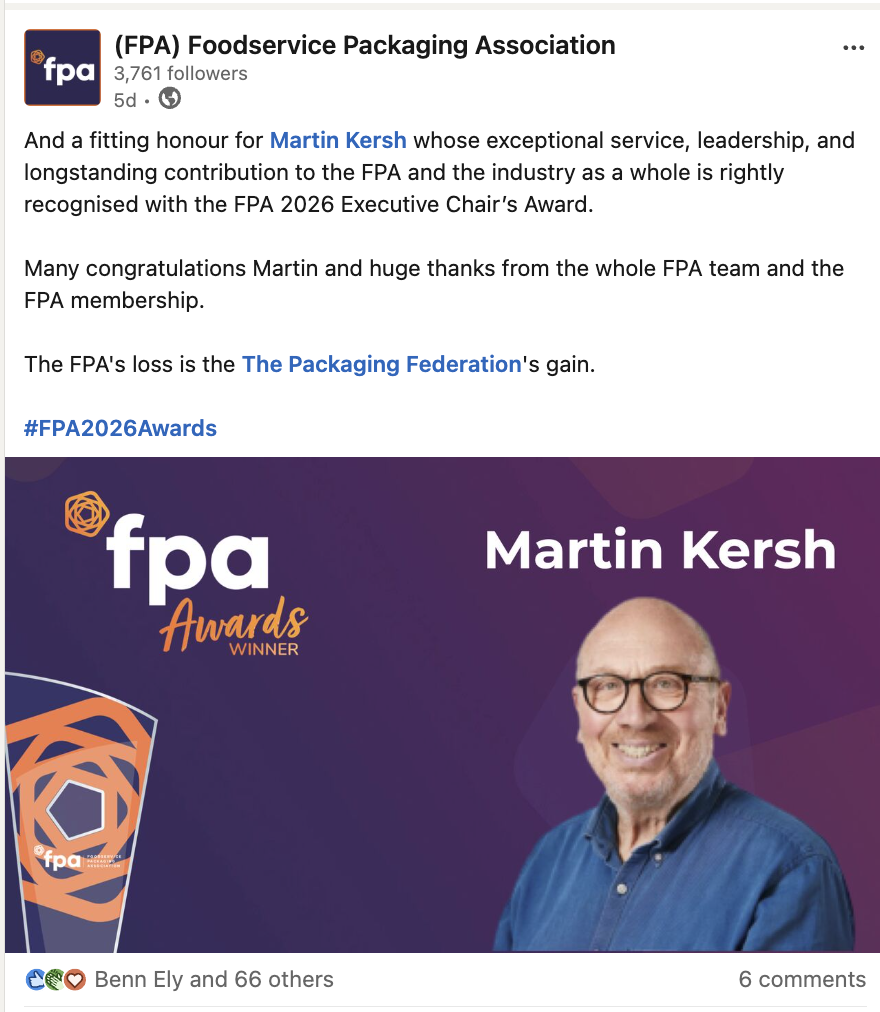
James Piper, CEO of Ecosurety, commenting on the UK plastics recycling system:
“The UK plastics recycling system is approaching a critical moment. EPR has the potential to transform how packaging is collected and recycled, but policy alone will not deliver the circular economy we all want to see. Without urgent investment in domestic recycling infrastructure and a system that provides certainty for investors, there is a real risk that policy ambition will run ahead of the system’s capacity to deliver”.
Join the FPA
The Foodservice Packaging Association represents the interests of its members at all levels and works hard to ensure its members are better represented, better informed and better connected.
FPA members receive early sight of this Digest at 6:15 a.m. each Friday morning.
Interested in joining the FPA?