The FPA Friday Digest
15 May 2026
A note from the FPA interim executive chair on behalf of the FPA Board
As FPA members will already be aware, Mike Revell has stepped down as executive chair of the Foodservice Packaging Association for personal and professional reasons.
Mike had previously indicated his intention to step down later this year in line with longer-term succession planning and the association’s transition to a new leadership structure. In light of this, the FPA Board agreed to accept his resignation and bring this transition forward.
Mike’s contribution to the association during his tenure has been significant and we thank him for his commitment and leadership. We wish him well for the future as he focuses on his wider professional commitments.
The FPA Board remains fully focused on ensuring continuity for members and maintaining momentum across the FPA’s ongoing activities, including first-round interviews for the new FPA CEO position, which took place earlier this week.
The FPA’s vice chair, Paul Synnott, will serve as interim executive chair until November 2026 and the association’s programme of work will proceed as planned – continuing our engagement with government, regulators and industry stakeholders on the issues that matter most to the sector.
As part of this ongoing work, the FPA continues to encourage businesses with concerns regarding potential pEPR non-compliance or evasion to share relevant information with the association in confidence. This intelligence remains important in helping the FPA represent members’ concerns and support the development of a fair and effective system.
Please email compliance@foodservicepackaging.org.uk with any concerns.
Thank you for your continued support and engagement.
Paul Synnott
Interim executive chair
On behalf of the FPA Board
In this week's Digest ...
While leadership at the association may be evolving, our commitment to keeping FPA Friday Digest readers informed continues. While this week's King’s Speech didn't include any major new legislation directly relating to packaging, today’s Digest reflects the increasingly fast-moving and interconnected nature of packaging policy and regulation – from updated UK pEPR payment calculations and Digital Waste Tracking developments, to growing debate across Europe and the US around how ambitious environmental legislation can be implemented in a practical and commercially workable way. We also look at mounting pressure on recycling infrastructure, international discussions around packaging traceability and recycling verification, and the operational challenges emerging as businesses adapt to evolving compliance requirements across global markets.
Updated pEPR local authority payment figures published
Defra and PackUK have published updated local authority payment values and supporting methodology documents for Years 1 and 2 of the pEPR scheme, including revised payment figures for England, Scotland, Wales and Northern Ireland. The updates provide further detail on how payments to councils are being calculated under the Local Authority Packaging Cost and Performance Model (LAPCAP), ahead of the transition to quarterly local authority payments from April 2026.
The guidance also reiterates that pEPR payments currently exclude certain waste streams, including street bin waste, litter and business waste, while drinks containers expected to fall under a future Deposit Return Scheme remain outside disposal fee calculations until at least 2028.
Glass sector warns over impact of rising environmental costs
UK glass manufacturers have warned that rising environmental levies and energy-related costs could threaten investment and long-term competitiveness within the sector, according to reporting in The Times. Industry representatives argue that growing regulatory and cost pressures risk increasing reliance on imported products from regions operating under less stringent environmental standards, potentially undermining domestic manufacturing resilience.
The concerns come amid wider industry adjustment to pEPR, carbon reduction policies and increasing sustainability-related compliance obligations across UK manufacturing and packaging supply chains. The sector has also warned that high energy intensity and limited ability to rapidly decarbonise some industrial processes continue to create significant commercial challenges.
The debate reflects broader concerns across packaging manufacturing about balancing environmental ambition with industrial competitiveness, investment confidence and supply chain resilience during a period of significant regulatory transition.
FPA comment: “The transition towards more sustainable packaging systems must be delivered in a way that also protects UK manufacturing competitiveness and supports long-term investment. Environmental policy can play an important role in driving innovation and improvement, but businesses also require regulatory certainty, realistic implementation timelines and a level international trading environment to avoid unintended economic consequences”.
UK recycling infrastructure facing growing pressure amid policy changes
Industry figures are warning that parts of the UK recycling infrastructure are coming under increasing pressure as rising operational costs, tighter regulation and new collection requirements continue to reshape the sector. Concerns have been raised that investment in domestic sorting and processing capacity may struggle to keep pace with policy initiatives designed to expand recycling rates and increase recovery of flexible plastics and other packaging materials.
The debate comes as businesses prepare for wider implementation of pEPR, Simpler Recycling reforms and future recyclability requirements, with industry representatives arguing that long-term policy success will depend on sufficient domestic infrastructure, stable end markets and commercially viable collection and processing systems.
FPA comment: “Delivering a more circular packaging system will require continued investment across the entire recycling chain, including collection, sorting, reprocessing and end-market development. Regulatory change and infrastructure development must evolve together if long-term recycling and circular economy objectives are to be achieved effectively and sustainably”.
Digital Waste Tracking moves closer as scrutiny of waste enforcement grows
The Regulatory Policy Committee (RPC) has given a ‘fit for purpose’ rating to Defra’s impact assessment for mandatory Digital Waste Tracking, paving the way for phased implementation from October 2026.
The reforms will introduce a centralised digital system for recording waste movements across the UK waste chain, replacing existing fragmented paper-based processes. Defra says the system will improve transparency, support enforcement activity and help tackle waste crime.
While the RPC endorsed Defra’s overall assessment, including estimated annual business costs of £40.8 million, it also warned that smaller businesses could face proportionately higher compliance burdens and called for stronger evidence in several areas of the analysis.
The developments come as the Office for Environmental Protection (OEP) raised concerns over the effectiveness of Environment Agency waste inspections in England. Following a review of inspections carried out between 2018 and 2022, the watchdog identified what it described as “significant short-comings” in the current system, questioning inspection quality and whether existing compliance metrics accurately reflect environmental outcomes. The OEP called for a more outcomes-focused approach to waste regulation and enforcement.
The developments highlight the growing emphasis being placed on data quality, traceability, enforcement and digital compliance infrastructure across the waste and packaging sectors, as regulators increasingly look to technology and reporting systems to strengthen oversight and tackle waste crime during a period of significant policy and operational change..
FPA comment: “The move towards mandatory Digital Waste Tracking reflects the increasing digitisation of environmental compliance and resource management across the UK. Improved traceability, stronger enforcement and more effective action against waste crime are all important objectives. However, recent concerns raised around waste inspection effectiveness also demonstrate that digital systems alone will not solve wider enforcement challenges. It's essential that new reporting frameworks remain practical, proportionate and accessible for businesses of all sizes, while being supported by consistent and effective regulatory oversight and realistic implementation timelines".
Concerns raised over fraud risks linked to Welsh DRS delays
Industry representatives have warned that delays to the planned Welsh Deposit Return Scheme could increase the risk of cross-border fraud and place additional pressure on scheme interoperability across the UK.
According to estimates referenced during ongoing discussions around DRS implementation, differences in launch timing between UK nations could potentially expose the system to significant levels of fraudulent activity, including the movement of containers between jurisdictions to claim deposits illegitimately. Concerns have also been raised around operational complexity for retailers, producers and logistics operators if implementation timetables become increasingly fragmented.
The debate highlights the continuing importance being placed on interoperability, fraud prevention and consistent implementation as governments and industry continue preparations for the planned October 2027 launch of DRS schemes across the UK.
New OEP chair signals continued scrutiny of environmental delivery
Government has named Helen Ghosh as its preferred candidate to chair the Office for Environmental Protection (OEP), the independent body responsible for holding public authorities to account on environmental law and commitments.
Ghosh is a former Permanent Secretary at Department for Environment, Food and Rural Affairs and most recently served as Director General of the National Trust, bringing extensive experience across environmental policy, regulation and delivery. Her appointment has been endorsed by the EFRA and Environmental Audit committees, although they have stressed the need for the OEP to strengthen relationships with stakeholders.
While the OEP does not set policy, its role in scrutinising delivery is likely to keep pressure on key reforms – including pEPR and wider waste and resource measures – particularly as implementation challenges and enforcement expectations come into sharper focus.
NEWS FROM EUROPE
Campaigners push back against calls to revisit PPWR provisions
Environmental campaign groups have criticised attempts by major multinational brands and industry organisations to reopen elements of the EU Packaging and Packaging Waste Regulation (PPWR), arguing the move risks undermining recently agreed legislation. The debate follows reports that companies including Coca-Cola, Heineken, McDonald’s and Mondelez are seeking changes or clarification around some of the Regulation’s most challenging provisions, including reuse targets, recycled content requirements, PFAS restrictions and rules affecting certain single-use packaging formats.
Industry signatories argue that legal uncertainty, delayed guidance and unresolved technical issues are creating risks for compliance, investment and competitiveness as implementation approaches. Environmental groups, however, insist the PPWR has already undergone extensive consultation and warn that reopening agreed provisions could weaken environmental protections and undermine confidence in the EU legislative process.
The dispute highlights growing tensions between environmental ambition and operational delivery as businesses across Europe prepare for implementation of one of the EU’s most significant packaging regulatory reforms in recent years.
FPA comment: “The scale and complexity of the PPWR means it is inevitable that businesses and stakeholders will continue to seek clarification around certain provisions as implementation approaches. Achieving long-term environmental objectives will require legislation that is not only ambitious, but also clear, practical and supported by realistic delivery timelines, appropriate infrastructure and workable compliance pathways”.
Industry adapting as plastics restrictions expand
The global packaging sector is continuing to adapt to expanding restrictions on single-use plastics, with businesses increasingly redesigning packaging formats, reviewing material choices and simplifying pack structures to meet evolving regulatory requirements. Analysis published this week highlights growing interest in fibre-based materials, recycled content and mono-material packaging as companies respond to tightening rules across Europe and other international markets. However, the report also notes that plastics remain important in applications requiring barrier performance, hygiene and durability, particularly within food packaging and foodservice sectors.
FPA comment: “The industry is continuing to evolve rapidly in response to changing legislation, customer expectations and sustainability targets. While material innovation and packaging reduction remain important areas of focus, it is equally important that regulatory approaches recognise the functional role packaging plays in areas such as food safety, product protection and waste prevention”.
INTERNATIONAL STORIES
California’s landmark packaging EPR law faces mounting implementation tensions
California’s SB 54 packaging regulations are facing criticism from both environmental groups and industry bodies within days of formally taking effect, highlighting the growing complexity surrounding implementation of one of the world’s most ambitious packaging and plastics laws.
Environmental organisations argue the final regulations introduce loopholes linked to chemical recycling and exemptions for certain packaging formats, while industry groups continue to raise concerns around compliance costs, operational burdens and legal uncertainty.
The legislation introduces wide-ranging producer responsibility obligations covering packaging and single-use plastic foodservice ware, alongside long-term recyclability and plastic reduction targets. Industry observers say the law is already forcing businesses to reassess supply chain agreements, franchise structures, packaging specifications and post-consumer material responsibilities in far greater detail than previously required – underlining how packaging EPR is increasingly reshaping broader corporate decision-making and operational risk management across global markets.
FPA comment: "This legal challenge demonstrates the importance of ensuring packaging legislation is clear, proportionate and operationally workable before implementation begins. Regulatory certainty and realistic compliance pathways are essential if environmental policies are to achieve their intended objectives without creating unnecessary complexity or unintended consequences for businesses.”
US packaging EPR scheme consults on national recycling verification standard
Circular Action Alliance (CAA), the producer responsibility organisation leading implementation of US packaging EPR programmes, has opened consultation on a proposed Responsible End Market (REM) standard covering paper, packaging and foodservice ware. The framework is intended to create more consistent verification of how recyclable materials are managed downstream of collection and sorting, while reducing the risk of fragmented state-by-state compliance approaches as packaging EPR expands across the US.
The proposed standard is being developed in partnership with ANSI-accredited certification body SCS Standards and Assurance Systems, with input from regulators, environmental organisations, academic experts and industry groups. The move reflects growing international focus on material traceability, end-market accountability and transparency within packaging recycling systems. Public consultation on the framework remains open until 7 July 2026.
FPA comment: “As packaging EPR systems continue to evolve internationally, transparency, traceability and confidence in recycling outcomes are becoming increasingly important. Effective circular economy systems depend not only on collection and recycling infrastructure, but also on clear and consistent verification of how materials are managed once they enter downstream recycling markets”.
Japan packaging disruption highlights wider supply chain vulnerability
A Japanese snack manufacturer has announced it will temporarily switch a number of products to black-and-white packaging after supply disruption linked to the Strait of Hormuz crisis created shortages of petroleum-derived materials used in printing inks.
The company said instability affecting supplies of naphtha – a petroleum derivative widely used within ink production – had impacted availability of certain raw materials, prompting the temporary move away from its traditionally brightly coloured packaging designs.
FPA comment: "This highlights the wider exposure of global packaging and manufacturing supply chains to geopolitical disruption, energy markets and raw material availability, particularly where packaging production remains closely linked to oil-derived inputs and international trade routes".
Uncertainty grows around future direction of global plastics treaty talks
Concerns have been raised over the future momentum of global plastics treaty negotiations after reports that Norway – one of the largest financial supporters of the UN Environment Programme (UNEP) and a leading advocate for an ambitious treaty – is reviewing elements of its environmental funding commitments. The development has prompted concern among environmental groups and observers involved in the ongoing negotiations towards a legally binding international agreement on plastic pollution.
Global treaty discussions have faced repeated delays and political disagreements in recent years, particularly around proposals linked to plastic production limits, chemicals regulation and obligations across the full plastics lifecycle. Negotiations are expected to resume in 2027 following the failure of previous talks to reach agreement.
Paper cup recycling access expands across the US
Recycling access for paper cups in the United States has increased to cover 20% of the population, according to the Foodservice Packaging Institute (FPI), up from 5% in 2017. The expansion has been driven through collaboration between paper mills, recyclers, packaging manufacturers and local authorities, alongside investment in sorting and fibre recovery infrastructure. Industry groups say the development demonstrates growing acceptance of paper cups within mainstream recycling systems as investment in end markets and processing capability increases.
The progress also highlights differing international approaches to foodservice packaging policy. While parts of Europe are increasingly focusing on reuse systems and restrictions on single-use packaging under the PPWR, the US market continues to place significant emphasis on expanding collection and recycling infrastructure for existing packaging formats.
FPA comment: “The expansion of paper cup recycling access in the US demonstrates the importance of investing in collection, sorting and end-market infrastructure alongside packaging design improvements. Effective circular economy systems depend not only on material innovation, but also on ensuring practical and scalable recovery pathways exist for packaging once it enters the waste stream”.
EXTERNAL EVENTS
Interpack highlights industry focus on AI, automation and regulatory readiness
The world’s largest packaging exhibition highlighted how automation, digitalisation, innovative materials and regulatory compliance are rapidly reshaping the global packaging sector, with exhibitors increasingly focused on AI-enabled manufacturing, sustainability and future-proof packaging solutions.
Organisers said this year’s exhibition reflected growing industry focus on data-driven manufacturing, resource efficiency, automation and preparation for major regulatory changes including the EU Packaging and Packaging Waste Regulation (PPWR). AI, smart manufacturing, recyclable materials and supply chain resilience featured heavily across the event programme and exhibitor announcements.
FPA partners with leading packaging sustainability event
The FPA is pleased to be partnering with the 2026 Packaging News Sustainability & Impact Summit and Awards, taking place at the Kia Oval on Tuesday 14 July.
Bringing together experts from across the value chain, the event will explore key themes including regulatory developments, material innovation and the practical challenges of delivering more sustainable packaging solutions in a rapidly evolving policy landscape.
As a partner, the FPA is supporting efforts to ensure that the foodservice packaging sector is represented within these discussions – particularly as businesses navigate the introduction of EPR, DRS and wider environmental requirements.
The event provides a valuable opportunity for members to engage directly with policymakers, industry leaders and technical experts, and to gain insight into how emerging frameworks are likely to impact packaging design, operations and compliance.
Further details, including agenda and registration, can be accessed via the event website
Stakeholder Engagement Forums – April to July dates
Dates and links to the next tranche of Circular Economy Stakeholder Forum meetings. No registration is required, the Microsoft Teams link accompanying each forum will provide direct access to that meeting.
Defra recommends individuals wishing to attend save each link to their calendars. No reminders will be sent.
June Forum – Tuesday 2 June: 14:30 to 16:00 Link to access forum
July Forum – Tuesday 7 July: 14:30 to 16:00 Link to access forum
FPA NEWS AND EVENTS
Confidential input requested
Businesses with concerns about how pEPR is operating in practice – including issues relating to scope, competition, enforcement or unintended consequences, are invited to share their experiences in confidence with the FPA. We also welcome intelligence on potential gaps in scope, market distortions or suspected avoidance behaviours, which can be shared in confidence.
This insight is invaluable in helping us build an accurate picture of how the system is functioning on the ground and in ensuring that industry concerns are effectively represented in our ongoing engagement with Defra, PackUK and the Environment Agency.
Please contact the compliance team directly via compliance@foodservicepackaging.org.uk. All information will be handled sensitively and used to inform our evidence base and policy discussions.
The FPA Golf and Activities Day returns for another fantastic day of networking and entertainment
FPA members, colleagues and customers are invited to join us on Thursday 11 June for the FPA’s ever-popular annual Golf and Activities Day, taking place at the stunning Breadsall Priory Country Club, just outside Derby.
Many members have already secured their places for what promises to be another excellent day of business networking, entertainment and informal industry engagement. Accommodation at Breadsall Priory is limited and rooms are already booking quickly, so early reservation is strongly recommended to avoid disappointment.
Whether you choose to take part in the Golf Day or the fun-filled ‘Quintessentially English’ Activities Day, the event offers a fantastic opportunity to strengthen existing relationships, make new industry connections and spend time with fellow FPA members, colleagues and customers in a relaxed setting.
Golf Day
Participants will enjoy 18 holes of golf within the beautiful grounds of Breadsall Priory Country Club. The competition will follow the four-ball-better-ball Stableford handicap allowance format, although guests who are not part of a full team can be paired with others on the day.
Following member feedback, there is also the option this year to be placed into mixed-company teams to maximise networking opportunities across the sector.
Prizes will include the FPA Golf Winner’s Cup for the highest individual score, the FPA Golf Champions Shield for the winning team, along with competitions for longest drive and nearest the pin.
Activities Day
For those preferring something a little different, the Activities Day promises plenty of entertainment and friendly competition, with teams taking part in a series of light-hearted challenges including axe-throwing, splat-the-rat, welly wanging, tug-of-war, croquet, boules, races and even duck herding.
Teams consist of five participants, with guests able either to enter as a full team or join mixed-company teams — another excellent way to meet and network with industry colleagues.
The day concludes with prize-giving and an evening barbecue, providing further opportunities to continue conversations and build valuable new business relationships in an informal atmosphere.
To help attendees maximise networking opportunities ahead of the event, the guest list is available to view online.
We are grateful to our sponsors for supporting this year’s event: South Staffordshire Paper Products Ltd (Longest Drive), Conglom International (Nearest the Pin), and Paranova (Activities).
Pricing, the full itinerary and booking details can be accessed via this link
Essential reading
MRW: LARAC review welcomes withdrawal of costly Policing Act fly-tipping provision. Read more here
Circular: SUEZ installs UV tag reading and sorting system at materials recycling centre. Read more here
Innovation News Network: How the legislative revolution in UK packaging is affecting BCMPA members. Read more here
Packaging Gateway: Global packaging rules move towards harmonisation. Read more here
Plastics Today: Circular Action Alliance launches public comment period for EPR verification framework. Read more here
Packaging Dive: Paper cup recycling access expands across the US. Read more here
Packaging Gateway: Packaging industry adapts as plastic bans expand. Read more here
letsrecycle.com: Refuse reflections – could Reform be a silver bullet for recycling? Read more here
Packaging Gateway: UN and packaging groups join forces to cut food waste. Read more here
JD Supra: Packaging EPR reports due May 31 – what US producers need to know. Read more here
Packaging News: UK recycling infrastructure under pressure amid rising costs and policy changes. Read more here
SunStar: Waste trade seen as new ASEAN growth driver. Read more here
Plastic News: US Plastics Pact called for scaled compsting infrastructure. Read more here
Quote of the week and post of the week
Mattia Pellegrini, head of unit at the European Commissison's Directorate General for the Environment (DG ENV) speaking in response to ongoing industry debate surrounding implementation of the EU Packaging and Packaging Waste Regulation (PPWR).
“The scale and complexity of the PPWR means it is inevitable that businesses and stakeholders will continue to seek clarification around certain provisions as implementation approaches”.
Packaging News on LinkedIn | @packaging-news
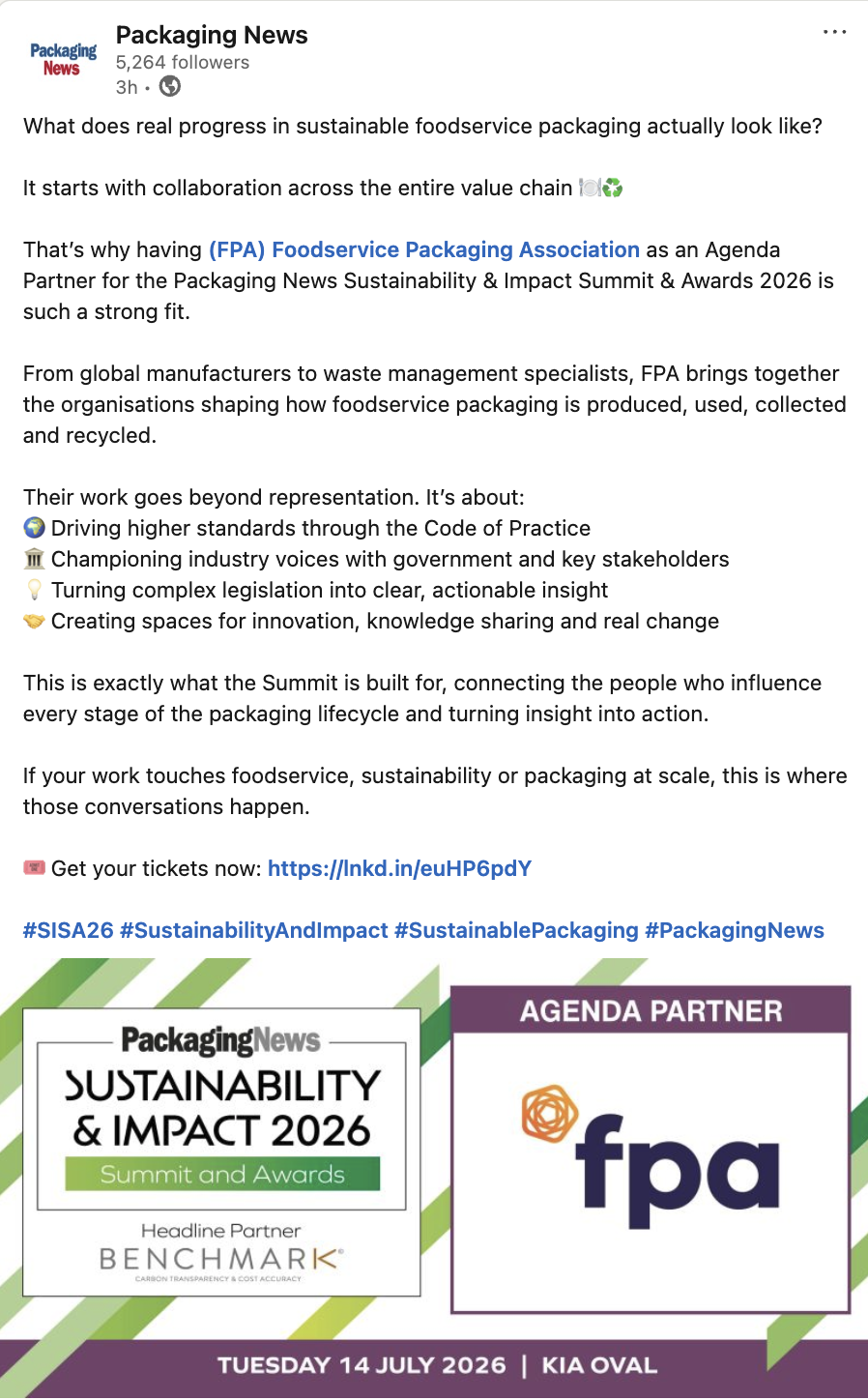
Click on the image above to access and / or comment on this post
Do you know a business that should join the FPA?
The Foodservice Packaging Association represents the interests of its members at all levels and works hard to ensure its members are better represented, better informed and better connected.
FPA members receive early sight of this Digest on Thursday evenings, prior to distribution each Friday morning, and can view an archive of previous Digests within their FPA Dashboards or via this link