FPA Friday Digest – 16 January 2026
Introduction by FPA executive chair Mike Revell
As many of you will know, I often liken EPR to the 'Wild West' where chaos ensues and the law typically arrives after the settlers. With EPR, it feels as if businesses are being asked to navigate unchartered territory, without a proper map, a compass, or agreement on where the borders actually lie. Policy ambition is riding a fast horse, but the systems needed to deliver EPR are still moving at wagon speed.
This week we feature yet another hiccup in the system, which, coupled with conversations I have been having with the Alliance of Foodservice Packaging Manufacturers, has triggered the FPA to undertake a major piece of research, and our findings to date are deeply worrying.
We are hopeful our investigations will be concluded in the next week or so, following which we will be writing to Defra, PackUK, and others to outline our concerns.
Watch this space ...
EPR payment enforcement emails add to the
growing list of system issues
"Our sector is not against EPR, but the current system is flawed. These ongoing issues can no longer be described as teething problems and are undermining industry confidence".
FPA members are reporting fresh operational concerns about the EPR regime, this time relating to how Notice of Liability (NoL) instalment payments are being handled.
The statutory NoL explicitly permits producers to pay their total liability in four quarterly instalments and allows payment by bank transfer, card, standing order, or Direct Debit. It does not state that instalments must be paid by Direct Debit, nor that a separate payment plan must be formally agreed where manual instalments are used.
However, some producers report receiving enforcement-style communication (which PackUK describes as an "automated chaser email") indicating that sanctions may apply unless businesses either set up a recurring direct debit or formally agree a separate payment plan with PackUK. This is despite those producers having already paid their first instalment on time, using an approved method, and in line with the schedule on the NoL.
This appears to impose additional administrative conditions that are not set out in the statutory notice itself, raising concerns about transparency, legal certainty, and proportionality.
The issue comes against the backdrop of a series of operational challenges since the system went live, including portal access problems, data submission difficulties, invoice anomalies, and the widely reported December direct debit failures, when some producers were charged multiple times in error. For many businesses, this caused severe cashflow disruption and distress.
PackUK has confirmed all producers receiving the chaser email will shortly be receiving further clarification and advises that its team is working to provide additional guidance on how to set up a payment plan.
In the meantime, affected producers are encouraged to contact the PackUK customer support team to set up their payment plan, on 0300 060 0002 or via email to eprcustomerservice@defra.gov.uk
PackUK: Advisory Group members and committee chairs confirmed
"The FPA welcomes the confirmation of PackUK’s Advisory Group members and committee chairs. We hope the industry knowledge and expertise represented will play a meaningful role in shaping a fairer, more transparent EPR system which works in practice as well as in principle”.
PackUK has confirmed the membership of its Scheme Administrator Steering Group, completing the appointment of its key Advisory Groups. Alongside the appointed committee chairs the group will help steer the delivery and oversight of EPR. The four groups – the Scheme Administrator Steering Group; the Recyclability Assessment Methodology Technical Advisory Committee, the Efficiency and Effectiveness Technical Advisory Committee; and the Communications and Behaviour Change Advisory Group – will play a key role in advising on governance, fee setting, scheme operation, and the practical implementation of EPR across the supply chain.
The confirmation of advisory members and committee leadership provides greater clarity on how industry expertise will feed into decision-making, scrutiny, and system development.
The full list of Advisory Group members and committee chairs can be accessed here
EU launches an SUPD evaluation and public consultation
“The SUPD has moved the industry toward alternative materials and reuse models, but ongoing evaluation is crucial to ensure the Directive delivers real benefits without creating unintended barriers for foodservice businesses. This EU consultation marks an important moment and we urge impacted foodservice packaging stakeholders to contribute evidence to help shape a Directive that works for both sustainability and business viability”.
On 23 December 2025, the European Commission launched a major public consultation and call for evidence to evaluate the Single-Use Plastics Directive (SUPD).
The EU law continues to phase out and restrict a range of single-use plastic items, including cups, cutlery, plates, straws, stirrers and polystyrene containers. Member States have already implemented bans and restrictions on these products, and the current consultation will test whether new tools or expanded scopes are needed to push further reductions or improve compliance with targets such as recycled content in PET bottles and separate collection rates.
The consultation will run until 17 March 2026 and is aimed at assessing how effective the SUPD has been in reducing environmental and health impacts, as well as promoting innovation and the circular economy. The results will support a comprehensive evaluation, due by mid-2027, and could inform future revisions of the Directive’s scope or measures.
EU circular economy package and plastics recycling support measures
“Regulation can only succeed if recycling systems are fit for purpose. Strengthening Europe’s circular infrastructure is essential to support both compliance and genuine environmental progress”.
In late December 2025, the European Commission also unveiled a package of measures to strengthen the circular economy and plastic recycling sector.
Although not yet law, this initiative aims to pilot actions that improve recyclate quality and circulation, support recycling infrastructure, and reduce reliance on virgin plastics.
These measures will influence the availability, cost, and performance of recycled materials used in foodservice packaging. Alignment between regulatory ambition and recycling capability will be critical to ensure compliance remains achievable.
Survey indicates strong consumer support for compostable packaging
"Policymakers need to take a balanced, evidence-based approach which recognises the role of compostable packaging alongside reuse and recycling, rather than applying one-size-fits-all solutions in response to a perceived consumer demand that is unlikely to translate into practice".
New survey findings indicate that 74% of UK adults believe the government should encourage the use of compostable packaging as part of its approach to tackling packaging waste and environmental impacts. The results suggest growing public awareness of packaging sustainability issues and increasing support for policy measures that enable alternative materials where appropriate.
A separate report published in October 2025 forecasted that the compostable plastic packaging market is forecast to grow at 12% annually over the next 10 years, attributing this to increased consumer demand for sustainable packaging solutions in addition to environmental concerns and government regulations.
Compostable materials already play a role in specific applications, particularly where food contamination limits recyclability. However, most packaging labelled 'biodegradable' provides no clear timeframe, breakdown conditions or testing standard. Research by Which? and WRAP consistently shows that around nine in ten products using the term fail to explain how or where degradation occurs. While consumers often assume 'biodegradable' means a product will break down anywhere, testing shows many materials only degrade under specific industrial composting conditions.
Government advisers have therefore raised the prospect of restricting or banning vague biodegradability claims unless they are supported by recognised certification, such as EN 13432, EN 17033, BS EN 14995 or TÜV Austria OK Compost. This would require packaging to state clearly whether it is home-compostable, industrial-compostable, or not compostable at all.
Dr Alan Campbell taking questions at the FPA stand
during Packaging Innovations & Empack
Back by popular demand, Dr Alan Campbell, director of The LCA Centre and expert on all things policy focused, will once again be making himself available during th event to provide practical guidance to FPA members and our guests during Packaging Innovations & Empack in February.
Dr Campbell will be offering pre-booked one-to-one appointments with FPA members, as well as attending the FPA stand (H70 within the Foodservice Packaging Zone) at designated times to answer informal 'walk-on' questions.
Some of the topics Dr Campbell will be able to advise on include:
- EU legislation and regulation affecting packaging and foodservice.
- Life cycle assessment (LCA) and environmental footprinting.
- Sustainability and environmental claims compliance.
- Evidence requirements, data challenges, and regulatory interpretation.
Please use this link to attend the event as an FPA guest and email Lisa to book a slot with Dr Campbell.
FPA 2026 Awards: Judges meeting to review PI award entries
The judges for the 2026 FPA Product Innovation Awards – front of house and back of house – will be meeting up in London on 21 January to review each of the entries.
This year the judging panel will be jointly chaired by Mike Revell, executive chair of the FPA and Martin Kersh, joint CEO of the Packaging Federation.
Huge thanks to the following industry experts who are giving up their valuable time to participate:
Laura Fernandez – Ocado.
Nikki Grainge – Marks & Spencer.
Helen McFarlane – McDonald’s Restaurants.
Kate Nicholls, UKHospitality.
Simon Oxley – Pret a Manger.
Waqas Qureshi – Packaging News.
Thanks also to Bidfood for sponsoring these categories once again this year.
FPA in the news
Packaging News: Packaging in 2026 – we need a fairer implementation of EPR. Read more here
Packaging News: New Year's evolution – packaging experts look ahead to 2026. Read more here
Label & Narrow Web: UK packaging industry experts look ahead to 2026. Read more here
WhatTheyThink: New Year's evolution – packaging experts look ahead to 2026. Read more here
Process and Control Today: New Year's evolution – packaging experts look ahead to 2026. Read more here
Packaging News: 2026 – the price of circularity? Read more here
Packaging Insights: UK pEPR – industry reacts to stricter PackUK Year 2 Illustrative Fees. Read more here
Essential reading
The Grocer: EPR tax wiping out takeaway packaging suppliers, claim firms. Read more here
The Caterer: UKHospitality warns of 2,076 closures in 2026. Read more here
Label Service: Biodegradable packaging under scrutiny as UK and EU prepare for tougher Green Claims rules. Read more here
Packaging Gateway: Packaging standards tighten EU-wide from 2026. Read more here
PET planet: European Commission: new package of measures to boost circular economy and strengthen plastics recycling. Read more here
Circular: 20,000 tonne Oxfordshire waste dump clearance to 'begin in February'. Read more here
Restaurant: Does there need to be a rethink in how the hospitality sector lobbies the government? Read more here
The Grocer: Consumers losing patience with shrinkflation, research finds. Read more here
The Caterer: From festive cheer to January fear – can hospitality survive the winter? Read more here
Quote of the week and post of the week
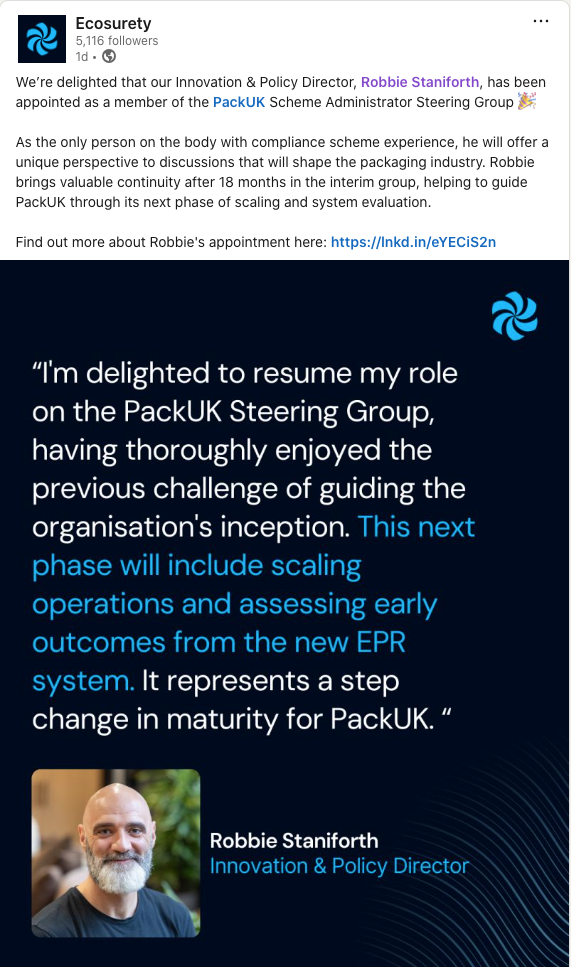
The Alliance of Foodservice Suppliers, which represents six companies supplying unfilled packaging to the ethnic foodservice sector, commenting in The Grocer on how businesses are being taken over by small producers or importers under the £2m-turnover EPR threshold:
“This is costing legitimate UK-based manufacturers and importers millions in lost sales. Worse still, those involved in this trade as so emboldened by the lack of enforcement that they are also failing to pay other taxes including plastic packaging tax and VAT. This has encouraged a wave of illegal activity”.
Join the FPA
The Foodservice Packaging Association represents the interests of its members at all levels and works hard to ensure its members are better represented, better informed and better connected.
FPA members receive early sight of this Digest at 6:15 a.m. each Friday morning.
Interested in joining the FPA?