The FPA Friday Digest
17 April 2026
Regular readers of the FPA Friday Digest will know that over recent weeks, the association has set out clear evidence that the current Packaging EPR system is creating unintended consequences for compliant UK businesses.
Our analysis highlighted a growing structural issue: a system that relies on self-registration and threshold exclusions, but where there is currently no reliable way to verify the full producer population. The result is a widening gap between those businesses that are visible, compliant and contributing – and those that are not readily visible within the system.
This is not about wrongdoing. It's about system design creating uneven outcomes, with the risk that compliant businesses, including many of our members, carry a disproportionate share of the cost burden.
We are now moving into the next phase of engagement.
Alongside our discussions with Defra, PackUK and regulators, it is essential that MPs understand the potential impact on businesses and jobs within their own constituencies.
MPs respond most strongly to issues that affect local employers. We are therefore asking members to take a simple but important step:
Please write to your local MP to raise this issue.
You don't need to be an expert in EPR policy – we have created a briefing note to outline the issue and why it’s important. What matters most is explaining, in practical terms, how this may affect your business, your competitiveness, and your ability to invest and employ locally.
To support you, below are links to the following documents:
- A list of constituencies where packaging employers are already known to be affected.
- A guide outlining how to go about contacting your MP.
- A short MP briefing note.
- A template letter you can use.
If you opt to write your own communication, we recommend focusing on:
- The risk of compliant businesses being placed at a competitive disadvantage.
- The lack of visibility and verifiability within the system.
- The potential impact on jobs, investment and local supply chains.
The FPA is asking MPs to support practical, proportionate steps, including:
- Independent verification of the EPR producer population.
- Buyer-facing tools to check compliance.
- A review of how thresholds are operating in practice.
- Greater transparency around enforcement and system coverage.
This is not about opposing EPR. The FPA and its members fully support the policy objectives. It is about ensuring the system is fair, enforceable, and economically sustainable.
Your voice as a local employer is far more powerful than any centralised representation we can make alone.
If you do contact your MP, I would be grateful if you could copy me in or let me know, so we can coordinate follow-up engagement.
Thank you for your continued support.
MP engagement highlights growing focus on EPR fairness and implementation
Recent local coverage has highlighted increasing political engagement with industry concerns around the implementation of the pEPR scheme.
Following a visit to Alexir Partnership in Kent, Tom Tugendhat MP met with Dick Searle and Martin Kersh from the Packaging Federation to discuss how the system is operating in practice.
The discussion centred on whether aspects of the current design are placing greater cost pressure on compliant UK businesses, and what this could mean for competitiveness, investment and wider supply chains. Concerns were also raised about how fee structures may be influencing material decisions in ways that do not always align with intended environmental outcomes.
This growing political interest is also being reflected at a national level. Recent parliamentary questions to Defra have sought clarification on the rollout and impact of pEPR, underlining the level of scrutiny now being applied as the scheme moves into operation.
From an industry perspective, there remains strong support for the objectives of EPR. However, there is a growing emphasis on ensuring the system is workable in practice, reflects how supply chains operate, and does not unintentionally disadvantage responsible producers.
The conversation also touched on broader implementation challenges, including how imports are treated, how thresholds interact with system fairness, and the importance of effective enforcement.
FPA comment: “As EPR moves from policy into practice, the focus must now be on how the system actually operates in the real world – and whether it is delivering fair outcomes for the businesses funding it. That is why it is so important that more MPs understand what this means for employers in their own constituencies. The more voices we have raising this locally, the stronger the case for ensuring the system works as intended – both environmentally and economically.”
Government signals no timeline on further EPR exemptions
Government has confirmed there is currently no set timetable for consulting on or introducing additional exemption criteria under the pEPR scheme.
In response to a parliamentary question from Sarah Dyke, Defra minister Mary Creagh stated that work is ongoing with stakeholders on the treatment of dual-use packaging and items unlikely to enter the household waste stream. However, no date has been set for either consultation or legislation on further exemptions.
The response suggests a cautious approach, with government emphasising that any changes must be “workable, enforceable, and protect the operational integrity of the scheme”.
For industry, the lack of a clear timeline is likely to reinforce existing uncertainty around scope and obligations, particularly for businesses dealing with packaging that sits across household and non-household use. It also underlines a broader theme emerging across EPR: that key design questions remain under active consideration, even as the system moves into live operation.
FPA comment: “Clarity on scope is fundamental to ensuring the system operates fairly. Where boundaries remain uncertain, there is a risk that costs are not distributed as intended, with compliant businesses carrying a disproportionate share. Getting this right is essential to maintaining confidence in the system as it evolves”.
Industry calls for an extension to PRN reform consultation
This week’s Circular Economy Joint Stakeholder Engagement Forum offered a broad update on the government’s packaging reform agenda, but it is the launch of a tightly timed consultation on Packaging Waste Recycling Note (PRN) reform that has quickly become the focal point for industry concern.
Defra officials confirmed that proposals to reform the PRN system are now live, with a consultation window running for just six weeks and closing on 5 May 2026. The PRN system, which underpins packaging waste recycling evidence, is a critical component of the wider pEPR framework. Any reforms therefore carry significant implications for cost allocation, market stability and investment signals across the sector.
However, the short duration of the consultation has prompted an immediate response from industry bodies. The Packaging Federation has confirmed it will write to Defra requesting an extension, arguing that the scale and complexity of the proposed changes require fuller scrutiny and meaningful engagement and the FPA will be adding its voice too.
Alongside the consultation, officials provided an update on the continued rollout of pEPR infrastructure and governance, a key milestone being the formal appointment of the UK Packaging Producer Responsibility Organisation (PRO), which commenced its role on 1 April. The PRO will take on an increasing share of operational delivery, working alongside PackUK, which will retain overall oversight and accountability to the four UK governments. The shift towards an industry-led delivery model is intended to harness producer expertise while maintaining regulatory control at a national level.
PackUK itself is progressing a number of core workstreams, including development of its five-year strategy (expected in Autumn 2026), preparation for updated fees and Notices of Liability, and further modelling for years three and four of the scheme. Work is also ongoing on RAM 2027, with publication anticipated in July.
On collections reform, Defra highlighted continued progress on Simpler Recycling in England, with a particular focus on reducing food waste and improving capture of recyclable materials.
Notably, a new workplace interventions pilot targeting micro-firms is due to launch this year. Delivered with support from Eunomia, the pilot will test scalable approaches to raising awareness and supporting compliance ahead of the March 2027 implementation deadline. Industry stakeholders are being encouraged to participate.
The Forum also referenced the recently published Waste Crime Action Plan, which sets out a three-pronged approach focused on prevention, enforcement and remediation. The plan signals a renewed emphasis on tackling illegal waste activity, an issue closely linked to concerns about compliance integrity within the wider packaging system.
Separately, the Environment Agency confirmed updates to guidance for accredited reprocessors and exporters, particularly in relation to recording and reporting obligations under the current regulations.
Defra reiterated its intention to work collaboratively with industry, highlighting ongoing opportunities to shape policy through forums, pilots and consultations. A full schedule of stakeholder engagement meetings has been set out for the remainder of 2026.
FPA comment: “This collaborative messaging from Defra is at odds with a six-week consultation on PRN reform and has not gone unnoticed. For many, it reinforces broader concerns about the pace of implementation and the need to ensure that key design elements of the system are subject to robust, evidence-based scrutiny. With the consultation deadline fast approaching, attention will now turn to whether DEFRA responds to calls for more time, and how far industry voices are actually reflected in the next phase of reform”.
UK Packaging PRO Joins EXPRA
The newly established packaging Producer Responsibility Organisation (PRO) has joined EXPRA, the European alliance of packaging recovery organisations, marking an important step in its development as the UK’s pEPR system moves into its operational phase.
EXPRA represents a network of PROs from across Europe, providing a platform for sharing best practice, technical expertise and policy insight on the implementation of Extended Producer Responsibility systems. Membership is typically seen as a signal of alignment with established EPR principles and a commitment to transparent, efficient scheme delivery.
For the UK PRO, joining EXPRA offers access to operational knowledge from more mature EPR systems, which could prove valuable as it begins to take on responsibility for managing producer payments and funding flows within the UK’s packaging system.
The move comes at a critical time for the UK’s pEPR rollout, with industry continuing to raise concerns around data accuracy, cost allocation and overall scheme design. Greater engagement with European counterparts may help inform the UK approach, particularly in areas such as governance, reporting frameworks and performance monitoring.
However, it also raises expectations. Many European systems represented within EXPRA have evolved over a number of years and are often cited as benchmarks for efficiency and transparency. UK stakeholders will be watching closely to see how quickly those standards can be reflected in the domestic system.
FPA comment: “As the transition from policy design to delivery gathers pace, the PRO’s involvement in international networks such as EXPRA underlines both the opportunity – and the pressure – to establish a system that is credible, consistent and fair for producers”.
WRAP steps up push on household recycling behaviour
WRAP has launched a new national TV campaign aimed at tackling a persistent weak point in the UK’s recycling system – the volume of recyclable packaging still being thrown away in household waste.
Airing across Sky channels from this week, the campaign focuses on simplifying recycling for consumers and reducing confusion over what can and cannot be recycled.
Despite ongoing policy reform, significant quantities of paper, plastic and metal packaging continue to be lost from the system each week, limiting material recovery and undermining overall performance.
The timing is notable. As pEPR shifts greater financial responsibility onto producers, outcomes will increasingly depend on what happens at the household level. Higher capture rates and better-quality recycling streams are essential if the system is to deliver on both environmental targets and cost efficiency.
FPA comment: “The message is a familiar one, but increasingly urgent: system design alone is not enough. Without consistent public participation, even the most well-structured recycling framework will fall short”.
Plastics industry calls for packaging tax revenues to be ringfenced
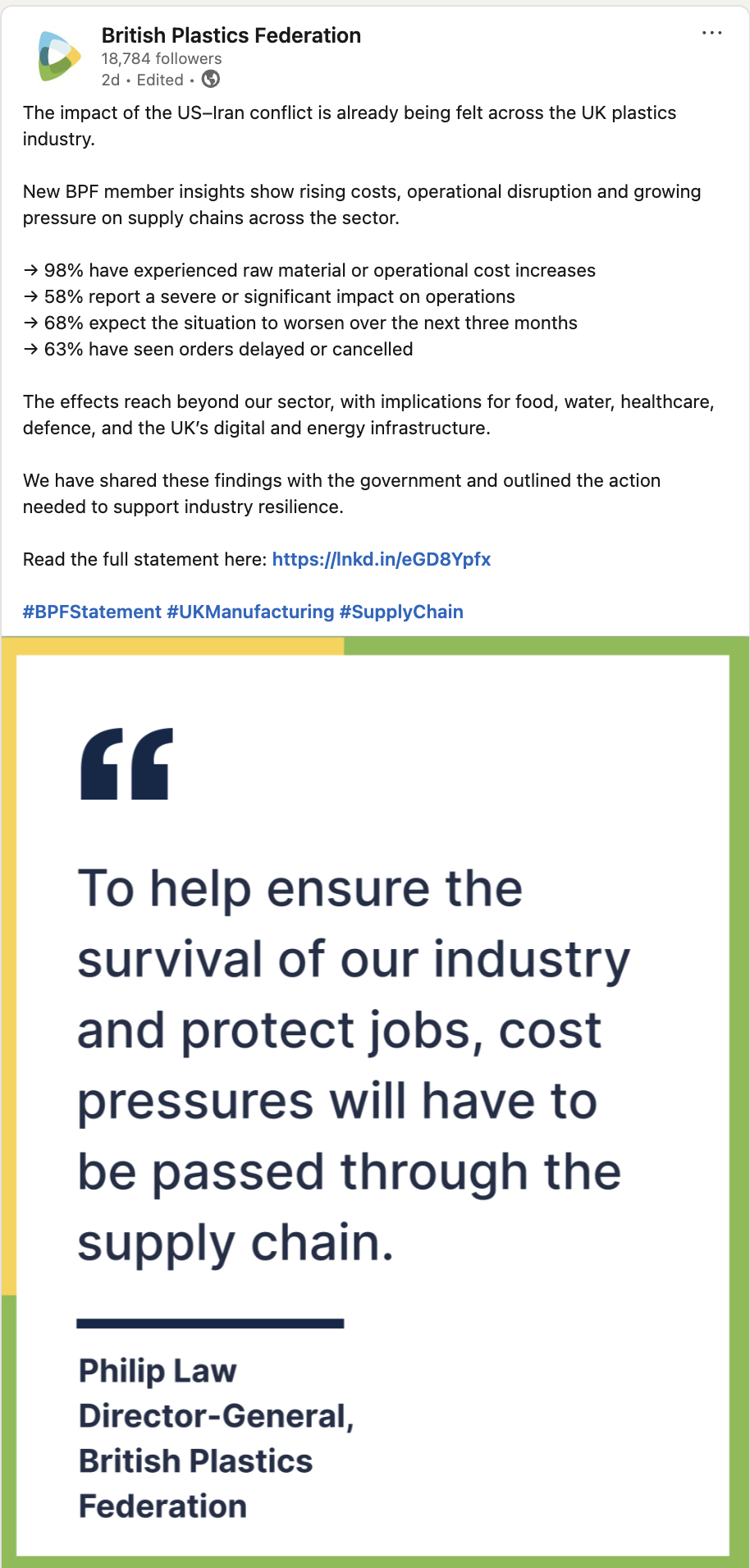
In last week's Digest we reported on the mounting Middle East situation affecting the plastics sector. This week, as geopolitical disruption adds fresh pressure to an already strained system, the UK plastics industry is urging government to ringfence revenues from the Plastics Packaging Tax (PPT). Latest reports suggest that a US-led blockade of Iranian ports is now beginning to disrupt shipping routes, with UK businesses bracing for further pressure in the weeks ahead.
According to the British Plastics Federation (BPF), the ongoing conflict in the Middle East has created ‘unprecedented’ disruption across the sector, with widespread raw material shortages, rising energy costs and supply chain instability now affecting the majority of businesses.
In response, the industry is calling on government to ensure that PPT revenues are reinvested directly into UK recycling infrastructure, rather than absorbed into general Treasury funds. The argument is a familiar one, but the context has shifted – with global supply chains under strain, the need for domestic material resilience has moved sharply up the agenda.
The case is being framed not just in environmental terms, but as a matter of economic and strategic importance. The UK remains heavily reliant on imported polymer feedstocks, leaving it exposed to external shocks. Strengthening domestic recycling capacity is therefore seen as a way to improve both circularity and supply security.
The intervention also taps into a broader theme emerging across packaging policy – that revenue-raising mechanisms must be clearly linked to outcomes. Without that connection, there is a growing risk that trust in the system begins to erode at a time when significant financial and operational demands are already being placed on compliant businesses.
FPA comment: “What this underlines is how exposed the UK remains to external shocks, and why building a resilient domestic system is so important. If producers are being asked to fund that system through taxation and EPR, there must be confidence that those funds are being used to deliver the infrastructure needed to reduce that exposure. This is not just an environmental issue – it’s about economic stability and ensuring that compliant businesses are not left carrying disproportionate risk in an increasingly volatile global market”.
Welsh Government rejects Exchange for Change as DRS administrator
The Welsh Government has rejected a proposal from industry group Exchange for Change to act as administrator for its Deposit Return Scheme (DRS), underlining a continued preference for tighter public oversight of scheme delivery.
Exchange for Change, backed by major retailers and waste management firms, had put forward an industry-led model for scheme operation. However, Welsh ministers have opted not to proceed, instead confirming that the process to appoint a scheme administrator will now be revisited.
The decision introduces a clear risk of delay to DRS implementation in Wales. Industry groups, including retail representatives, have raised concerns that continued uncertainty over governance could undermine business readiness, particularly for those already investing time and resource into preparing for rollout.
While details on Wales’ preferred model remain limited, the move reflects a broader tension seen across packaging policy: balancing the efficiencies and expertise offered by industry-led delivery with the need for government oversight and accountability.
The development also comes against the backdrop of ongoing efforts to align DRS approaches across the UK, including interoperability requirements and differing policy choices such as Wales’ inclusion of glass.
Taken together, the episode highlights that, despite progress on policy direction, fundamental questions around governance, timing and delivery remain unresolved, and will be critical to how effectively DRS is ultimately implemented.
FPA comment: ”The rejection of Exchange for Change highlights the ongoing uncertainty around DRS governance, even as timelines begin to firm up. It also reinforces a broader theme seen across packaging policy: the challenge of aligning industry capability with government control in the design and delivery of complex environmental systems. With implementation still some way off, the focus will now turn to how Wales structures scheme administration – and whether a UK-wide approach to governance can ultimately be achieved”.
Dozens of councils granted long exemptions from recycling reforms
Up to 79 councils in England are set to be exempt from new recycling requirements for more than a decade, with some transitional arrangements extending as far as 2043.
The exemptions relate to the rollout of Simpler Recycling reforms, which aim to standardise collections and improve material capture across England. However, long-term waste contracts and existing infrastructure constraints mean some local authorities will not be required to align with the new system for many years.
While transitional flexibility has always been part of the policy design, the scale and duration of these exemptions have raised concerns about consistency. A core objective of Simpler Recycling is to reduce confusion for households by creating a more uniform system – something that could be undermined if collection approaches continue to vary significantly across the country.
FPA comment: “The development also has implications for packaging. As pEPR places increasing emphasis on performance and cost efficiency, uneven collection arrangements risk creating variability in material quality and availability, as well as ongoing complexity for consumers. In practice, this reinforces a familiar challenge – delivering national reform through locally delivered services. Without greater alignment, there is a risk that progress on recycling rates and system clarity will be slower, and less consistent, than policymakers intended”.
Public backs stronger government action on aluminium recycling
New polling suggests strong public support for greater government action to boost aluminium recycling in the UK, adding further pressure for investment in domestic reprocessing capacity.
The research indicates that a clear majority of consumers expect more to be done to ensure valuable materials like aluminium are captured and recycled effectively, rather than lost to waste. With aluminium seen as one of the most recyclable materials in the system, the findings highlight a perceived gap between potential and current performance.
For policymakers, the results reinforce the importance of aligning infrastructure and policy with public expectations. As pEPR and DRS progress, improving capture rates and strengthening end markets will be critical to delivering both environmental outcomes and system credibility.
FPA comment: “High-value materials like aluminium represent a significant opportunity, but only if the system is capable of consistently recovering them at scale”.
Defra seeks industry expertise to support circular economy reforms
Defra is inviting industry professionals to play a direct role in shaping the UK’s transition to a circular economy, through a new round of secondments and advisory roles within its Circular Economy Directorate.
The programme brings together industry, government and academic expertise to support the design and delivery of key reforms, including packaging regulation, waste crime, digital tracking and food waste reduction. Previous secondees have helped ensure that policies are more practical and scalable in real-world conditions.
A range of flexible opportunities are available, from short-term advisory roles to longer secondments. On Monday 20 April interested parties are invited to join a 30-minute webinar giving an overview of the opportunities available. The webinar will be followed by a short Q&A, with optional 10-20 minute drop-in sessions throughout the day.
Expressions of interest are open until 30 April 2026. Follow this link for further information and details of how to apply.
FPA comment: “The FPA strongly supports Defra’s collaborative approach and the recognition that industry expertise is essential to making these systems work in practice. However, meaningful engagement requires realistic timelines. Secondments and resource commitments of this nature take time to arrange, and if government is serious about collaboration,
NEWS FROM EUROPE
EU signals next phase of packaging reform under Circular Economy Act
The European Commission is preparing the next phase of its circular economy agenda, with packaging expected to play a central role in a broader 'Circular Economy Act' aimed at strengthening resource efficiency across the bloc.
Early indications suggest the initiative will build on existing measures such as the Packaging and Packaging Waste Regulation (PPWR), with a greater focus on recyclability, material use and system-wide performance. The move reflects a continued push towards more standardised and ambitious requirements across EU markets.
For businesses, the direction of travel is becoming increasingly clear: packaging will sit within a wider framework of circular economy obligations, with tighter expectations on design, data and material recovery.
For UK exporters, this adds another layer of complexity. Companies placing packaging on the EU market will need to navigate both domestic reforms and evolving EU requirements, reinforcing the need for consistent, scalable approaches across multiple jurisdictions.
FPA comment: “As with other recent developments, the key challenge will be delivery. Ambition is increasing, but questions remain around how quickly systems can adapt, and whether infrastructure and supply chains can keep pace with regulatory change”.
INTERNATIONAL STORIES
California’s $5bn plastic fund signals shift beyond traditional EPR
Policymakers in California are considering the creation of a $5 billion plastic pollution fund, marking a notable departure from more traditional approaches to producer responsibility.
The proposal, currently under negotiation, would see major producers contribute to a central fund aimed at addressing the environmental and societal impacts of plastic waste. Unlike conventional Extended Producer Responsibility (EPR) systems – which are typically designed to cover the operational costs of collection, sorting and recycling – the California model appears to extend further, incorporating broader environmental remediation and community investment.
This has raised concerns among industry stakeholders about proportionality, governance and the basis on which contributions would be calculated. The potential use of settlements or quasi-penalty style funding mechanisms also points to a shift towards a more expansive, and arguably more punitive, interpretation of producer responsibility.
FPA comment: “As discussions continue, the proposal will be closely watched for the precedent it could set – not only in the US, but in shaping the global direction of travel for producer responsibility frameworks”.
US steps up efforts to align packaging rules
Moves are underway in the US to bring greater consistency to packaging regulation, as policymakers look to address a fragmented landscape of state-level requirements.
Recent developments point to a growing focus on improving recyclability standards, labelling clarity and producer responsibility frameworks, reflecting similar policy trends seen in the UK and EU. However, progress remains uneven, with differences between states continuing to present challenges for businesses operating nationally.
FPA comment: “Packaging requirements are tightening across multiple markets, adding complexity but also reinforcing the need for more consistent, scalable solutions”.
EXTERNAL EVENTS
Upcoming BPF events
The British Plastics Federation has announced its spring events programme.
Please follow the individual links for booking information. The PRAS event on 09 July is free to attend. FPA members can claim a 20% discount by using the code FPA2026 at checkout for the other four events.
13 May 2016: The Challenges of Incorporating Recycled Content into Plastics Packaging (online event)
19 May 2026: Plastics in Construction (online event)
21 May 2026: Achieving Net Zero
10 June 2026: REACH and the Plastics Industry
09 July 2026: PRAS (Plastics Recycling and Sustainability)
Stakeholder Engagement Forums – April to July dates
Dates and links to the next tranche of Circular Economy Stakeholder Forum meetings. No registration is required, the Microsoft Teams link accompanying each forum will provide direct access to that meeting.
Defra recommends individuals wishing to attend save each link to their calendars. No reminders will be sent.
May Forum – Tuesday 5 May 14:30 to 16:00 Link to access forum
June Forum – Tuesday 2 June: 14:30 to 16:00 Link to access forum
July Forum – Tuesday 7 July: 14:30 to 16:00 Link to access forum
FPA NEWS
FPA Board changes
The FPA is pleased to announce the appointment of Mark Durston of Novolex to the FPA Board, replacing Paul Smith who stepped down recently.
Mark brings a wealth of industry experience and a strong track record of contribution to the association, having served as chair of the FPA’s Membership Committee for several years. In that role, he has played a key part in supporting member growth, strengthening engagement and ensuring the association continues to reflect the needs of a diverse and evolving membership base.
At Novolex, Mark holds a senior leadership position within one of the sector’s leading global packaging manufacturers, with extensive experience across foodservice packaging, customer partnerships and commercial strategy. His insight into both UK and international markets will be a valuable addition to the FPA Board as the industry navigates a period of significant regulatory and structural change.
Commenting on the appointment, FPA executive chair Mike Revell said:
“Mark has been a highly engaged and constructive voice within the Association for a number of years, particularly through his leadership of the Membership Committee. He brings a strong understanding of both our members and the wider market, and I am delighted to welcome him to the FPA Board. I would also like to thank Paul Smith for his contribution and support during his time on the FPA Board”.
FPA Annual Golf & Activities Day
Thursday 11 June
FPA members, colleagues and customers are invited to join us on Thursday 11 June for the FPA’s ever-popular Annual Golf and Activities Day – this year taking place at the stunning Breadsall Priory Country Club, near Derby.
Choose between an 18-hole Golf Day or a lively ‘Quintessentially English’ Activities Day, featuring everything from axe-throwing and welly wanging to croquet, tug-of-war and even duck herding!
Whether you come as a team or join others on the day, it’s a fantastic opportunity to connect with colleagues, customers and industry peers within a relaxed setting.
The day concludes with an evening barbecue, rounding off a great day of activity and networking.
Places are limited, so early booking is recommended. FPA members should check their inboxes for booking details and sponsorship opportunities.
Essential reading
Packaging Europe: 'The EU Commission's PPWR guidance leaves the hard questions unanswered. Read more here
letsrecycle.com: DRS tendering process launched with companies given two-weeks to submit bids. Read more here
Packaging News: Valpak launches global EPR platform. Read more here
letsrecycle.com: Six-month clean-up starts at Kidlington waste dump. Read more here
European Commission: Single-use plastics – 10 countries ahead of schedule on collection targets. Read more here
Packaging Insights: British Glass urges pause on pEPR over glass packaging penalties. Read more here
Packaging Digest: How AI is simplifying EPR compliance. Read more here
Packaging Gateway: Portugal starts return scheme for plastic and metal drink containers. Read more here
Packaging Digest: Greenwashing allegations 'recycled' in suit against retailers. Read more here
Plastics Today: Resin price report – buyers facing a compounding problem that a reactive posture cannot solve. Read more here
MRW: CLA registers a cow as an upper tier waste carrier to highlight the need for reform. Read more here
edie: Electricity bills relief expanded to 10,000 UK manufacturers. Read more here
Quickserve Magazine: Deliveroo celebrates 2bn orders and reveals top order trends. Read more here
Quote of the week and post of the week
Karen Graley, head of the UK Packaging PRO speaking about joining EXPRA:
“This is an important move for us. After years of debate on how to implement EPR effectively in the UK, we now have a system designed to be transparent, efficient, and producer-led. Through EXPRA, we will exchange knowledge, share best practices, and learn from international experience to ensure that UK EPR operates closer to the genuine non-profit model proven across Europe”.
Follow this link to view and/or comment on the LinkedIn post on the right
Join the FPA
The Foodservice Packaging Association represents the interests of its members at all levels and works hard to ensure its members are better represented, better informed and better connected.
FPA members receive early sight of this Digest at 6:15 a.m. each Friday morning.
Interested in joining the FPA?