The FPA Friday Digest
20 February 2026
EPR – a broken system?
Our research is now complete, and we are on the verge of delivering our open letters to Defra, PackUK and the Environment Agency to alert them to our findings and call for a full review of how the EPR scheme is monitored and enforced.
Recent media coverage has highlighted growing industry concern over what has been described as a potential financial 'black hole' within the EPR system, alongside frustration at the lack of clarity around fee calculations, cost allocation and revenue shortfalls. If reports suggesting that invoices may need to be recalculated due to insufficient funds prove accurate, that only reinforces the urgency of ensuring the full market is properly captured and contributing fairly.
Let’s be clear from the outset. FPA members have no issue with the principle that the producer pays. They believe in doing the right thing. They have registered for EPR, reported their data and are paying their Notices of Liability.
But many of them are now losing business to competitors that appear to be operating below the EPR thresholds and therefore not paying into the system at all.
That creates a very simple problem. If some companies are not in the system, the cost doesn’t disappear, it simply falls on those who are.
More and more, the FPA is hearing first-hand from businesses facing lost contracts, squeezed margins and the real prospect of redundancies. These are responsible companies being undercut while still carrying the full regulatory burden.
We are not accusing individual companies of breaking the law. But the current design of the scheme makes it difficult to see who is genuinely below the threshold and who simply is not visible.
If the full market is not being captured, compliant businesses end up paying more to make up the difference. That is neither sustainable nor equitable.
Trade associations such as ours are now spending significant time and resources identifying cases that appear to fall outside the system. While I am sure the FPA is not alone in being prepared to pass that information to the relevant authorities, it raises a fair question: if industry bodies are effectively helping to police the scheme, will there be any recognition of that effort? Or, at the very least, will compliant firms see relief if they are carrying more than their fair share?
We recognise that environmental policy is not intended to penalise those who follow the rules while effectively rewarding those who do not. Costs should be shared fairly across the entire market, not just the visible part of it.
However, the reality emerging suggests that transparency, enforcement and system integrity now require urgent attention.
We are asking all members: if you have concerns about businesses you believe should be within the scope of EPR but are not registered, or are deliberately not paying their way, please share that information with us in confidence by emailing compliance@foodservicepackaging.org.uk or contacting me directly. We will handle all information responsibly.
While determining compliance may be the regulator’s role, ensuring the system works fairly is in everyone’s best interests. As the trade body for the foodservice packaging industry, we are more than willing to play our part to help secure a genuinely level playing field.
EPR modulated disposal fees confirmed from 2026-27
“As the system moves from flat funding to performance-based charging, the next three years will be critical in determining how effectively modulation drives real packaging redesign without creating unintended market distortion. The principle of rewarding recyclable design is sound, but producers will need predictability and robust methodology to make long-term investment decisions”.
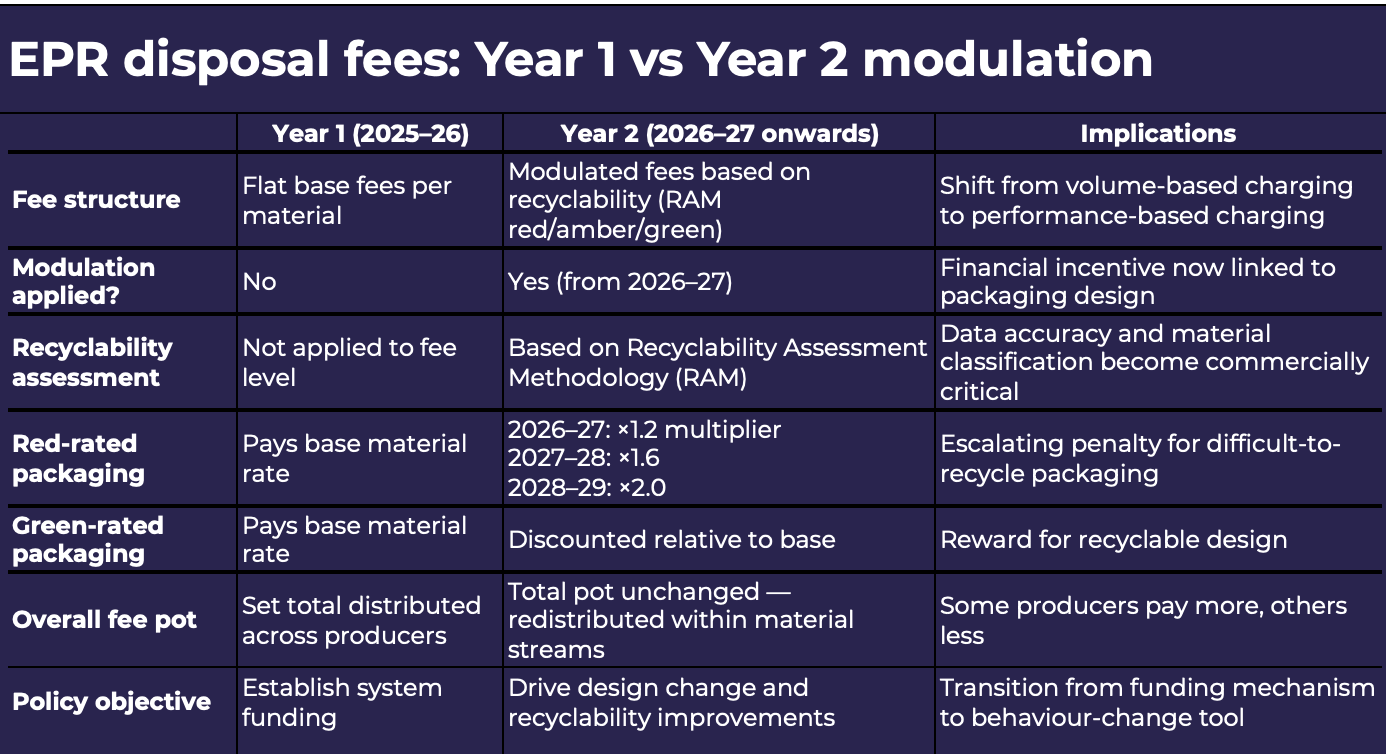
Defra and PackUK have confirmed that modulated household packaging disposal fees under EPR will take effect from 2026-27 (Year 2), marking a significant shift from the flat material-based charging model used in the first year of the scheme.
In Year 1 (2025-26), producers pay base fees per tonne by material, with no adjustment for recyclability. However, from 2026-27 onwards, fees will be modulated using the Recyclability Assessment Methodology (RAM), applying red, amber or green ratings to packaging formats.
Under the confirmed structure:
- Red-rated packaging will face escalating multipliers:
×1.2 (2026-27), ×1.6 (2027-28), ×2.0 (2028-29) - Green-rated packaging will attract discounted fees
- The overall fee pot remains unchanged, but costs will be redistributed within material streams
Industry stakeholders have welcomed early transparency on modulation factors but continue to call for more clarity on the methodology and how local authority costs are allocated by material, given the commercial impact of fee differentials.
The move represents a transition from a system designed primarily to fund local authority waste management to one explicitly intended to influence packaging design decisions.
The impact of modulation will not be uniform across materials.
Plastics are likely to see the greatest financial exposure, given the diversity of formats and prevalence of films, composites and hard-to-recycle flexible packaging. Elements such as labels, pigments, closures and laminates may materially affect a format’s RAM rating.
By contrast, glass generally benefits from established collection and recycling infrastructure, suggesting lower modulation risk in most cases. However, parallel policy developments, including divergence in the Welsh DRS, may create additional complexity for producers.
Fibre-based materials are typically well positioned, though composite structures and plastic linings could shift ratings where recyclability is restricted.
Aluminium and steel packaging, with strong capture rates and established secondary markets, are comparatively less exposed to modulation penalties.
The introduction of modulation means that packaging design, data accuracy and supply chain transparency now carry direct financial consequences. Producers will need to ensure robust internal RAM assessments, align sustainability and procurement strategies, and factor escalating red multipliers into medium-term packaging roadmaps.
The government announcement can be viewed here
Treasury told Defra to budget for 'impossible' full EPR recovery
“Requiring full recovery from year one was always unrealistic. It puts unnecessary strain on both government and industry. What the sector needs now is a total review of EPR, resulting in a realistic system that ensures the delivery of the desired environmental outcomes without more unnecessary market disruption and uncertainty”.
Senior government sources have told The Grocer that Defra include “full recovery” of costs from year one of EPR packaging tax in its budget planning, despite warnings from officials that this was unachievable in practice.
Industry bodies say the demand has put pressure on fee-setting and contributed to uncertainty in how packaging costs are being calculated for businesses under EPR. Linked coverage also highlights ongoing challenges with the system’s cost forecasts and potential impacts on packaging invoices.
Defra and the Environment Agency update guidance on packaging data collection for EPR
On 17 February Defra and the EA updated the official guidance on how to collect packaging data for EPR. The guidance explains what data producers must collect and report to comply with EPR, including packaging activity, material type, class, weight, recyclability, and nation-specific sales and waste information. It also covers key reporting deadlines and requirements for both large and small producers of packaging.
The updated guidance confirms the current information reflects the latest EPR data collection rules and expectations for producers, including how recyclability and nation-of-sale data should be recorded and reported under the system now being implemented by regulators and PackUK.
Key points:
- Organisations must collect and retain detailed packaging data for at least seven years to support calculation of recycling obligations and fees.
- Large producers are required to report comprehensive datasets – including packaging type, activity, material, weight, and recyclability.
- Small producers report a simplified dataset focused on essential material and weight categories.
- The guidance also explains what constitutes being 'established in the UK' for reporting purposes.
- The data collected feeds into obligations for reporting deadlines, fee calculation, and recyclability assessments used by regulators and PackUK.
PRN and PERN digital service on track for 27 February go-live
“Digitising the PRN and PERN system is a critical reform, but reliability is fundamental. Recent access issues underline how important it is that the platform is fully stable before go-live. Confidence in the evidence system depends not just on stronger controls, but on practical usability for producers and reprocessors”.
The new digital service for managing Packaging Recovery Notes (PRNs) and Packaging Export Recovery Notes (PERNs) is reported to be on track to go live from 27 February.
The platform is designed to replace legacy systems with a centralised digital service aimed at improving transparency, data integrity and fraud prevention within the PRN/PERN system, but has been fraught with diffiuclties since its introduction..
The most recent technical difficulties left some producers and compliance scheme members temporarily unable to access the system. Sector reports indicated that users experienced login failures and functionality issues, raising concerns about readiness ahead of the planned transition.
Regulators have acknowledged the disruption and indicated that work has been undertaken to stabilise the platform before full go-live. The move to digitisation is widely viewed as a necessary step in strengthening oversight of recycling evidence flows, particularly amid ongoing scrutiny of PRN market volatility and historic transparency concerns.
Defra has also confirmed that some operators have experienced difficulties accessing the digital service after receiving invitation emails. Users are advised to check spam or junk folders for messages from the Defra report packaging waste mailbox and consult the online account-access guidance. Any unresolved issues should be directed to the pEPR helpdesk.
Alongside the service update, the Environment Agency has published a Regulatory Position Statement (RPS365) covering monthly reporting duties for accredited reprocessors and exporters in England under the Producer Responsibility (Packaging and Packaging Waste) Regulations 2024. The RPS temporarily defers the requirement to submit monthly data on packaging waste received, recycled or exported, and PRNs or PERNs issued, while digital reporting functionality is finalised. Operators must still collect and record data using the official summary log templates, and all other legal obligations under the Packaging Regulations remain in force.
Welsh glass DRS approval triggers industry backlash and commercial warnings
“This decision represents a key moment for DRS across the UK. Environmental ambition must be matched by practical delivery. If interoperability is not watertight, the risk is not just administrative burden but real commercial consequences, including product rationalisation and reduced consumer choice”.
The UK Government has formally granted the Welsh Government an exclusion under the UK Internal Market Act (UKIMA), allowing Wales to include single-use glass bottles within its forthcoming Deposit Return Scheme (DRS). The decision marks a significant divergence from England and Northern Ireland, where glass is not currently included in scope.
Under the agreement, Wales must launch its DRS for plastic and metal drinks containers on 1 October 2027, ensure interoperability with a UK-wide system – including a single registration and reporting platform, reciprocal takeback, consistent logos and a common deposit level – and extend the transitional period for glass until October 2031, during which a 0p deposit will apply and no labelling or targets will be enforced. A joint taskforce involving all four UK governments and relevant Deposit Management Organisations will oversee implementation.
While environmental groups have welcomed the move as consistent with Wales’s recycling ambitions, reaction across the drinks and retail sectors has been notably cautious. Trade bodies have warned that divergence risks creating operational complexity, higher compliance costs and cross-border friction for producers supplying multiple UK markets.
Industry concerns intensified following reports that some suppliers are now reviewing whether to continue supplying certain products into Wales if dual labelling, separate stock management or additional logistics requirements become commercially unviable. Retailers operating near the England–Wales border have also raised concerns about return-point management and potential consumer confusion if schemes are not fully interoperable in practice.
The development comes at a time of heightened regulatory and financial pressure on producers. Recent confirmation of modulated disposal fees under Extended Producer Responsibility (EPR) from 2026-27 will introduce differential charging based on recyclability, increasing cost sensitivity around packaging format choices. Against that backdrop, stakeholders argue that clarity, consistency and UK-wide alignment are essential to avoid unintended market distortion.
For producers, the immediate focus will be on monitoring the interoperability taskforce, assessing labelling and supply chain implications, and factoring potential divergence into 2027-2031 packaging and investment planning.
Whether Wales’s inclusion of glass ultimately strengthens circular outcomes without fragmenting the market will depend heavily on how closely the four nations coordinate in the months ahead.
Consumers back use of recycled plastics in everyday packaging, report finds
New research from Amcor has found strong consumer support for the use of post-consumer recycled (PCR) plastics in everyday packaging, with a clear majority of shoppers saying they favour products containing recycled material over those made from virgin plastic. The findings suggest growing public acceptance of visible recycled content, even where it may slightly alter the appearance or finish of packaging.
The report highlights that sustainability credentials are increasingly influencing purchasing decisions. Industry experts say the results provide further encouragement for manufacturers investing in higher PCR content.
Emma Bourne's replacement announced
Following Emma Bourne’s move to a new role as Director General for EU Reset and Trade after spending three years with Defra in senior circular economy and waste leadership roles, the department has confirmed her replacement.
Becky Shrubsole is set to become Bourne’s permanent successor later in 2026. Shrubsole is described as ‘a seasoned Defra director with a track record of delivery in partnership with business, local authorities and devolved governments’.
Stepping in as interim director is policy and programme leader Simon James, who will join the Circular Economy team from 16 February. James is currently responsible for delivering local air quality improvements through a Government Major Projects programme.
In a message to stakeholders, Defra’s Director General Sally Randall said that both James and Shrubsole are “hugely excited about their new roles” and look forward to working closely with industry and policy partners.
Defra launches Wave 2 Circular Economy secondments
Defra has announced the second wave of fully funded secondment opportunities within its Circular Economy Portfolio, inviting industry and sector specialists to work directly with government on the development and delivery of key reforms supporting England’s transition to a circular economy.
The 12-month posts (with potential extension) are funded by Defra, with secondees remaining employed by their home organisation.
Applications are open only to individuals permanently employed by an organisation with employer approval; applications via limited companies, consultancies or sole trader arrangements will not be considered.
Plastics & Packaging roles
- Plastics & Packaging Waste Regulatory Reform: Local Authority – ID: #S02
- Packaging Technologist Innovation Advisor – ID: #S03
- Industry Expert in Plastics Reduction – ID: #S05
- Regulatory Expert in Plastic Reduction – ID: #S06
- Packaging Recovery Note / Packaging Export Recovery Note Secondee – ID: #S08
Waste & Recycling roles
- Waste Recycling Improvement Expert – ID: #S10
- Software Vendor Secondee (Digital Waste Tracking) – ID: #S13
- Litter, Fly-tipping & Waste Crime: Local Place Lead – ID: #S14
- Waste Crime Enforcement Expert – ID: #S15
- Waste Management Secondee (Shipments & Hazardous Waste) – ID: #S16
Agrifood & Textiles roles
- Agrifood Secondee (Anaerobic Digestion & Composting) – ID: #S22
- Textiles Industry Secondee – ID: #S23
The opportunities sit across priority reform areas including packaging and plastics reform (including pEPR and DRS), recycling system performance, waste crime and Digital Waste Tracking, agrifood infrastructure, and textiles circularity.
For a full job description, candidates should contact the Circular Economy People Team, stating the relevant Role ID number, and the team will email the details directly: CEPeopleteam@defra.gov.uk
Expressions of interest (CV plus supporting statement, clearly referencing the Role ID) must be submitted by 23:55 on Monday 2 March 2026.
NEWS FROM EUROPE
Zero Waste Europe calls for EPR model focused on waste prevention
Environmental network Zero Waste Europe has proposed a shift in Extended Producer Responsibility (EPR) policy to place stronger emphasis on waste reduction and prevention, rather than primarily funding end-of-life waste management.
The organisation is advocating for EPR systems that directly incentivise producers to reduce material use, prioritise reuse models and redesign products to minimise waste generation in the first place. The proposal argues that current EPR frameworks across Europe remain too focused on financing collection and recycling infrastructure, rather than fundamentally reducing resource consumption.
Zero Waste Europe suggests that future EPR schemes should include stronger eco-modulation of fees, binding waste prevention targets, and clearer requirements for reuse and refill systems. The group also highlights the importance of aligning EPR policy with broader EU circular economy and climate objectives.
The proposal comes as many European countries, including the UK, are in the early stages of either implementing or reforming packaging EPR schemes, with increasing attention on fee modulation, recyclability assessment methodologies and system transparency.
EXTERNAL EVENTS
Packaging Innovations & Empack
More than 8,000 visitors attended Packaging Innovations & Empack 2026, organisers Easyfairs have confirmed, with sustainability and regulatory reform dominating discussion across the two-day event.
Sessions focused on EPR, modulated disposal fees and DRS implementation were particularly well attended. One of the most closely watched sessions was the presentation from PackUK on the rollout of packaging EPR.
The update, delivered by Esther Carter of PackUK, prompted a visibly strong reaction from parts of the audience. Attendees raised challenging questions around fee transparency, data accuracy, system readiness and the financial pressures facing producers as modulation begins from 2026-27.
While the session demonstrated clear appetite for engagement and clarification, it also underscored the heightened sensitivity across the sector as reforms move from policy design into operational delivery. Industry frustration over timelines, cost certainty and implementation complexity was evident among exhibitors.
Organisers declared the 2026 show a success, noting strong exhibitor engagement and high levels of visitor interaction across seminar stages and innovation showcases.
Stakeholder Engagement Forums – February to July dates
Dates and links to the next tranche of Circular Economy Stakeholder Forum meetings. No registration is required, the Microsoft Teams link accompanying each forum will provide direct access to that meeting.
Defra recommends individuals wishing to attend save each link to their calendars. No reminders will be sent.
March Forum – Tuesday 3 March: 14:30 to 16:00 Link to access forum
April Forum – Tuesday 7 April: 14:30 to 16:00 Link to access forum
May Forum – Tuesday 5 May 14:30 to 16:00 Link to access forum
June Forum – Tuesday 2 June: 14:30 to 16:00 Link to access forum
July Forum – Tuesday 7 July: 14:30 to 16:00 Link to access forum
FPA NEWS
FPA 2026 Awards: spotlight on the 'Unsung Hero' finalists
Behind every successful business are individuals whose dedication, expertise and hard work keep things moving – often without the spotlight or recognition they truly deserve.
We’re delighted to announce the shortlisted finalists for the Unsung Hero Award 2026 – recognising those working in packaging who play critical roles behind the scenes and make an extraordinary difference to their organisations every single day.
Congratulations to each of the following:
Andrew Shepherd, Huhtamaki UK & Ireland
Dan Wain, Bunzl UK and Ireland
Darren Tickle, Klöckner Pentaplast
Ella O'Toole, Notpla
Hayley Dorney, Bidfood UK
Joy French, Duni Group
Kate Connaughton, Go-Pak Group
Katrina Curl, Xampla
Matt Standen, Zeus Food
These individuals represent the very best of our sector – the problem-solvers, the quiet achievers, the team players and the steady hands who help their businesses thrive.
The Unsung Hero Award is about shining a light on those whose impact may not always be visible externally, but whose contribution internally is invaluable. It’s a privilege to recognise the passion and professionalism that exists across our industry.
FPA in the news
Packaging Insights: Foodservice industry tackles pEPR confusion and drives change
Packaging Scotland: FPA reveals finalists for inaugural Apprentice of the Year accolade
Packaging Insights: Packaging Innovations 2026: FPA chair flags pEPR uncertainty
Essential reading
The Grocer: Fury grows over EPR financial 'Black hole' silence. Read more here
The Grocer: Treasury demanded Defra budget for 'impossible' full EPR recovery. Read more here
Packaging News: PackUK – £1bn in pEPR funding now distributed after 'busy first year'. Read more here
Packaging News: Where will it all end? MPMA comments on higher pEPR fees warning. Read more here
ISIS: Isis explains – the cases against PPWR. Read more here
letsrecycle.com: PRN and PERN digital service on track to go live from 27 February. Read more here
Packaging Journal: Starbucks strengthens cup recycling. Read more here
The Grocer: Wales given internal market go-ahead to include glass in deposit return scheme. Read more here and Wales facing mass withdrawal over DRS go-ahead. Read more here
resource.co: British Glass raises concerns following approval for Welsh inclusion of glass in DRS. Read more here
The Grocer: Confusion over 'incorrectly classified' soft plastic adds to UK's waste mountain fears. Read more here
MRW: UK DRS debate makes a case for learning lessons from abroad. Read more here
The Grocer: Confusion over 'incorrectly classified' soft plastic adds to UK's waste mountain fears. Read more here
Scottish Government: Ban on the supply and sale of wet wipes containing plastic set for August 2027. Read more here
resource.co: European aluminium beverage can recycling rate reaches record 76.3%. Read more here
Packaging Dive: Will EPR actually increase recycling? Read more here
Quote of the week and post of the week
Jason Galley, director and chief executive of MPMA, responding in Packaging News to PackUK's warning re the reissue of EPR bills:
“Those following the pEPR scheme over the past year will no doubt be scratching their heads at how much the new system has been plagued with problems. These are not just inconsequential, minor teething or administrative glitches but instead issues that are having real, immediate impacts on businesses across the country affecting costs, cashflow and budgeting.
"This week saw one of those issues rear its ugly head – the potential shortfall in the collection of pEPR fees following a high number of appeals, demonstrating the confusion among Producers around what the fees should be. More worrying is that issues with rising costs are hardwired within the pEPR system. This could fairly be described as a hospital pass for the incoming PackUK team back this time last year".
Join the FPA
The Foodservice Packaging Association represents the interests of its members at all levels and works hard to ensure its members are better represented, better informed and better connected.
FPA members receive early sight of this Digest at 6:15 a.m. each Friday morning.
Interested in joining the FPA?