The FPA Friday Digest
24 April 2026
In last week's Digest, we called on members and the wider industry to write to their MPs to highlight the real-world impact of the UK’s packaging EPR system. I would like to personally thank those who have already taken the time to do so – and in particular those who have copied us into their correspondence. These contributions are invaluable in helping us build a clear and credible picture of how the system is operating in practice.
For those yet to engage, I would strongly encourage you to do so. We have created a suite of resources to support you – including template letters and key briefing points – all of which are available via the home page of the FPA website. The more evidence we can collectively present, the stronger our case for ensuring the system works fairly and effectively for all.
That message is becoming increasingly important. This week’s developments underline that while the direction of travel for EPR is clear, key aspects of its design remain unresolved. In particular, the absence of a defined timetable for addressing dual-use packaging and non-household exemptions will be a concern for many businesses seeking clarity on their obligations.
As ever, the principle of producer responsibility is not in question. But the effectiveness of the system depends on clarity, consistency and confidence in its operation. Where uncertainty persists, so too does the risk of uneven outcomes, and ultimately, additional pressure on those already doing the right thing.
This week’s wider discussion around sustainability reporting standards also underlines the growing importance of consistent, reliable data – something that remains fundamental to the credibility and effective operation of EPR.
The FPA will continue to engage constructively with Defra, PackUK and the Environment Agency to press for the clarity and transparency that industry needs. In the meantime, your voice remains one of the most powerful tools we have.
FPA challenges Welsh plans to extend EPR to litter and street bin costs
The FPA has submitted its response to the Welsh Government’s consultation on proposals to extend packaging EPR to cover the costs of managing littered packaging and waste collected via street bins.
In our response, the association raises fundamental concerns about the principle of extending producer responsibility to cover litter, arguing that littering is an illegal activity and that responsibility should sit with those who dispose of waste improperly, rather than with producers.
We also highlight significant practical challenges with the proposed policy options, noting that they risk introducing complex and burdensome reporting requirements without delivering a fair or proportionate allocation of costs. In particular, concerns are raised around reliance on incomplete data and the potential for cross-subsidisation between producers.
While the FPA does not support the extension of EPR in this way, it acknowledges that governments may still choose to proceed. In that context, the response sets out alternative approaches aimed at reducing administrative burden and improving proportionality, including the use of aggregated nation-of-sale data and simpler fee structures.
The consultation, which closes today, reflects a broader policy direction of travel across the UK – raising important questions about the scope of producer responsibility and how costs should be fairly allocated across the system.
FPA comment: “Extending EPR to cover litter risks shifting responsibility away from where it belongs. Producers are already meeting significant obligations under the system, asking them to fund the consequences of illegal behaviour raises serious questions around fairness and proportionality”.
Packaging voice strengthened on the Business and Trade Select Committee
Chris Bloore has been appointed to the Business and Trade Select Committee, which plays a central role in scrutinising government policy on business, trade and industrial strategy – including issues such as regulation, competitiveness, supply chains and the impact of legislation on UK industry.
Bloore’s appointment is particularly notable for the packaging sector. As chair of the APPG for Packaging and the Circular Economy, he brings direct insight into the challenges and opportunities facing the industry.
FPA comment: "Chris Bloore's presence on the Committee provides a valuable opportunity to ensure that the perspectives of the packaging value chain are more clearly understood at the heart of government. At a time when businesses are navigating significant regulatory change, this closer connection between industry and policymakers is welcomed".
Retail leaders propose a six-month suspension of pEPR
Retail leaders have called on government to take urgent action to address rising food inflation, warning that continued cost pressures risk further strain on both businesses and consumers.
Industry figures have pointed to a combination of factors driving price increases, including supply chain pressures, labour costs and regulatory burdens. Among the measures being proposed is a six-month suspension of packaging EPR, with businesses arguing that the scheme is adding significant cost at a particularly challenging time.
This reflects growing concern about the cumulative impact of EPR as it begins to feed through the value chain. As producers absorb and pass on these costs, there is increasing scrutiny of how the system is operating in practice, and whether it is delivering a fair and proportionate outcome.
FPA comment: “The call for intervention highlights a broader issue – the interaction between new regulatory frameworks and wider economic conditions. Without greater clarity, predictability and confidence in cost allocation, there is a risk that well-intentioned policy could contribute to inflationary pressure across the system”.
UK Packaging Pact launches with strong industry backing
WRAP has launched its UK Packaging Pact, bringing together more than 100 organisations from across the packaging value chain in what is being positioned as a step change in efforts to deliver a more circular system.
Building on previous initiatives, the Pact expands its scope beyond plastics to address packaging more broadly, with a stronger focus on driving practical, measurable change. Signatories have committed to a shared set of objectives aimed at improving recyclability, reducing material use and strengthening circularity across the system.
The Pact highlights the growing importance of coordinated action across the value chain. Delivering meaningful change will depend not only on material innovation, but also on the performance of the wider system – including collection, sorting, reprocessing and end markets – alongside alignment with consumer behaviour and emerging regulatory frameworks.
While the level of industry engagement signals strong intent, recent commentary has also emphasised the importance of translating commitments into outcomes that function as intended in practice, particularly where multiple policy initiatives continue to evolve in parallel.
FPA comment: “The Pact highlights the growing importance of coordinated action across the foodservice packaging sector. Delivering meaningful change will depend not only on material innovation, but also on alignment with collection infrastructure, consumer behaviour and regulatory frameworks”.
UK Sustainability Reporting Standards aim to end ‘fragmented’ disclosures
Growing attention is being paid to the UK’s Sustainability Reporting Standards (SRS), with industry voices highlighting their potential to bring greater consistency to what has long been a fragmented and complex reporting landscape.
The proposed framework is expected to align closely with international standards, helping to create greater consistency in how companies report sustainability data. For businesses operating across multiple markets, this could reduce duplication and improve comparability, which are long-standing challenges under the current patchwork of reporting requirements.
However, while greater alignment is broadly welcomed, the transition is likely to bring additional complexity in the short term. Companies will need to assess how new requirements interact with existing obligations, including pEPR reporting, carbon disclosures and wider ESG commitments.
The move also brings into sharper focus the importance of robust, consistent and verifiable packaging data. As the EPR system continues to bed in, questions around data accuracy, reporting consistency and visibility across the producer base remain central to its effectiveness. More standardised sustainability reporting could support improvements in this area over time, but only if requirements are clearly defined and aligned with existing regulatory frameworks.
FPA comment: “The direction of travel is welcomed. But as with EPR, the ultimate test will be whether reporting systems are not only well-designed in principle, but also workable and coherent in practice”.
DRS moves towards delivery with new specifications and tender phase
Exchange for Change has published new material specifications to support the rollout of the UK’s Deposit Return Scheme (DRS), as the programme moves into the tender phase following a three-month supplier engagement process.
The specifications provide early guidance on how in-scope drinks containers should be designed and handled, with a clear focus on improving material quality, recyclability and consistency across the system. In parallel, the shift into procurement marks a significant step towards implementation, as infrastructure and service requirements begin to be formalised ahead of the planned 2027 launch.
Alongside this, producers are being advised that new barcode requirements will form a key part of the system, enabling accurate identification of in-scope containers and supporting deposit validation. This adds a further layer of technical and operational complexity for businesses preparing for implementation.
While the scheme is primarily focused on drinks containers, the implications extend across the value chain, influencing material choices, labelling requirements and broader design decisions.
The specifications also place increasing emphasis on designing packaging for recyclability from the outset, signalling closer alignment with emerging EPR recyclability requirements.
FPA comment: “As multiple frameworks continue to develop in parallel, ensuring consistency between DRS, EPR and wider recyclability standards will be critical to delivering a system that functions as intended in practice”.
Exchange for Change considers appeal over Welsh DRS decision
Exchange for Change is considering an appeal following the Welsh Government’s decision not to appoint it as the Deposit Management Organisation (DMO) for Wales under the forthcoming Deposit Return Scheme (DRS).
The development introduces further uncertainty into the delivery of a consistent UK-wide DRS, with different approaches continuing to emerge across the devolved nations. Industry has repeatedly highlighted the importance of interoperability to minimise complexity for producers operating across borders.
While DRS is primarily focused on drinks containers, fragmentation in system design and governance has wider implications for the packaging sector. Diverging requirements can add complexity to labelling, logistics and reporting, particularly for businesses operating across multiple UK markets.
FPA comment: “The situation reinforces the need for clarity, coordination and alignment as implementation timelines approach – both within DRS and across related frameworks such as EPR – to ensure systems are workable in practice and do not place unnecessary burdens on industry".
CMA scrutiny of green claims sharpens focus on supply chains
A growing body of commentary is warning that packaging companies are entering a new phase where compliance is no longer optional, but a fundamental condition of market access, as regulatory scrutiny of environmental claims continues to increase.
The Competition and Markets Authority (CMA) has sharpened its focus on how sustainability credentials are communicated across supply chains, emphasising that claims must be clear, accurate and supported by robust evidence. This expectation extends beyond individual businesses to include claims made by suppliers and partners.
At the same time, wider industry analysis suggests that companies failing to meet evolving regulatory requirements – across areas such as recyclability, labelling and reporting – risk being excluded from key markets. Together, these developments signal a tightening compliance environment, where environmental performance and transparency are becoming central to commercial viability.
Given the widespread use of terms such as ‘recyclable’, ‘compostable’ and ‘sustainable’ in the foodservice packaging sector, this is particularly relevant. Any inconsistency between claims and real-world outcomes – including collection, sorting and reprocessing capabilities – could expose businesses to regulatory challenge.
FPA comment: “This underlines the importance of due diligence and clear governance around environmental messaging. Increasingly, compliance needs to be built into both product design and communication strategies”.
Rise of food halls reshaping demand for foodservice packaging
Food halls are continuing to grow in popularity across the UK, emerging as a key driver of footfall and innovation within the hospitality sector.
By bringing multiple operators together under one roof, food halls offer consumers greater choice and flexibility, while enabling independent brands to scale more quickly without the overheads of standalone sites. This model is proving particularly resilient in a challenging trading environment, helping to attract both casual diners and destination visitors.
This trend is significant for the foodservice packaging sector. High turnover, takeaway-friendly formats and the need for consistent customer experience across multiple vendors are driving demand for standardised, high-performance packaging solutions. This includes packaging that supports portability, maintains food quality, and aligns with sustainability expectations.
At the same time, the shared nature of food hall environments can create additional complexity around waste management and recycling, placing greater emphasis on clear labelling, material consistency and alignment with local collection infrastructure. As EPR costs begin to influence material choices more directly, operators and suppliers will need to increasingly balance performance, compliance and cost.
Given their controlled environments and high volumes, looking ahead, food halls could also act as testing grounds for more coordinated approaches to packaging, including reuse models, on-site segregation systems and clearer consumer-facing guidance.
FPA comment: “Food halls are a great example of how quickly formats can evolve, and packaging has to evolve with them. The challenge will be ensuring that solutions are not only functional and sustainable but also aligned with the realities of waste collection and the increasing cost pressures coming through EPR”.
NEWS FROM EUROPE
Government rejects calls to realign with EU rules
Government has rejected calls from industry to pursue a phased realignment with EU regulations, signalling a continued commitment to diverging from EU frameworks despite concerns from some sectors about increasing complexity and cost.
Business groups had argued that closer alignment could help reduce friction for companies operating across both UK and EU markets, particularly in areas such as packaging, labelling and environmental compliance. However, ministers have indicated that regulatory independence remains a priority.
The decision reinforces the likelihood of ongoing divergence in foodservice packaging requirements, particularly as EU policy continues to evolve under measures such as the Packaging and Packaging Waste Regulation (PPWR). This could create additional compliance challenges for businesses trading across borders, including differences in material standards, labelling expectations and reporting obligations.
FPA comment: “This adds to the wider picture of an increasingly complex regulatory landscape, where companies must navigate overlapping, and in some cases diverging, frameworks across EPR, DRS and broader sustainability requirements”.
Businesses urge EU to stick to deforestation rules timeline
Major global food and consumer goods companies have urged the European Commission to avoid further changes to the EU Deforestation Regulation and to proceed with implementation as planned.
In a joint intervention, businesses warned that continued amendments or delays could create uncertainty and undermine progress already made in preparing for the regulation, which is due to come into force at the end of 2026. The call comes amid ongoing debate within the EU over whether timelines should be adjusted to reflect industry readiness.
The regulation is particularly relevant for fibre-based materials such as paper and board, where traceability and due diligence requirements will become increasingly important. The development highlights the growing expectation that businesses demonstrate full visibility across their supply chains, from raw material sourcing through to end use.
FPA comment: "The call for regulatory certainty mirrors wider industry concerns around the need for clear, consistent frameworks, ensuring businesses can plan effectively and invest with confidence".
Next-generation materials compete to shape Europe’s packaging future
A new wave of next-generation packaging materials is emerging across Europe, as businesses seek alternatives that can meet both performance requirements and tightening sustainability expectations.
Innovations across fibre-based, bio-based and advanced polymer materials are being positioned as potential solutions to reduce environmental impact while maintaining functionality. However, competition between these material types is intensifying, with each offering different benefits, and trade-offs, in terms of recyclability, cost, scalability and compatibility with existing waste management systems.
Decisions around material choice are becoming more complex, but the success of next-generation materials will depend on how well they integrate into existing systems and whether they can deliver consistent outcomes at scale.
FPA comment: “Decisions around material choice are becoming more complex, but the success of next-generation materials will depend on how well they integrate into existing systems and whether they can deliver consistent outcomes at scale".
INTERNATIONAL STORIES
Evolving hospitality formats continue to reshape packaging demand globally
Policymakers in California are considering the creation of a $5 billion plastic pollution fund, marking a notable departure from more traditional approaches to producer responsibility.
The proposal, currently under negotiation, would see major producers contribute to a central fund aimed at addressing the environmental and societal impacts of plastic waste. Unlike conventional Extended Producer Responsibility (EPR) systems – which are typically designed to cover the operational costs of collection, sorting and recycling – the California model appears to extend further, incorporating broader environmental remediation and community investment.
This has raised concerns among industry stakeholders about proportionality, governance and the basis on which contributions would be calculated. The potential use of settlements or quasi-penalty style funding mechanisms also points to a shift towards a more expansive, and arguably more punitive, interpretation of producer responsibility.
FPA comment: “As discussions continue, the proposal will be closely watched for the precedent it could set – not only in the US, but in shaping the global direction of travel for producer responsibility frameworks”.
EXTERNAL EVENTS
Stakeholder Engagement Forums – April to July dates
Dates and links to the next tranche of Circular Economy Stakeholder Forum meetings. No registration is required, the Microsoft Teams link accompanying each forum will provide direct access to that meeting.
Defra recommends individuals wishing to attend save each link to their calendars. No reminders will be sent.
May Forum – Tuesday 5 May 14:30 to 16:00 Link to access forum
June Forum – Tuesday 2 June: 14:30 to 16:00 Link to access forum
July Forum – Tuesday 7 July: 14:30 to 16:00 Link to access forum
FPA NEWS AND EVENTS
FPA Annual Golf & Activities Day
Thursday 11 June
FPA members, colleagues and customers are invited to join us on Thursday 11 June for the FPA’s ever-popular annual Golf and Activities Day, taking place at the stunning Breadsall Priory Country Club, near Derby.
Whether you opt for the 18-hole Golf Day or the lively ‘Quintessentially English’ Activities Day – featuring everything from axe-throwing and welly wanging to croquet, tug-of-war and even duck herding – it’s set to be a fantastic day of relaxed networking with your guests and industry peers.
We are grateful to our sponsors for supporting the event: South Staffordshire Paper Products Ltd (Longest Drive), Conglom International (Nearest the Pin), and Paragon (Activities), whose contributions help make the day possible.
With strong interest already, we encourage you to secure your place if you haven't already. The day concludes with prize-giving and an evening barbecue, providing the perfect opportunity to unwind and continue conversations.
Pricing, the full itinerary and booking details can be accessed via this link.
FPA in the media
Packaging News: FPA urges foodservice packaging businesses to contact MPs about pEPR issues. Read more here
Packaging Scotland: FPA urges foodservice packaging businesses to highlight pEPR concerns. Read more here
Sustainable Packaging News: FPA urges foodservice packaging businesses to contact their MPs about pEPR issues. Read more here
Packaging News: War, EPR and economic uncertainty creates shifts in buying habits. Read more here
Essential reading
Circular: Industry must ensure pEPR works in practice not just on paper.Read more here
The Grocer: Is this finally the start of the UK's packaging revolution? Read more here
Packaging Gateway: No compliance, no market – the new reality for packaging companies. Read more here
letsrecycle.com: Big Plastic Count – UK discards 82bn plastic items a year, with EfW use on the rise. Read more here
Phys.org: Water-based process could make compostable packaging practical at industrial speeds. Read more here
letsrecycle.com: Exchange for Change considering an appeal of Welsh DMO rejection. Read more here
The Grocer: Retail leaders say government must intervene now to fight food inflation. Read more here
MRW: UK Packaging Pact to target 'evolving' circularity challenges. Read more here
Packaging World: How to navigate EPR as multiple state deadlines converge. Read more here
Packaging Europe: A look at the global EPR landscape (feature). Read more here
Packaging Gateway: Plastic alternatives sound good, but are hard to deliver. Read more here
Sustainable Plastics: How to make recycled plastics safer – what the OECD says must change. Read more here
Quote of the week and post of the week
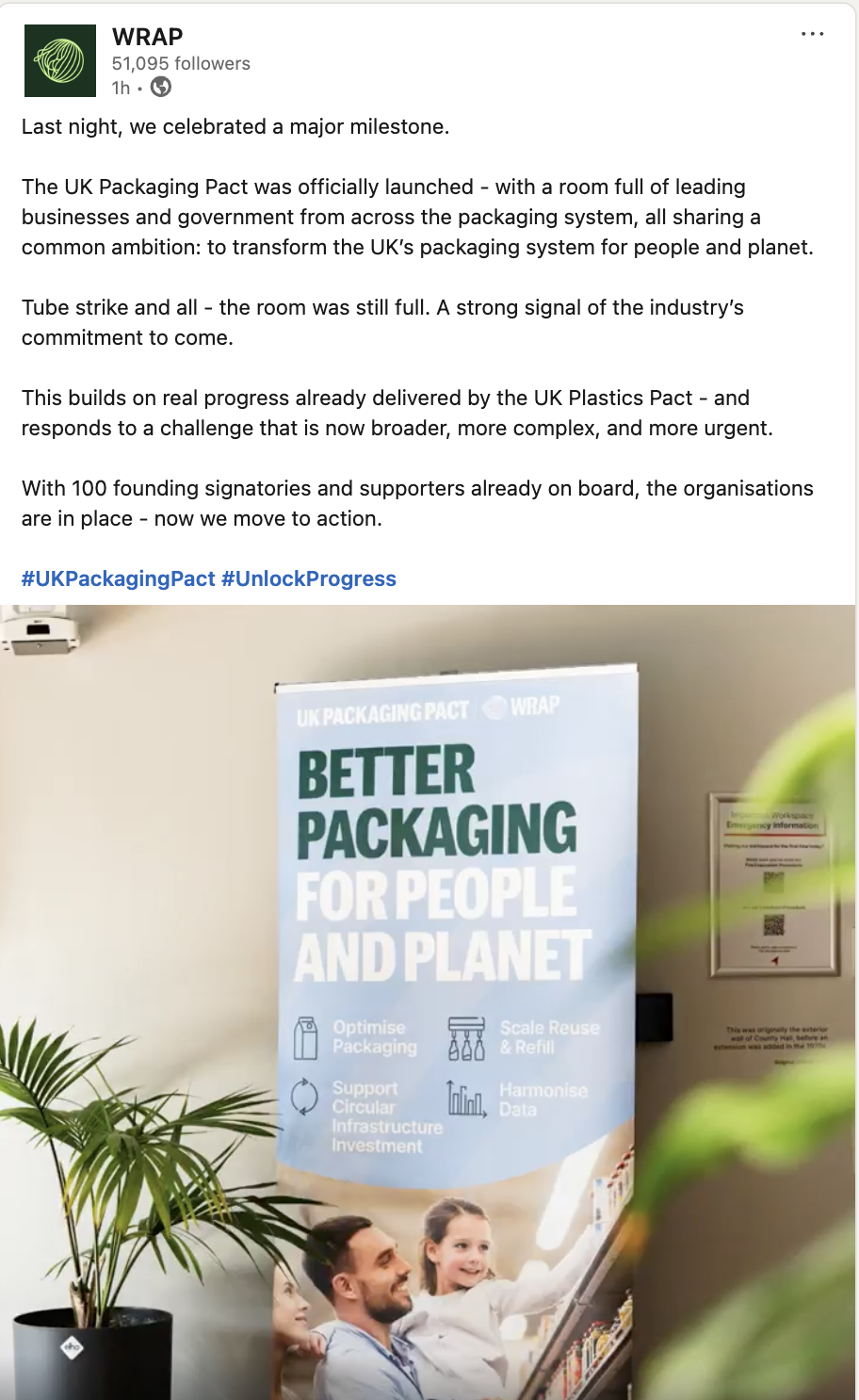
The Plastic Packaging Tax Coalition commenting on the UK Packaging Pact in BusinessGreen:
“Businesses are already working hard to improve packaging outcomes, but alignment between policy, infrastructure and consumer behaviour will be critical to success”.
Follow this link to view and / or comment on the LinkedIn post on the right
Do you know a business that should join the FPA?
The Foodservice Packaging Association represents the interests of its members at all levels and works hard to ensure its members are better represented, better informed and better connected.
FPA members receive early sight of this Digest on Thursday evenings, prior to distribution each Friday morning, and can view an archive of previous Digests within their FPA Dashboards or via this link