The FPA Friday Digest
27 March 2026
Following last week’s focus on enforcement and system integrity, this issue takes a step back to look at how the packaging system is evolving in practice.
Across a number of the articles, there is a clear shift towards delivery – from design choices that influence recyclability, to investment in recycling infrastructure and the strategic direction of the sector more broadly. These are the areas that will ultimately determine how effectively policy ambition translates into real-world outcomes.
This is also reflected in the work of the FPA Compliance Team, including Anne Sutton’s recent visit to The LCA Centre, which highlights the growing importance of robust, evidence-based analysis in supporting material understanding and environmental claims.
With key milestones approaching, members are reminded they should ensure their packaging assessments and supporting data are in place in advance of the Recyclability Assessment Methodology (RAM) requirements coming into effect from 1 April 2026. Further clarification re take-back protocols is included below.
On a separate note, as next week is the Easter Bank Holiday, there will be no Friday Digest. And due to FPA team holidays, the following week's issue may be a little delayed so please bear with us.
In the meantime, on behalf of myself and the rest of the FPA team, we hope you have a restful and enjoyable break.
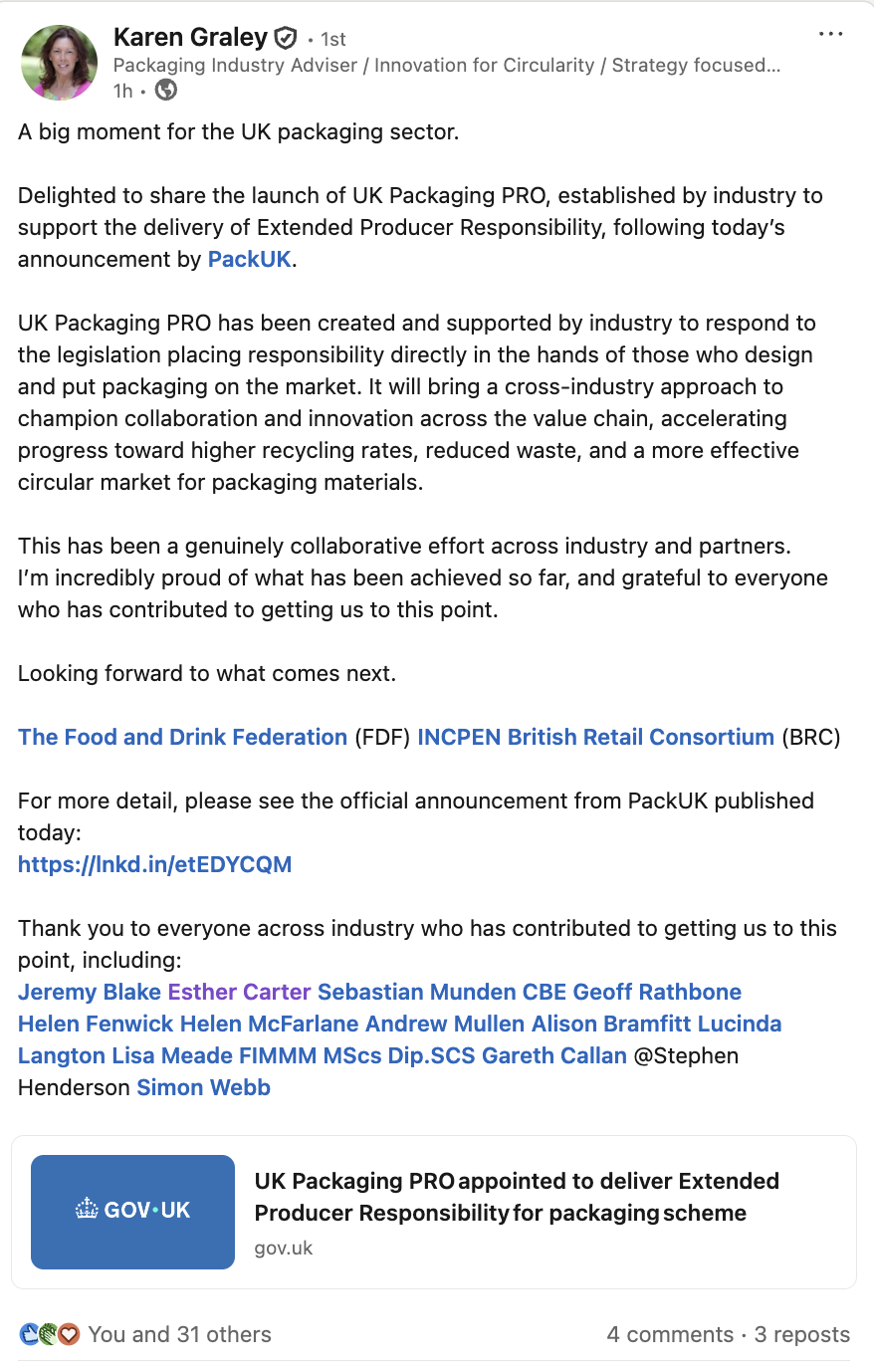
PackUK appoints Producer Responsibility Organisation (PRO) to lead next phase of pEPR
PackUK has announced the appointment of the UK Packaging PRO as the Producer Responsibility Organisation (PRO) for packaging Extended Producer Responsibility (pEPR), marking a significant milestone in the scheme’s rollout. The appointment follows a competitive process and has been broadly welcomed by major brands and stakeholders as a key step forward in implementing pEPR.
The industry bid was led by the Food and Drink Federation (FDF) and the Industry Council for Packaging and the Environment (INCPEN), brings together more than 100 major brands, retailers and trade bodies. Established as an independent, not-for-profit, producer-led body, it will work alongside PackUK and governments across the UK to provide advice and recommendations on the delivery of the scheme.
Further coverage, including reporting by The Grocer, confirms Karen Graley , who has played a key role in the application process, will lead UK Packaging PRO with former Unilever UK & Ireland CEO Sebastian Munden appointed chair of the board.
Transition to the PRO will be phased, with responsibilities delegated gradually to support stability as the scheme develops. While the PRO will play a central role in advising on system design and delivery – and how the system evolves in practice – key decisions, payments and financial flows will remain under government oversight via PackUK.
The introduction of a producer-led PRO reflects a model widely used across Europe, where industry involvement has been credited with improving efficiency, increasing recycling rates and strengthening system accountability.
The appointment will take effect from 01 April 2026 and is expected to strengthen collaboration across the value chain, bringing together producers, retailers and recyclers to help shape a more effective and efficient system.
FPA comment: “The establishment of a producer-led PRO is an important step, but its success will depend on how effectively it addresses the issues we are already seeing in the system. We welcome the appointment of Karen Graley and the involvement of organisations such as the Packaging Federation, with whom we work closely, in helping to shape this next phase. The priority must now be to ensure the system operates fairly in practice, with all obligated packaging captured, creating a level playing field for compliant businesses”.
Notice of Liability guidance sets expectations ahead of producer invoices
The government has published new guidance on Notices of Liability (NoL) under the packaging EPR scheme, providing producers with greater clarity on how their financial obligations will be communicated ahead of invoicing.
The notice is intended to give businesses advance visibility of their likely charges, allowing time to review data submissions and prepare financially before invoices are issued.
The guidance confirms that producers will be expected to carefully check the information contained within their notice, including packaging tonnages and classifications. Where discrepancies are identified, there will be a defined window for queries or corrections before costs are finalised. This places a clear onus on producers to ensure the accuracy and completeness of their data submissions, an issue that has already proven challenging during the early stages of scheme implementation.
For many businesses, the Notice of Liability will be the first concrete indication of the scale of their EPR exposure. With fee modulation and full cost recovery still bedding in, the notices are likely to be closely scrutinised, particularly in light of wider concerns about data robustness, scheme transparency, and the potential for future cost adjustments.
FPA comment: "The publication of this guidance reinforces the transitional nature of Year 1 of the scheme. With government having intervened to cover the initial funding shortfall, attention is now turning to how liabilities will be calculated and communicated in subsequent years, and whether the system can deliver predictable and equitable outcomes for obligated producers".
PackUK clarifies evidence requirements for take-back protocols under RAM
PackUK has issued further clarification on take-back protocols under the Recyclability Assessment Methodology (RAM), following queries from compliance schemes.
The guidance reinforces that, to achieve an AMBER rating, producers must provide robust, end-to-end evidence that their packaging is recyclable at scale. This includes demonstrable traceability across the full recycling chain, from collection and sortation through to reprocessing and final end use.
Crucially, PackUK has emphasised that without clear evidence of a defined end market for the reprocessed material, packaging must be classified as RED.
The clarification places particular focus on traceability and specificity, requiring producers to show:
- How and where materials are collected, sorted and reprocessed.
- Which accredited service providers are involved.
- What the recycled material is ultimately used for, and by whom.
The guidance also highlights the complexity of the flexible plastics waste stream, making clear that AMBER ratings must be based on evidence for the specific polymer type in question. For example, evidence supporting the recycling of LDPE films cannot be applied to polypropylene materials unless explicitly demonstrated.
Producers and compliance schemes are therefore advised not to apply blanket AMBER ratings across material categories without meeting all five take-back criteria.
Further refinements to take-back protocols are expected as part of the ongoing development of RAM 2027, informed by feedback from industry and the RAM Technical Advisory Committee.
FPA comment: “The clarification underlines the increasing importance of credible, verifiable data within pEPR reporting and recyclability assessments".
Government publishes Waste Crime Action Plan alongside £45m enforcement boost
Government has published its new Waste Crime Action Plan, setting out a strengthened approach to tackling illegal activity across the waste sector, alongside a £45 million funding boost for enforcement.
The plan outlines a coordinated effort to improve intelligence sharing, strengthen regulatory powers and increase enforcement activity, with the Environment Agency playing a central role. Measures include enhanced use of technology such as drones, closer collaboration through the Joint Unit for Waste Crime, and, as reported in last week's Friday DIgest, proposals to equip enforcement officers with police-style powers, including stop and search.
Waste crime is estimated to cost the UK economy hundreds of millions of pounds each year, undermining legitimate operators and distorting markets. The publication of the Action Plan signals a clear intent to address these issues more robustly.
Effective enforcement will be critical to ensuring that materials placed on the market are properly managed, supporting the integrity of systems such as pEPR.
The move also reinforces a broader industry message: that system design must be matched by credible enforcement and oversight. Without this, there remains a risk that costs fall disproportionately on compliant businesses, while non-compliant activity continues to operate at the margins.
Alongside the publication of the plan, the Environment Agency has launched a new industry engagement initiative, inviting businesses and stakeholders to contribute to the fight against waste crime and share insight on where the system can be strengthened. The consultation can be accessed via the button below.
FPA comment: “This is a welcome step, but enforcement must keep pace with the realities on the ground. Without it, the burden will continue to fall on compliant businesses while activity outside the system goes unchecked. System integrity depends on both good design and effective enforcement. This is about ensuring a level playing field as much as it's about tackling waste crime".
Households 'throwing away hundreds' in recyclable material, WRAP warns
New analysis from WRAP suggests UK households are discarding significant amounts of recyclable material each week, with the value of recoverable resources running into hundreds of pounds annually per household. The findings reinforce long-standing concerns about the gap between what is technically recyclable and what is actually captured through the system.
WRAP’s work highlights that large volumes of commonly used materials – including paper, card, plastics and metals – are still ending up in residual waste streams. This reflects a combination of inconsistent collection systems, ongoing consumer confusion, and limited access to recycling for certain formats. While policy reforms such as Simpler Recycling are intended to address some of these barriers, the data underlines how far the UK still has to go to achieve consistent, high-performing collection outcomes.
The issue is not new. Previous WRAP and Defra-backed studies have repeatedly shown that a substantial proportion of household waste remains recyclable in principle, yet capture rates lag behind targets. Industry commentators have also pointed to the role of packaging design, labelling clarity and local authority variation in driving this disconnect, factors that sit squarely within the scope of ongoing EPR reforms.
For producers, the findings may sharpen focus on the 'real-world recyclability' of packaging. Under the forthcoming modulation of EPR fees, materials that are not effectively collected and reprocessed at scale risk being penalised, regardless of their theoretical recyclability. This reinforces the importance of aligning packaging formats with existing infrastructure and ensuring clear, consistent consumer communication.
FPA comment: "The WRAP analysis adds weight to the argument that system performance, not just material design, will determine the success of the UK’s circular economy ambitions. Without improvements in collection consistency, sorting capability and public engagement, a significant proportion of valuable material will continue to be lost from the system".
Food manufacturing sector under pressure despite strong economic contribution
New figures from the Food and Drink Federation highlight the continued importance of the UK food and drink manufacturing sector, which now contributes £42 billion to the economy and accounts for 23.7% of total manufacturing turnover.
Across the wider supply chain, the sector is worth an estimated £172 billion, supporting nearly half a million jobs nationwide and playing a central role in regional economies across the UK.
However, the FDF is warning that businesses are facing a challenging and increasingly constrained operating environment, with rising costs, regulatory pressures and geopolitical uncertainty impacting investment and growth.
In 2025, insolvency rates in food manufacturing rose significantly, increasing at nearly three times the rate of the wider manufacturing sector since 2019. At the same time, production costs continued to climb, with average increases of 4.4%, rising to over 5% for smaller businesses.
External pressures, including conflict in the Middle East and sustained high energy costs, are adding further strain, particularly given the sector’s reliance on energy across every stage of production.
Despite these challenges, the sector continues to invest, with major developments across the UK underlining its long-term importance to regional growth and employment.
The FDF is calling on government to provide greater support to enable businesses to invest in technology, skills, innovation and more sustainable production methods, warning that without this, the long-term resilience and competitiveness of the sector could be at risk.
FPA comment: “Continued pressure on food manufacturers is likely to feed through into packaging demand, pricing and material choices, while also influencing the pace at which businesses can invest in more sustainable packaging solutions. As cost pressures persist, the ability of the wider value chain to absorb additional regulatory burdens, including those associated with pEPR, will remain a key area to watch”.
Scrutiny of environmental claims intensifies
Environmental marketing claims are facing increasing scrutiny in the UK as regulators step up action against potential ‘greenwashing’.
Recent commentary highlights how regulators, including the Competition and Markets Authority (CMA), are moving from guidance towards active enforcement of rules governing environmental claims. The CMA’s Green Claims Code requires businesses to ensure sustainability claims are accurate, clear and supported by evidence.
The issue is particularly relevant to packaging manufacturers as claims relating to recyclability, compostability, and material composition become more prominent on products and packaging.
FPA comment: "This development supports the work of the FPA's Compliance Team and underlines the importance of ensuring that environmental claims relating to packaging materials are robust, evidence-based and capable of withstanding regulatory scrutiny".
FPA Compliance Team report on a
visit to The LAC Centre
Recently, the FPA’s compliance director Anne Sutton visited The LCA Centre to gain a deeper understanding of the analytical capabilities available to FPA members. The laboratory’s client base spans government agencies, industry and academic institutions, reflecting the growing importance of reliable materials analysis in areas such as product performance, regulatory compliance and sustainability claims.
Based in Nijmegen, The LCA Centre operates as a specialist laboratory focused on the forensic analysis of packaging materials and their composition. The facility houses an extensive range of advanced analytical instrumentation, including technologies based on X-ray, infra-red and laser analysis. These are operated by highly qualified chemical and materials scientists, many with PhD-level expertise in polymer and fibre technologies.
During the visit, the team demonstrated how the laboratory analyses complex packaging structures – including multi-layer films and composite materials – to determine their precise material composition. This type of analysis can be particularly valuable where clarity is required on recyclability, material identification, or the accuracy of environmental and material claims.
Combining detailed analytical capability with expertise in regulatory frameworks has also led to the centre becoming involved in work relating to the Single-Use Plastics Directive (SUPD), particularly in the area of synthetic plastic identification. The LCA Centre is currently collaborating with several leading European analytical laboratories to develop a harmonised protocol to ensure consistent analytical techniques are applied across different facilities.
The FPA has worked with The LCA Centre on a regular basis, commissioning more than 30 analytical studies during 2025 alone to support members with material identification and compliance-related queries.
The laboratory’s client base spans government agencies, industry and academic institutions, reflecting the growing importance of reliable materials analysis in areas such as product performance, regulatory compliance and sustainability claims.
Members who would like to better understand the material composition of their products, verify environmental or material claims, investigate product performance issues, or benchmark against competitor products may benefit from the specialist analytical services offered by The LCA Centre.
The facility’s advanced laboratory capabilities make it a valuable resource for packaging manufacturers, distributors and users seeking independent technical analysis and verification of packaging materials.
Photos from the visit, including images of the laboratory and some of the analytical equipment in use, can be viewed via the 'image rich' version of the Friday Digest via the link at the top of this page.
FPA members interested in learning more can contact Anne Sutton at compliance@foodservicepackaging.org.uk
Design emerging as a central issue in packaging sustainability debate
A recent editorial in recycling trade publication Materials Recycling World highlights the growing importance of packaging design in achieving meaningful improvements in recycling performance and resource efficiency.
The article argues that while policy initiatives such as Extended Producer Responsibility (EPR) and deposit return schemes are intended to drive change, design decisions made at the outset of the packaging lifecycle remain one of the most influential factors in determining whether materials can be effectively collected, sorted and recycled.
According to the editorial, improving recyclability is not simply a matter of switching materials but requires greater attention to the interaction between packaging formats, recycling infrastructure and end-markets for recovered materials. Design choices around material combinations, labelling, colour and format can all influence whether packaging can be processed successfully through existing systems.
The piece also highlights the role that policy frameworks can play in encouraging more sustainable design. Mechanisms such as modulated EPR fees, recyclability guidance and clearer design standards are increasingly being used to incentivise packaging that works effectively within recycling systems. It suggests closer collaboration between packaging manufacturers, brand owners, recyclers and policymakers will be necessary if design improvements are to translate into measurable gains in recycling performance.
FPA comment: "For packaging producers, design for recyclability is fast becoming a central expectation rather than an optional consideration, particularly as regulatory frameworks begin to place greater emphasis on lifecycle impacts and circular economy outcomes".
Food-to-go market set for continued growth, with implications for packaging demand
New insight from Lumina Intelligence highlights continued growth in the UK food-to-go market, with strong momentum expected across the next few years.
The report indicates that the UK food-to-go sector is projected to grow steadily, with the market expected to reach c.£25–30 billion in value over the medium term, driven by evolving consumer habits and increased out-of-home consumption. Growth is being supported by hybrid working patterns, increased mobility and demand for convenience-led formats, particularly in coffee shops, convenience retail and quick-service outlets.
At the same time, operators are navigating a more competitive environment. The report highlights a continued focus on value, speed of service and product innovation, alongside a balancing act between premiumisation and affordability as consumers remain price-conscious.
Continued expansion in food-to-go is likely to sustain demand for single-use and short-use packaging formats, particularly those supporting portability, temperature retention and ease of use.
However, growth is taking place alongside rising expectations around sustainability and recyclability, placing increasing emphasis on material choice and packaging design.
FPA comment: "The findings reinforce the role of packaging as a critical enabler of the food-to-go market, while highlighting the need for solutions that balance functionality, cost and environmental performance".
Investor interest in UK waste sector continues to diversify
Investor interest in the UK waste and recycling sector is continuing to broaden, with a growing range of financial backers targeting opportunities across the market.
Recent analysis highlights how investment is no longer focused solely on large waste management operators, but is increasingly flowing into specialist recycling businesses, infrastructure projects and niche service providers. Areas of interest include materials recovery, plastics recycling, and technologies supporting the circular economy.
The trend reflects a combination of factors, including regulatory change, sustainability commitments and long-term demand for recycling capacity, all of which are shaping the future of the sector.
FPA comment: "Increased investment in waste and recycling infrastructure could support improvements in collection, sorting and processing capability, particularly as pEPR begins to reshape funding flows within the system. At the same time, the diversification of investor interest indicates a sector that is continuing to evolve".
NEWS FROM EUROPE
Europe: from policy direction to delivery – pressure shifts to implementation
Following last week’s focus on lobbying activity around PFAS and resistance to environmental 'Omnibus' reform, attention across Europe is now shifting from policy direction to practical implementation and delivery.
Momentum continues to build behind the EU’s Packaging and Packaging Waste Regulation (PPWR), with businesses increasingly focused on what compliance will mean in practice, particularly around material restrictions, recyclability requirements and data expectations.
At the same time, regulators are sharpening their focus on evidence and accountability, with growing scrutiny on recyclability claims and environmental messaging. This reflects a broader shift towards ensuring that sustainability claims are fully substantiated and aligned with real-world infrastructure capability.
This evolving landscape reinforces a key theme emerging across both EU and UK policy: that system integrity, traceability and verifiable outcomes are now central to regulatory expectations, with increasing alignment between policy ambition and enforcement.
FPA comment: "Compliance will depend not only on meeting headline regulatory requirements, but on the ability to demonstrate end-to-end credibility across the value chain, from material composition through to collection, reprocessing and end markets".
INTERNATIONAL STORIES
Global brand owners outline vision for EPR systems for beverage cartons
The Consumer Goods Forum has published a vision for how Extended Producer Responsibility (EPR) systems should operate for liquid packaging cartons, emphasising the role of producers in funding recycling infrastructure and improving collection systems.
The proposal highlights the importance of clear governance, consistent fee structures and investment in recycling capacity to ensure EPR schemes deliver real circular economy outcomes.
While focused on beverage cartons, the discussion reflects wider debates across packaging sectors about how EPR systems should be structured and managed, including the role producers should play in directing funds generated through compliance fees.
As countries continue introducing or reforming EPR policies, industry groups are increasingly seeking greater influence over how schemes operate and how revenues are used to improve recycling performance.
FPA comment: "The report resonates with issues currently being raised in the UK around the implementation of pEPR, including the importance of ensuring compliance systems are designed in a way that delivers environmental outcomes while maintaining a level playing field for participating businesses".
Rising ransomware threat highlights growing risk to food and packaging supply chains
A series of recent cyber incidents is underlining the increasing threat posed by ransomware attacks across the food and packaging supply chain, with manufacturers and processors becoming more frequent targets.
Such attacks can disrupt production systems, halt operations and delay deliveries, creating immediate knock-on effects across interconnected supply chains. A recent incident highlighted in Food Ingredients 1st and affecting Japanese beverage giant Asahi Group Holdings, illustrates how quickly cyber disruption can impact large-scale food production and distribution.
The growing prevalence of ransomware reflects the increasing digitisation of manufacturing and supply chain operations, where reliance on integrated systems can create vulnerabilities if not adequately protected.
As a result, cyber risk is emerging as a core operational consideration, alongside more familiar challenges such as regulatory change, cost pressures and sustainability requirements.
The trend reinforces the importance of robust cybersecurity measures, supplier resilience and contingency planning, as businesses look to safeguard operations in an increasingly connected and complex global environment.
FPA comment: "Disruption at major food producers can lead to sudden shifts in demand, order volatility and supply chain instability, affecting packaging manufacturers, distributors and logistics providers".
EXTERNAL EVENTS
Arena Live returns with first event of 2026
Arena will host its first live event of 2026 next month, bringing together senior leaders from across the foodservice sector for an evening of insight, discussion and networking.
The event will explore the key trends, challenges and opportunities shaping the industry, offering attendees the chance to hear from expert speakers and engage in open conversation with peers from across the supply chain.
Arena’s live events are known for their informal, high-quality networking environment, providing a valuable platform to exchange ideas and build connections across operators, suppliers and service providers.
With strong interest expected, early booking is recommended.
Arena will host its first live event of 2026 next month, bringing together senior leaders from across the foodservice sector for an evening of insight, discussion and networking.
The event will explore the key trends, challenges and opportunities shaping the industry, offering attendees the chance to hear from expert speakers and engage in open conversation with peers from across the supply chain.
Arena’s live events are known for their informal, high-quality networking environment, providing a valuable platform to exchange ideas and build connections across operators, suppliers and service providers.
With strong interest expected, early booking is recommended. To find out more visit https://arena.org.uk
The UK Food & Drink Shows return to the NEC this April
The UK Food & Drink Shows will return to the NEC Birmingham from 13–15 April, bringing together over 1,200 exhibitors across four co-located events: Food & Drink Expo, Farm Shop & Deli Show, National Convenience Show and Forecourt Show.
The event offers a valuable opportunity for industry professionals to discover new products, explore packaging and equipment solutions, and connect with key players across foodservice, retail and wholesale.
Alongside the exhibition, a packed programme of talks and interviews will feature leading voices from across the sector, including representatives from Borough Market, Booker, Co-op Wholesale and a range of food and farming businesses.
Designed to help visitors make the most of their time, a digital event companion will provide an interactive floorplan, navigation tools and real-time updates.
Follow this link to find out more and register for free tickets
Stakeholder Engagement Forums – April to July dates
Dates and links to the next tranche of Circular Economy Stakeholder Forum meetings. No registration is required, the Microsoft Teams link accompanying each forum will provide direct access to that meeting.
Defra recommends individuals wishing to attend save each link to their calendars. No reminders will be sent.
April Forum – Tuesday 14 April: 14:30 to 16:00 Link to access forum
May Forum – Tuesday 5 May 14:30 to 16:00 Link to access forum
June Forum – Tuesday 2 June: 14:30 to 16:00 Link to access forum
July Forum – Tuesday 7 July: 14:30 to 16:00 Link to access forum
FPA NEWS
FPA Annual Golf & Activities Day
Thursday 11 June
FPA members, colleagues and customers are invited to join us on Thursday 11 June for the FPA’s ever-popular Annual Golf and Activities Day – this year taking place at the stunning Breadsall Priory Country Club, near Derby.
Choose between an 18-hole Golf Day or a lively ‘Quintessentially English’ Activities Day, featuring everything from axe-throwing and welly wanging to croquet, tug-of-war and even duck herding!
Whether you come as a team or join others on the day, it’s a fantastic opportunity to connect with colleagues, customers and industry peers within a relaxed setting.
The day concludes with an evening barbecue, rounding off a great day of activity and networking.
Places are limited, so early booking is recommended. Pricing, the full itinerary and booking details can be accessed via this link.
Essential reading
GOV.UK: UK packaging PRO appointed to deliver EPR for packaging scheme. Read more here
Environment Agency: Improving regulation worldwide – our international role and why it matters. Read more here
The Grocer: Winner of bid to run extended producer responsibility scheme revealed. Read more here
The National: Overwhelming number of Scots back deposit return scheme, study finds. Read more here
Packaging News: Return, refill repeat – are reuse systems ready for the new rules? Read more here
MRW: Councils 'leaving it late' for flexible collections – Recoup. Read more here
PHYS.ORG: Why drawing eyes on food packaging could stop seagulls stealing your chips. Read more here
Recycling Today: AF&PA joins NAW lawsuit against EPR in Oregon. Read more here
The Caterer: Monitor, measure and manage: food waste made simple. Read more here
Packaging News: London tops UK for refill destinations. Read more here
Quote of the week and post of the week
Dietician Kathleen Benson, quoted in the Daily Meal in a section entitled Myth: plastic packaging is dangerous:
"Some people prefer transferring food to glass or stainless-steel containers, which is reasonable. That said, food packaging materials are regulated, and the more common food safety risks typically involve improper handling, storage, and temperature control rather than the packaging itself".
Join the FPA
The Foodservice Packaging Association represents the interests of its members at all levels and works hard to ensure its members are better represented, better informed and better connected.
FPA members receive early sight of this Digest at 6:15 a.m. each Friday morning.
Interested in joining the FPA?