The FPA Friday Digest
20 November 2026
Two significant developments dominate this week's Digest: welcome changes to RAM 2027 following industry representations and the FPA's ongoing engagement with PackUK, and the publication of higher-than-anticipated pEPR fees for 2026/27.
The financial implications of the confirmed fees, alongside proposals to accelerate future modulation, underline the importance of the FPA's work to ensure recyclability assessments are supported by robust technical evidence and reflect the practical realities of foodservice packaging manufacture.
It's also a busy time for the FPA. Entries and ticket bookings are now open for our 2027 Awards, FPA Jobs is attracting media attention, plans are under way for a dedicated RAM webinar and our Young & Emerging Professionals initiative is gathering momentum. You can find details of all these developments, sponsorship opportunities, forthcoming events and our recent media coverage in the FPA News and Events section.
On the regulatory front, PackUK's confirmed pEPR disposal fees for 2026/27 are higher than previously anticipated for most materials. We examine the financial implications of the first year of fee modulation, the redistribution of costs across material categories and proposals to accelerate modulation in future years.
Meanwhile, renewed instability in the PRN market is adding to financial pressures on businesses, with the Environment Agency's latest clarification raising questions about the assumptions underpinning October's regulatory intervention.
We also examine the implications of the UK-EU agreements on food standards and emissions trading, parliamentary discussions on support for domestic food and drink manufacturing, and developments in European packaging regulation.
Our ‘Have your say’ section highlights several opportunities for members to influence future policy, including accelerated pEPR fee modulation, RAM 2028 and Defra's new Plastic Film Forum. With several deadlines falling over the coming days, we encourage members to review this section.
As always, the Digest brings together the latest UK, European and international developments, research and innovation, and forthcoming industry events.
Have a good weekend.
PACKAGING REFORMS UPDATE
PackUK responds to industry representations on RAM 2027 – a positive outcome for FPA industry representation
The FPA has welcomed PackUK's decision to revise two elements of the Recyclability Assessment Methodology (RAM) for 2027, following representations from the FPA and the wider packaging industry.
Of particular significance is PackUK's decision to revert to its original approach to PFAS – an outcome specifically advocated by the FPA during its participation in PackUK's technical sprint groups.
PFAS – return to the intentionally added approach
For 2027 reporting, PackUK will retain the approach adopted under RAM version 1.1, whereby packaging containing intentionally added PFAS will automatically receive a red rating, with existing exemptions where the predominant material is aluminium, steel or glass.
The decision follows industry concerns about the availability of appropriate testing, the ability of producers to obtain reliable evidence across complex international supply chains and the time required to prepare for the proposed thresholds.
PackUK has emphasised that further technical and regulatory work on PFAS will continue to inform future iterations of RAM.
Direct printing on rigid plastics – red to amber
In a further welcome development for foodservice packaging manufacturers, PackUK will amend the classification of direct printing on rigid polypropylene (PP), high-density polyethylene (HDPE) and polyethylene terephthalate (PET) thermoforms from red to amber for 2027.
Further testing and evidence gathering will inform the treatment of directly printed packaging in future iterations of RAM.
Updated RAM 2027 guidance will be published on GOV.UK in due course.
A positive outcome for FPA engagement
The announcement demonstrates the value of the FPA's ongoing engagement with PackUK and the contribution of its Sustainability and Government Affairs (SAGA) group, chaired by Louisa Goodfellow of Ecosurety, in ensuring the practical concerns of foodservice packaging manufacturers are represented.
FPA comment: “We are delighted PackUK has listened to industry representations, particularly in relation to PFAS, where the decision to retain the intentionally added approach reflects the position advocated by the FPA during the technical sprint groups.
“Our thanks go to Louisa Goodfellow and members of the FPA's SAGA Committee for their continued work in representing the sector and contributing technical expertise to the development of RAM.
“This is a positive example of what can be achieved through constructive, evidence-led engagement between industry and policymakers.
“With proposals to accelerate the financial penalties for red-rated packaging, it is more important than ever that classifications are supported by robust technical evidence and reflect the practical realities facing manufacturers. We hope PackUK will adopt a similarly responsive approach to other areas of concern identified by the FPA".
PackUK confirms 2026/27 pEPR fees – with increases above previous estimates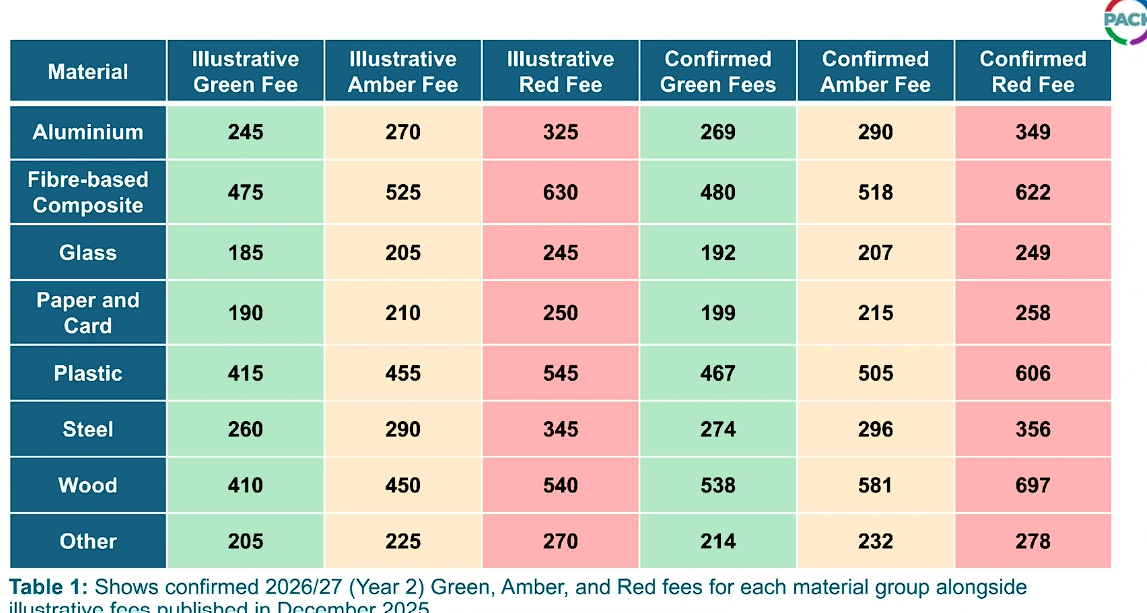
PackUK has published its confirmed packaging extended producer responsibility (pEPR) waste disposal fees for the 2026/27 assessment year, relating to packaging placed on the market during the 2025 calendar year.
These are the first fees to incorporate modulation based on packaging recyclability, as determined by the Recyclability Assessment Methodology (RAM).
Red-rated packaging will attract a 20% surcharge on the amber base fee, while green-rated packaging will benefit from a 7.5% discount.
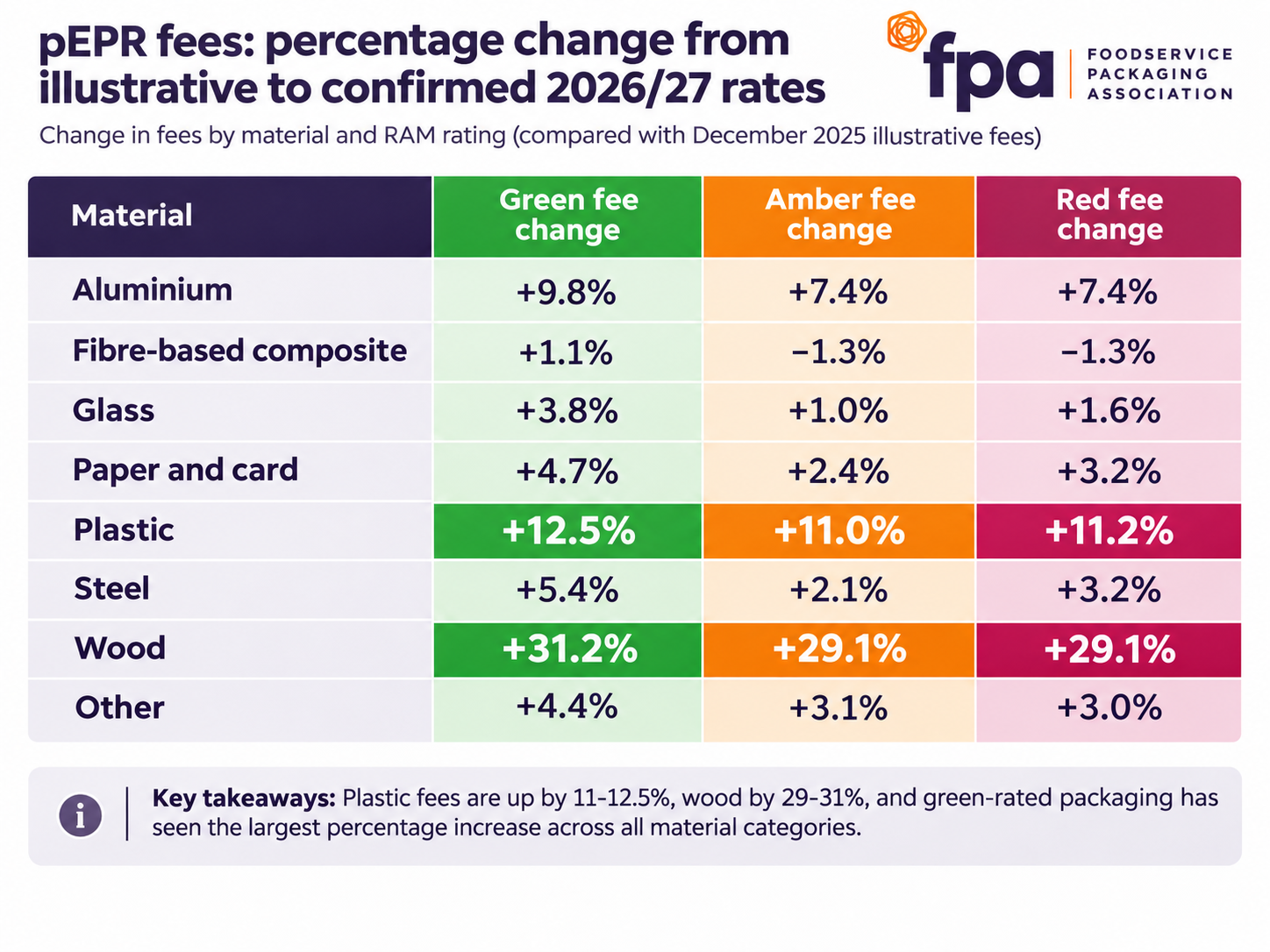
The confirmed fees are higher than the illustrative figures published in December 2025 for most material categories, with plastic and wood seeing particularly significant increases. The amber fee for plastic has increased by 11% to £505 per tonne, while wood has increased by 29% to £581 per tonne.
Fibre-based composites are the only material category where confirmed amber and red fees are lower than the previous estimates.
Factors contributing to the revised fees include differences between anticipated and reported packaging recyclability profiles and lower overall volumes of obligated packaging than originally anticipated.
Notices of Liability were scheduled to be issued from Thursday 26 November.
Understanding the modulation mechanism
Under PackUK's modulation methodology, additional revenue generated by red-rated packaging surcharges is pooled across all eight material categories and redistributed through a common percentage discount on green-rated packaging.
The mechanism is designed to be revenue neutral, redistributing costs between producers without increasing the overall value of disposal fees collected through modulation itself.
However, as the discount depends on the quantities, recyclability ratings and base fees of materials reported across the scheme, businesses will continue to face uncertainty over future packaging costs, even where red-rating multipliers are known in advance.
Further increases proposed
As reported in last week's Digest, PackUK is seeking feedback on proposals to accelerate fee modulation, increasing the red-rating multiplier as follows:
- 2027/28: from 1.6 to 2.0 times the amber fee, relating to packaging placed on the market during 2026.
- 2028/29: from 2.0 to 2.4 times the amber fee, relating to packaging placed on the market during 2027.
Of particular interest within the draft policy statement is the proposed treatment of certain immediate-contact medical packaging from 2028/29. In recognition of regulatory and safety constraints, qualifying packaging assessed as red would attract amber fees, while green-rated packaging would remain eligible for discounts.
Although foodservice packaging is subject to different regulatory requirements, the proposal raises wider questions about how modulation should accommodate essential packaging functionality, food safety, product protection and circumstances where technically viable alternatives are limited.
PackUK intends to launch a further call for evidence on the future direction of modulation in early 2027, with its policy for 2029/30 to be determined following further review.
FPA comment: “The FPA is deeply concerned by the higher-than-anticipated EPR fees, which represent yet another significant financial burden on an industry already grappling with escalating costs and regulatory uncertainty.
“Many businesses have based budgets, commercial agreements and pricing decisions on the illustrative figures published last December. Businesses cannot be expected to plan, invest and remain competitive without greater predictability of the financial consequences of government policy.
“It's also important to understand that modulation redistributes costs across both businesses and material categories. The resulting fees are therefore influenced not only by the recyclability of an individual producer's packaging, but by the packaging placed on the market by other obligated producers.
“The proposed acceleration of modulation makes it increasingly important that RAM classifications are underpinned by robust evidence, that businesses are afforded realistic implementation timescales and that greater predictability of costs can be achieved.
“PackUK's proposed treatment of certain medical packaging is an interesting development, recognising that regulatory, safety and technical requirements can constrain packaging choices. Similar consideration should be given to essential foodservice packaging functionality, including food safety, hygiene, product protection and the prevention of food waste.
“The cumulative financial impact of packaging reforms is becoming increasingly concerning. Government must take greater account of the economic consequences of its policies and the ability of UK manufacturers to remain competitive. This further reinforces the need for an early, independent review of the scope, operation and economic impact of pEPR.
“The FPA will continue to raise these issues through its regular engagement with PackUK and government, alongside our longstanding concerns around the scope of producer obligations, regulatory compliance and the equitable distribution of costs”.
Read PackUK's announcement here and access the confirmed fees and supporting calculation methodology here
The deadline for responses to PackUK's draft updated modulation policy statement is 11.59pm on Wednesday 16 December. Responses should be sent to PackUK.Evidence@defra.gov.uk
PRN market under renewed pressure despite regulatory intervention
Concerns are mounting over the effectiveness of October's government and regulatory intervention to stabilise the Packaging Recovery Note (PRN) market, with PRN prices remaining high and further increases recorded for some materials.
According to figures from The Environment Exchange's PRN Pricewatch, reported by The Grocer this week, plastic PRN prices have begun to stabilise at around £470 per tonne, while steel prices have increased from £95 to almost £240 per tonne.
The developments have prompted renewed calls for government intervention and longer-term reform of the packaging recycling evidence system.
In October, the four UK environmental regulators introduced Regulatory Position Statements, providing conditional enforcement easements for producers and compliance schemes meeting the following proportions of their statutory 2026 recycling obligations:
- Plastic: 83%
- Steel: 92%
- Wood: 90%
However, in a stakeholder Q&A published this week, the Environment Agency confirmed that the modelling underpinning the intervention assumed all producers would make use of the reduced enforcement thresholds.
While producers remain free to meet their full statutory recycling obligations, continued purchasing beyond the reduced thresholds could affect the availability of evidence and the effectiveness of the intervention.
The regulator is encouraging a proportionate and responsible approach to evidence procurement but has confirmed there are currently no plans to amend RPS 383, although it continues to monitor the situation with Defra.
The Environment Agency has also clarified the position regarding certificates of compliance. Producers relying on the RPS must:
- Submit their certificates of compliance by 31 January 2027.
- Manually calculate their evidence requirements under the RPS.
- Record any shortfall against their statutory recycling obligations.
An additional column on the public register will identify producers that have met the conditions of the RPS.
The latest developments underline the continuing uncertainty surrounding packaging compliance costs, particularly in the context of this week's higher-than-anticipated pEPR disposal fees.
Government's formal response to its consultation on PRN and PERN system reform, which closed in May, remains outstanding.
FPA comment: “The continuing volatility in the PRN market, alongside increases in pEPR disposal fees, is placing considerable additional financial pressure on businesses.
“The Environment Agency's confirmation that its modelling assumed universal use of the regulatory easements raises important questions about the assumptions underpinning the intervention and its ability to deliver the intended outcomes.
“While short-term interventions may be necessary, businesses cannot continue to operate against a backdrop of unpredictable costs and recurring market instability. There is an urgent need to address the underlying structural issues, ensure sufficient investment in UK recycling infrastructure and provide businesses with greater regulatory and financial certainty.
“Government must also consider the cumulative economic impact of its packaging reforms, rather than addressing each element of the regulatory framework in isolation”.
Read the regulatory position statement here, access RPS 383 here and the PRN/PERN reform consultation here
Defra sets out timetable for evaluating packaging reforms
Defra has provided further details of its plans to evaluate the effectiveness of the UK's collection and packaging reforms, including extended producer responsibility for packaging (pEPR).
In its post-legislative scrutiny memorandum on the Environment Act 2021, published earlier this month, Defra confirmed it is undertaking an interim process evaluation, expected to be completed towards the end of 2026.
A final process evaluation is scheduled for 2027, with a comprehensive assessment of the impact and economic consequences of the wider collection and packaging reforms due in 2029.
The timetable is of particular interest given growing industry concerns about the costs, operation and economic consequences of pEPR, alongside calls from the FPA and the Packaging Federation for earlier independent scrutiny of the scheme.
The distinction between evaluating how the reforms are being implemented and assessing their economic and environmental outcomes is important. While the earlier evaluations should provide useful insights into the operation of the reforms, businesses will have to wait considerably longer for the comprehensive impact assessment.
FPA comment: “It is encouraging that evaluation work is already under way. However, given the scale of the financial liabilities facing producers and the pace at which the scheme is evolving, it is essential that emerging findings are used to inform policy decisions as they are made.
“The FPA would welcome greater clarity on the scope of the interim evaluation, when its findings will be made available to industry and how these will inform decisions on the future development of pEPR.
“An early, independent assessment of the scheme's scope, economic consequences and effectiveness remains a priority".
Read Defra's memorandum here
Government questioned over transparency of pEPR
Green Party MP Hannah Spencer has asked government what steps it is taking to improve transparency within the UK's pEPR scheme.
Responding on 18 November, Environment Minister Emma Hardy pointed to the publication of local authority payment methodologies, illustrative and confirmed producer fees, and PackUK's Operational Plan.
She also highlighted PackUK's commitment to improving transparency as the scheme develops, including through its work with the producer-led UK Packaging PRO.
However, the response contained no new commitments or timescales for improving transparency.
The exchange is particularly timely given the differences between the illustrative and confirmed 2026/27 fees published this week, reinforcing the importance of greater visibility of the data, assumptions and costs underpinning producer liabilities.
Read the parliamentary question and response here
HAVE YOUR SAY
British Industrial Competitiveness Scheme – applications close 30 November
Manufacturers potentially eligible for electricity cost relief under the British Industrial Competitiveness Scheme (BICS) are encouraged to submit applications before 11.59pm on Monday 30 November.
The scheme could reduce electricity costs for qualifying manufacturers by up to £40/MWh from April 2027.
Businesses can check their eligibility here, consult the application guidance here, watch a recorded explanatory webinar here and apply here
Help shape plastic film recycling – deadline 01 December
Defra is inviting expressions of interest in four new Plastic Film Forum working groups, due to be established in January 2027, focusing on:
- Collections
- Materials recycling facility sorting
- Recycling infrastructure
- End markets
The groups will help develop a transition framework to support the introduction of mandatory plastic film collections from households and workplaces in England from 01 April 2030. Individuals and organisations with relevant expertise are encouraged to register their interest through their representative organisation or by emailing recycling@defra.gov.uk by Tuesday 01 December 2026.
Read more about the government's plans here
Government product and packaging producer survey – closes 4 December
Businesses involved in manufacturing, supplying and using packaging are encouraged to contribute to government's 2026 Product and Packaging Producer Survey.
The survey is open to packaging manufacturers and businesses acting as packaging producers, including those supplying businesses below the pEPR de minimis thresholds. It seeks evidence on sustainability, circularity, consumer behaviour, waste management and the effects of environmental policy on businesses, including packaging EPR.
The FPA strongly encourages members to participate, ensuring government hears directly from businesses experiencing the practical and financial impacts of packaging reforms.
Accelerated pEPR fee modulation – make your views heard. Response deadline: 16 December
Following publication of the confirmed 2026/27 pEPR fees this week, the FPA is reminding members of the importance of responding to PackUK's proposals to accelerate fee modulation.
The proposed changes would increase the red-rated packaging multiplier:
- 2027/28: from 1.6 to 2.0 – a 25% increase in the multiplier.
- 2028/29: from 2.0 to 2.4 – a 20% increase in the multiplier.
Of particular concern is that the first of these increases would apply to packaging placed on the market during 2026, meaning businesses could face substantially higher liabilities in respect of products already manufactured and sold.
Members are strongly encouraged to provide evidence of the potential impact on their businesses, including:
- Financial liabilities in relation to packaging already placed on the market.
- Pricing arrangements and existing contractual commitments.
- The availability of suitable, commercially viable alternative packaging formats.
- Product development, testing and manufacturing lead times.
- Investment decisions and UK manufacturing competitiveness.
- Limitations in existing collection, sorting and reprocessing infrastructure.
PackUK is also seeking views on proposed changes to the modulation of immediate and contact-sensitive medical packaging from 2028/29.
There are no proposed changes to the multiplier for 2026/27. Modulation policy beyond 2028/29 will be considered separately through a planned call for evidence in 2027.
Responses should be emailed to PackUK.Evidence@defra.gov.uk by 11.59pm on Wednesday 16 December 2026.
Members are also encouraged to share their concerns and supporting evidence with the FPA to inform the association's response and ongoing engagement with PackUK.
PackUK and the four UK administrations will consider the responses before providing an update in early 2027.
Help shape RAM 2028 – evidence deadline 31 December
UK Packaging PRO is inviting producers and other stakeholders to submit technical evidence and proposals for changes to the Recyclability Assessment Methodology (RAM) for 2028 and beyond. Submissions should identify specific areas for improvement, supported by practical testing, collection, sorting or reprocessing evidence. UK Packaging PRO will assess the proposals and develop recommendations for PackUK, which retains responsibility for final decisions.
Complete the evidence submission form and send it with supporting material to ram-evidence@ukpackagingpro.org.uk.
Access the guidance and submission form here
EU seeks evidence on bio-based plastics in packaging – evidence deadline 13 January
The European Commission is seeking evidence on the use of bio-based feedstocks in plastic packaging as part of its review of Article 8 of the Packaging and Packaging Waste Regulation (PPWR).
The exercise will consider environmental performance, technological development, availability of materials and the potential role of bio-based feedstocks in meeting future packaging requirements.
UK manufacturers and exporters supplying EU markets are encouraged to contribute evidence on material performance, sourcing, food-contact requirements, recyclability and potential compliance implications.
Read more and access the consultation here
Other consultations and evidence opportunities
Defra – deforestation-related due diligence.
Views are sought on proposed due diligence requirements relating to timber and forest-risk commodities.
Deadline: 17 January 2027. Respond here
Environmental Standards Scotland – waste and resources legislation.
Evidence is sought on how effectively environmental legislation relating to waste, sustainable resource use and the circular economy is operating in Scotland.
Deadline: 17 January 2027. Find out more here.
Scottish Government – Household Recycling Code of Practice.
Consultation on proposed national standards for local authority household recycling services.
Deadline: 21 January 2027. Respond here.
FPA member evidence – EU PPWR authorised representatives.
The FPA continues to welcome evidence from members about the financial and administrative implications of appointing authorised representatives in EU member states under the Packaging and Packaging Waste Regulation.
Please contact the FPA with your experiences.
Confidential input requested – help us build the evidence
The FPA continues to welcome confidential feedback on how pEPR is operating in practice, particularly where regulations may be creating unintended consequences or placing compliant businesses at a competitive disadvantage.
We are interested in experiences relating to producer registration, the scope and application of regulations, enforcement, suspected avoidance of obligations, market distortions and the impact of compliance costs on business decisions.
Practical examples and supporting evidence are particularly valuable and help inform our ongoing discussions with Defra, PackUK and the Environment Agency.
Members can contact the FPA compliance team via email here
Information will be treated sensitively, with confidentiality respected when considering how evidence may be used in policy discussions.
IN BRIEF
Defra helps micro-firms prepare for Simpler Recycling. Defra has held two awareness webinars ahead of the extension of Simpler Recycling requirements in England to businesses with fewer than 10 full-time equivalent employees from 31 March 2027. The changes will affect many independent hospitality and foodservice businesses. Access government guidance here
Waste carrier licence applications surge following DWT launch. Environment Agency figures obtained by Reconomy reveal that weekly waste carrier licence applications in England more than doubled following the introduction of mandatory Digital Waste Tracking (DWT) on 01 October, suggesting the new requirements may already be encouraging greater compliance. Read more here
EU confirms revised deadline for digital waste shipment documentation. The European Commission has confirmed that mandatory digital documentation for shipments of green-listed waste will now be introduced on 01 September 2027, rather than 01 January 2027, allowing businesses and authorities more time to prepare. Read the European Commission announcement here
Planning approval granted for new energy-from-waste facility: MVV Environment has secured planning permission for its proposed Canford energy-from-waste facility in Poole, following a successful appeal against the council's refusal. The facility is designed to process up to 260,000 tonnes of waste annually and generate 30MW of electricity. Read more here
Accountancy body calls for clarity on Plastic Packaging Tax reforms: The Institute of Chartered Accountants in England and Wales (ICAEW) has called for greater clarity on draft legislation allowing chemically recycled plastic to count towards Plastic Packaging Tax recycled-content requirements through a mass balance approach. Its recommendations include clearer calculation rules, protection for businesses relying on supply chain certification and consideration of transitional arrangements ahead of implementation on 01 April 2027. Read the ICAEW consultation response here
TOMRA reviews future of plastics recycling business: Recycling technology specialist TOMRA has announced a strategic review of its plastics recovery business, TOMRA Feedstock, with options including a potential sale or external investment to support expansion. The announcement comes amid continuing concerns about Europe's ability to meet future mandatory recycled-content targets. Read more in Reuters here
Tetra Pak expands into spoonable food packaging: Tetra Pak has launched a paper-based carton developed specifically for spoonable foods, including yoghurts, desserts, plant-based alternatives and soft cheeses. Read more here
ELSEWHERE ...
UK-EU summit concludes food standards agreement negotiations
The UK and EU have concluded negotiations on a new sanitary and phytosanitary (SPS) agreement, following last Friday's summit in Brussels.
Subject to the necessary legislative procedures, the agreement is due to apply from 01 March 2028 and will see Great Britain align dynamically with EU rules across a range of food, agricultural and related regulatory areas.
The agreement is intended to reduce trade barriers, paperwork and regulatory checks on goods moving between Great Britain and the EU, and facilitate the movement of goods from Great Britain to Northern Ireland.
Of particular interest to the packaging sector, once fully implemented, the agreement will remove the vast majority of ‘Not for EU’ labelling requirements for food products moving from Great Britain to Northern Ireland, potentially simplifying packaging specifications and reducing the need for separate packaging inventories.
Government has previously confirmed that the EU's Packaging and Packaging Waste Regulation (PPWR) falls outside the scope of the SPS agreement and that future decisions on packaging waste regulation in Great Britain will be made domestically.
While the agreement has been broadly welcomed by major food retailers and exporters, some industry representatives have raised concerns about the potential impact of regulatory alignment on imports from outside the EU and the associated costs for businesses sourcing internationally.
The separate application of relevant provisions of PPWR in Northern Ireland under the Windsor Framework remains an important consideration for businesses supplying across the UK.
FPA comment: “While measures to reduce trade barriers and simplify the movement of goods are welcome, differences in packaging regulation between markets remain a significant consideration for manufacturers.
“The FPA will continue to monitor developments and press for regulatory clarity, sufficient implementation timescales and an approach that supports the competitiveness of UK businesses”.
View government's SPS agreement explainer here, its clarification on packaging waste regulation here and The Grocer's analysis of the implications for the food and drink sector here
UK-EU carbon market agreement reached, but waste incineration timetable remains uncertain
The UK and EU have concluded negotiations to link their respective Emissions Trading Schemes (ETS), following last Friday's summit in Brussels.
The agreement, expected to become operational from 01 January 2028, will enable emissions allowances to be used across both schemes and reduce carbon-related barriers to trade.
It also provides for a coordinated approach to bringing waste incineration, including energy from waste (EfW), into the scope of emissions trading.
In August the UK government confirmed that plans to extend the UK ETS to waste incineration from 2028 would be deferred. A revised implementation date has yet to be announced.
FPA comment: “As government develops its approach to carbon pricing in the waste sector, it is important – given the potential implications of carbon pricing for waste treatment costs and how any additional costs might ultimately be reflected in pEPR fees – that the cumulative impact of environmental policies on businesses is fully understood.
“Packaging producers are already facing significant additional costs under pEPR. Clarity will be needed on how any costs arising from the inclusion of waste incineration in emissions trading will be treated, including their potential implications for producer fees”.
View government's explanation of the agreement here and further analysis from letsrecycle.com here
Lords question government's support for food and drink manufacturing
The government's approach to supporting UK food and drink manufacturing came under scrutiny in the House of Lords on Monday, with peers questioning why the sector has not been identified as a priority within the government's Industrial Strategy.
Lord Smith of Ranmoor highlighted the sector's economic contribution, growth potential and ambitions to increase UK food self-sufficiency from approximately 60% to 70% by 2040.
Lord Lansley questioned the exclusion of food and drink manufacturing from the British Industrial Competitiveness Scheme (BICS), highlighting the sector's energy-intensive nature and estimating that it could be missing out on potential energy cost savings of £300 million or more.
Packaging EPR was also raised during the debate, with Lord Sharpe of Epsom referring to the Food and Drink Federation's estimate that the scheme would cost businesses £1.1 billion in its first year alone.
Responding for government, Baroness Ramsey of Wall Heath acknowledged the importance of long-term stability and regulatory certainty in encouraging investment, recognising the significant contribution food and drink manufacturing makes to economic growth, resilience and employment.
However, the government gave no commitment to extending the scope of its Industrial Strategy or energy cost support measures to explicitly include food and drink manufacturing.
FPA comment: “The FPA welcomes parliamentary recognition of the importance of domestic food and drink manufacturing and the need to create the conditions for investment.
“Foodservice packaging is a critical part of the food supply chain, with an essential role in protecting food, reducing waste and supporting UK food security.
“Businesses will only invest with confidence if there is clear policy direction, regulatory stability and an operating environment that enables UK manufacturers to remain competitive.
“The government must consider the cumulative impact of energy costs, environmental regulation and other financial pressures on the entire food supply chain, including the packaging industry”.
Read the House of Lords debate here
Government acknowledges fibre-based composite recycling challenges
Responding to a written parliamentary question from Lord Blencathra, Defra minister Baroness Hayman of Ullock has acknowledged the challenges associated with domestic reprocessing of beverage cartons.
Lord Blencathra asked what discussions government had held, or intended to hold, with manufacturers of fibre-based composite packaging about the difficulties of separating the constituent materials for recycling.
The minister confirmed that government engages regularly with industry and pointed to the role of modulated pEPR fees in incentivising improved packaging recyclability and investment in reprocessing infrastructure.
However, the response provided no details of specific plans to expand domestic reprocessing capacity.
The exchange is particularly relevant given forthcoming changes to RAM affecting a number of fibre-based foodservice packaging formats.
View the parliamentary question and response here
EUROPE
EU ban on plastic waste exports to non-OECD countries takes effect
The European Union's ban on exports of plastic waste to countries outside the Organisation for Economic Co-operation and Development (OECD) came into effect on 21 November.
Introduced under the EU Waste Shipment Regulation, the measure is intended to prevent the transfer of environmental burdens to countries that may lack the infrastructure to manage plastic waste effectively and to encourage greater investment in European recycling capacity.
The ban will remain in place until at least 21 May 2029, after which non-OECD countries may apply for permission to receive EU plastic waste.
Exports to OECD countries, including the UK and Türkiye, will remain possible but will be subject to increased scrutiny.
According to the European Commission, the EU generates approximately 40 million tonnes of plastic waste annually, of which between one million and 1.5 million tonnes are exported. Around half of its plastic waste exports in 2025 went to non-OECD countries.
The UK received approximately 108,000 tonnes of EU plastic waste during 2025.
The restrictions could have implications for international waste flows, demand for European reprocessing capacity and the availability and pricing of recycled plastics.
Further restrictions on exports of other waste materials to non-OECD countries are due to take effect in May 2027, although exemptions may be granted to countries able to demonstrate appropriate waste management capabilities.
FPA comment: “Measures to improve the environmental management of packaging waste must be accompanied by sufficient investment in recycling infrastructure and viable end markets for recycled materials.
“The FPA has consistently highlighted the importance of expanding domestic recycling capacity, particularly where producers are facing increasingly stringent recyclability and recycled-content requirements”.
Read the European Commission's announcement here
OPRL survey highlights business uncertainty over PPWR labelling requirements
A snapshot survey conducted by OPRL has highlighted continuing uncertainty among businesses preparing for new labelling requirements under the EU's Packaging and Packaging Waste Regulation (PPWR).
Of the 32 businesses surveyed, just 28% expressed confidence in their understanding of what would be required.
Some 59% of respondents supply products into Northern Ireland, while more than 30% trade in over 10 EU countries.
Managing differences in requirements between countries emerged as a leading concern, alongside the challenges associated with updating large numbers of product lines within limited timescales, designing compliant artwork and interpreting legislative requirements.
OPRL is updating its labelling tools in preparation for the new requirements and is encouraging businesses to establish which markets they supply and develop a comprehensive understanding of their packaging composition.
As reported in last week's Digest, the European Commission has delayed the planned adoption of its harmonised packaging labelling implementing act until the second quarter of 2027.
FPA comment: “The findings reinforce the importance of providing businesses with clear technical guidance and realistic implementation timescales.
“For packaging manufacturers supplying multiple markets, the complexity of differing national requirements, artwork changes and customer specifications should not be underestimated.
“Greater regulatory consistency would help reduce unnecessary administrative and financial burdens, particularly for businesses supplying both the UK and EU markets”.
Further delay to EU Circular Economy Act
The European Commission has reportedly postponed publication of its proposed Circular Economy Act for a fourth time, with 15 December now identified as a provisional publication date.
The legislation is intended to strengthen the market for secondary raw materials, improve access to recycled feedstocks and reduce barriers to the movement of waste and recycled materials between EU member states.
The proposals are of particular interest to packaging manufacturers given the forthcoming mandatory recycled-content requirements under the Packaging and Packaging Waste Regulation (PPWR), alongside continuing concerns over the availability and competitiveness of recycled materials.
The FPA will continue to monitor developments ahead of publication of the legislative proposals.
INTERNATIONAL
Further delay to EU Circular Economy Act
The European Commission has reportedly postponed publication of its proposed Circular Economy Act for a fourth time, with 15 December now identified as a provisional publication date.
The legislation is intended to strengthen the market for secondary raw materials, improve access to recycled feedstocks and reduce barriers to the movement of waste and recycled materials between EU member states.
The proposals are of particular interest to packaging manufacturers given the forthcoming mandatory recycled-content requirements under the Packaging and Packaging Waste Regulation (PPWR), alongside continuing concerns over the availability and competitiveness of recycled materials.
The FPA will continue to monitor developments ahead of publication of the legislative proposals.
China proposes revised environmental standards for public sector packaging procurement
China's Ministry of Finance, working with other government departments, has published proposed revisions to environmental procurement standards covering commodity and express delivery packaging.
Food packaging is excluded from the proposed general commodity packaging standard, remaining subject to separate national requirements.
The consultation closed on 25 November, with the final standards yet to be published.
View the Ministry of Finance's announcement here (in Chinese).
OTHER NEWS
UK
The Caterer: Compass Group reports strong annual revenue and profit growth and confirms its ambition to move its primary stock market listing from London to New York. Read more here
Parliament: Government responds to questions on glass container imports and support for domestic glass manufacturers. Read more here
RESEARCH AND TECHNOLOGY
Food and Beverage Business: Polytag and Provenance integrate evidence-backed product claims into smart QR codes, enabling brands to update consumer-facing information without changing packaging artwork. Read more here
FreshPlaza: Fyffes develops new packaging solutions for bananas and pineapples, including a packing system designed to reduce plastic use per shipping container by 46%. Read more here
Packaging Scotland: Amcor launches lightweight food pots using up to 35% less plastic. Read more here
EUROPE
Glass International: O-I Glass proposes the permanent closure of its Vayres glass manufacturing facility in France amid challenging market conditions. Read more here
Investing.com: KKR has reportedly reached an agreement to acquire a majority stake in Portuguese rigid plastic packaging manufacturer Logoplaste, in a transaction that could value the company at more than €1.2 billion. Read more here
INTERNATIONAL
Packaging Dive: International Paper confirms plans to spin off DS Smith as an independent business focused on Europe, the Middle East and Africa, with completion expected on 07 December. Read more here
MRW: The COP31 climate summit concluded at the weekend without consensus on its proposed overarching agreement, following opposition from the EU, UK and several other countries over the scale of its climate ambitions. Read more here
Washington State Department of Ecology: 38 plastic producers fined a combined $246,548 for failing to meet mandatory recycled-content requirements. Read more here
Brookfield: Brookfield agrees to acquire global specialty glass packaging manufacturer PGP Glass from Blackstone for $1.7 billion. Read more here
China Pulp & Paper: Guanhao High-Tech announces plans to close its subsidiary's Taiping paper manufacturing plant, citing production overcapacity, ageing equipment and competitive pressures. Read more here
FPA NEWS & EVENTS
FPA in the news
Sustainable Packaging News: FPA launches 2027 Awards with call for entries and new award category
Packaging News: FPA launches Jobs and recruitment service
Packaging Scotland: FPA launches new jobs platform to recruit and retain talent
Packaging Journal: Britain lowers EPR fees for glass packaging
Pivotal Foods: New UK Packaging proposals could add cost pressure to frozen food supply chains
FPA planning a dedicated RAM webinar
With significant changes to the Recyclability Assessment Methodology (RAM) on the horizon, alongside proposals to accelerate the financial penalties for red-rated packaging, the FPA is planning a dedicated webinar to help members understand the implications for their businesses.
The webinar will focus on the practical and financial consequences of RAM changes for foodservice packaging, including the treatment of bagasse, fibre-based composites, coffee cups, packaging designed for food to be heated within it and other affected formats.
We also intend to explore the implications of PackUK's proposed changes to fee modulation, the evidence requirements underpinning RAM assessments and opportunities for industry to contribute to future revisions of the methodology.
Further details will be announced shortly.
In the meantime, members with specific questions or concerns they would like addressed during the webinar are encouraged to forward these to Lisa McGowan at the FPA.
FPA 2027 Awards – entries and ticket bookings now open!
The countdown to the FPA 2027 Awards has begun, with entries and ticket bookings now open for the industry's annual celebration of excellence, taking place on Thursday 04 March 2027 at The Grand, Brighton.
From innovative products and environmental achievements to exceptional individuals, outstanding businesses and successful marketing campaigns, the FPA Awards recognise the breadth of talent, creativity and expertise across the foodservice packaging sector.
We encourage members to start thinking about their entries now. What has your business achieved over the past year? Which individuals have made an exceptional contribution? Which products, initiatives or campaigns deserve wider industry recognition?
Celebrating innovation
We are delighted to welcome Packaging Innovations & Empack as the sponsor of both the Front of House and Back of House Product Innovation Awards for 2027.
Having supported the FPA Awards for many years as overall event sponsor, Packaging Innovations & Empack will now help shine a spotlight on the businesses developing innovative packaging solutions and driving the sector forward.
Our thanks also go to all our returning and new sponsors, whose support makes the FPA Awards possible.
Could your organisation be our overall event sponsor?
The change has opened up a rare opportunity for another organisation to become the overall sponsor of the FPA Awards, providing exceptional visibility and opportunities to engage with senior decision-makers across the foodservice packaging sector.
Sponsorship opportunities are also available for the Designer Award and selected elements of the day's entertainment.
Explore the opportunities and meet our 2027 sponsors here
Be there – be recognised!
Whether you're entering the Awards, showcasing your products at the afternoon exhibition, entertaining customers or celebrating with colleagues, we look forward to welcoming you to The Grand in March.
- Explore the award categories and submit your entries here
- Find out what's included and book your tickets here
- Visit the new FPA 2027 Awards pages here
Recruiting? Make use of FPA Jobs
Following last week's launch of FPA Jobs, we are encouraging businesses to take advantage of our dedicated sector recruitment platform when advertising their vacancies.
From apprenticeships and early-career opportunities to specialist technical, commercial and management positions, FPA Jobs is designed to help businesses reach candidates with an interest in the foodservice packaging industry.
By bringing sector vacancies together in one place, we also hope to raise awareness of the breadth of career opportunities available across our industry.
If your business is currently recruiting, why not make FPA Jobs part of your recruitment strategy?
View current opportunities here or submit a vacancy here
Next steps for the FPA Young & Emerging Professionals initiative
Following the successful introduction of the FPA Young & Emerging Professionals (YEP) initiative at this month's Environment Seminar, work is under way to develop a programme of activities for the initiative's founding cohort.
Ten young and emerging professionals from FPA member businesses attended the seminar, taking the opportunity to develop their knowledge of the issues shaping the sector, engage with industry experts and build connections with their peers.
FPA Board director and Cromwell Polythene managing director Henry Lee has taken on the role of chairing the new FPA YEP Committee and has already been in contact with the cohort to seek their views on the future direction of the initiative.
Potential activities include industry site visits, discussions with experienced professionals and opportunities to broaden participants' understanding of the foodservice packaging supply chain.
A key element of the initiative is ensuring that its activities reflect the interests, aspirations and development needs of the young and emerging professionals themselves.
The FPA YEP initiative forms part of the association's wider commitment to attracting, developing and retaining talent within the foodservice packaging industry.
Members interested in nominating young and emerging professionals or supporting the initiative are encouraged to get in touch.
Find out more here
Missed the FPA Environment Seminar?
With further significant developments in packaging regulation since our Environment Seminar earlier this month, now is a particularly good time to revisit the presentations and discussions from the event.
Our comprehensive collection of session reports and available presentations covers developments in pEPR, the Recyclability Assessment Methodology, European packaging regulation, consumer behaviour, environmental claims, recycling technology and the role of AI in sustainability.
Whether you attended the event and would like to revisit particular sessions or were unable to join us on the day, the reports provide a valuable resource for understanding the issues shaping the future of foodservice packaging.
Access the seminar reports and presentations here
EXTERNAL EVENTS & PARTNER NEWS
Packaging Innovations & Empack 2027: Foodservice Packaging Zone returns
Packaging Innovations & Empack returns to the NEC Birmingham on 24-25 February 2027, bringing together packaging manufacturers, suppliers, brand owners and industry experts to explore the latest materials, technologies and solutions shaping the sector.
Themed 'Innovation in Practice' the event will once again feature the Foodservice Packaging Zone within which the FPA will be exhibiting. The dedicated area provides an opportunity for foodservice packaging manufacturers and suppliers to showcase their products, innovations and services to buyers and decision-makers from across the foodservice, food-to-go and hospitality markets.
Alongside the exhibition, visitors will have access to expert presentations, live experiences and industry discussions covering packaging innovation, sustainability and changing regulatory requirements.
FPA members interested in exhibiting within the Foodservice Packaging Zone are encouraged to explore the opportunities available, while visitors can register to attend free of charge.
Defra Circular Economy Joint Stakeholder Forum
Tuesday 01 December
The final Circular Economy Joint Stakeholder Forum of 2026 will take place on Tuesday 01 December, from 2:30 p.m. to 4:00 p.m. via Microsoft Teams Live.
Important: Defra has advised that registration links have changed and participants who have previously registered will need to re-register.
Forum dates:
Tuesday 01 December
2:30 PM – 4:00 PM
Register for 01 December session
Tuesday 02 February
Joining details to follow. There will be no forum in January.
Do you know a business that should join the FPA?
The Foodservice Packaging Association represents the interests of its members at all levels and works hard to ensure its members are better represented, better informed and better connected.
FPA members receive early sight of this Digest on Thursday evenings, prior to distribution each Friday morning, and can view an archive of previous Digests within their FPA Dashboards or via this link