The FPA Friday Digest
29 May 2026
In this week's FPA Friday Digest ...
This week’s Digest once again underlines the extent to which packaging policy has moved from the margins of environmental debate into the centre of business, consumer and political decision-making.
The latest national coverage of packaging EPR has focused heavily on the potential impact on food prices, with industry leaders warning that additional costs will inevitably be felt across supply chains already under significant pressure. For FPA members, this is not an argument against producer responsibility. It is a reminder that policy must be delivered in a way that is fair, proportionate, transparent and workable.
That point is particularly important as the Environment Agency’s latest compliance monitoring activity, the government’s consultation on recycled content evidence under the Plastic Packaging Tax, and the ongoing establishment of the EPR Producer Responsibility Organisation all point in the same direction: the packaging sector is entering a new era of data-led compliance.
The challenge now is to ensure this new regime rewards those businesses already investing in responsible practice, while preventing gaps in registration, enforcement or evidence requirements from undermining confidence in the system. Compliance must be visible, consistent and enforceable if it is to command industry support.
This week’s international stories also offer important lessons. Ireland’s experience with single-use plastics and deposit return shows how well-intentioned interventions can produce unexpected operational consequences if practical delivery issues are not fully anticipated. Meanwhile, calls for a digital one-stop-shop for EPR across the EU highlight the growing need to simplify and harmonise reporting requirements for businesses operating across borders.
The FPA will continue to support the principle of a more circular packaging economy. However, the next phase of reform will be judged not by ambition alone, but by delivery: whether costs are understood, whether compliance is enforced, whether data is robust, and whether responsible businesses are protected from avoidable disadvantage.
Packaging EPR moves into food inflation debate
Concern over the potential inflationary impact of packaging reform continued to build this week, with grocery businesses, manufacturers and industry representatives warning that rising compliance costs risk placing further pressure on food prices across already stretched supply chains.
A series of national and trade media reports highlighted growing concern that the cumulative cost of pEPR could ultimately feed through to consumers at a time when businesses are already managing higher wage costs, energy prices, transport pressures and wider economic uncertainty.
The debate reflects a broader shift in how packaging policy is now being viewed across the market. EPR is increasingly being treated not simply as an environmental initiative, but as a major commercial, operational and inflationary consideration for businesses throughout the food and packaging supply chain.
At the centre of the discussion is the scale of the costs involved and how those costs are distributed. While the government maintains that pEPR is designed to incentivise more recyclable packaging and ensure producers contribute towards the management of packaging waste, businesses across the sector continue to raise questions around affordability, transparency and implementation practicality.
The wider debate around how EPR costs should be allocated also reached Parliament this week. In response to a written question from Connor Rand MP asking whether pEPR should be linked more closely to business profitability rather than packaging volume, circular economy minister Mary Creagh said the government had “no plans” to alter the existing approach.
Creagh said pEPR was designed around the principle that producers should meet the cost of managing the household packaging they place on the market once it becomes waste. She added that profitability did not reflect the amount, type or recyclability of packaging supplied, nor the costs created for local authority waste management services.
The response provides a clear indication that government remains committed to the core “polluter pays” structure of the scheme, despite growing concern from industry over cumulative cost impacts and implementation challenges.
For packaging businesses, the issue is no longer whether reform is coming, but how it is implemented in practice. As pEPR moves from policy framework to operational reality, industry will increasingly look for clarity around governance, enforcement, fee transparency and how producer payments translate into measurable improvements in collection, sorting and recycling infrastructure.
FPA comment: "The FPA has consistently argued that compliant producers must not be penalised by a system that allows gaps in registration, inconsistent enforcement or unclear obligations to persist. As EPR costs become increasingly visible to the wider public, the need for a credible, enforceable and fair system will only continue to grow".
Karen Graley interview highlights scale of EPR delivery challenge
The Grocer’s interview with Karen Graley provides a timely reminder of the scale and sensitivity of the task now facing the packaging sector.
The Producer Responsibility Organisation (PRO) sits at the centre of one of the most politically charged reforms currently affecting food, grocery and packaging supply chains. Its role will be critical in ensuring the EPR system operates effectively, supports local authority waste services, and gives producers confidence that the money collected is being used to deliver genuine improvements.
The interview is significant because it reinforces the fact that EPR is no longer a theoretical policy framework. It is becoming an operational system with real financial, administrative and reputational consequences.
Karen is well known and highly respected across the packaging and wider resource management sector, and her involvement in helping to shape the PRO comes at a pivotal moment for packaging reform in the UK.
The practical challenges involved in implementing pEPR should not be underestimated. Industry will be looking for strong leadership, open engagement and a clear focus on operational delivery as the scheme develops. Karen’s extensive experience across packaging compliance, recycling systems and producer responsibility gives her a strong understanding of both the opportunities and practical challenges facing the sector.
Businesses will now be looking for clarity on governance, accountability, transparency and performance measurement. Producers need to understand not only what they are paying, but how those payments translate into improved collection, sorting, recycling and data outcomes.
FPA comment: "The success of EPR will depend heavily on trust. Building that trust will require open engagement with industry, clear reporting, robust compliance checks and an honest assessment of where the system is working – and where further refinement imay still be needed".
Environment Agency publishes packaging compliance monitoring activity
The Environment Agency has published its latest compliance monitoring and enforcement activity for packaging producer responsibility, setting out its monitoring work and successes during 2025.
The publication is important because compliance remains one of the biggest tests for the credibility of the packaging reforms. The EA’s monitoring role covers producer registration, data accuracy, compliance scheme duties, reprocessor and exporter obligations, and the integrity of evidence used to demonstrate recycling performance.
For businesses already investing significant time and money in compliance, enforcement is not a peripheral issue. It is central to fairness.
A system that relies on self-registration and complex data reporting must be backed by visible regulatory oversight. Without that, there is a risk that responsible businesses carry the cost while less visible or less compliant actors escape scrutiny.
FPA comment: "The publication of compliance activity is welcome, but industry will continue to look for evidence that monitoring is sufficiently resourced, targeted and responsive to market behaviour. As EPR costs rise, expectations around enforcement will rise with them".
University of Manchester secures funding to tackle complex waste recycling
Researchers at The University of Manchester have secured £13 million in funding for projects aimed at improving the recycling and recovery of complex waste materials. The three‑year project, REMOVE‑UM: REcovering MOlecular ValuE from Unrecycled Multi‑materials, is funded by EPSRC and Defra.
The initiative will focus on developing new approaches to processing materials that are traditionally difficult to recycle, including multi-material and contaminated waste streams that often present significant technical and economic challenges for existing recycling infrastructure.
The funding reflects growing recognition that achieving long-term circular economy objectives will require not only regulatory reform, but also significant investment in recycling technology, material recovery systems and infrastructure innovation.
FPA comment: "As EPR and wider packaging reforms continue to evolve, innovation in sorting, processing and material recovery is likely to become increasingly important in supporting the transition towards a more circular packaging system".
Waste incineration debate continues
ENDS Waste & Bioenergy reported that the government is expected to oppose the Waste Incinerators Bill if it is reintroduced.
The Bill sought to restrict the construction of new waste incinerators and included provisions relating to the taxation of waste disposed of through incineration and local authority contracts. While the Bill’s future appears uncertain, the debate reflects wider concern about the role of energy-from-waste in England’s waste hierarchy.
The issue also reinforces the importance of infrastructure planning. Packaging reform cannot be delivered through producer payments alone. It requires sufficient collection capacity, sorting technology, reprocessing markets and clear end-market demand for recycled material.
FPA comment: "The long-term success of EPR depends on improving collection, sorting and recycling outcomes. If too much material continues to move into residual waste treatment, the environmental and economic case for reform becomes harder to demonstrate".
UK signals closer alignment with EU chemicals regulation
The Chemical Engineer reported that UK officials have indicated the UK will prioritise alignment with EU chemicals regulation unless there are exceptional reasons to diverge.
This is significant for packaging because chemicals regulation has direct implications for materials, coatings, inks, additives, food-contact applications and supply chain compliance. Greater alignment could reduce friction for businesses operating across both UK and EU markets, although the detail will matter.
The direction of travel also sits within a broader UK-EU reset, with businesses increasingly looking for regulatory stability and reduced duplication. For packaging manufacturers, consistency can support investment, simplify compliance and reduce barriers to trade.
FPA comment: "Alignment means businesses will need to keep a close eye on future EU developments, particularly where they intersect with PPWR, food-contact materials and restrictions on substances of concern".
UK consumption study highlights overseas environmental impacts
Research reported by edie and published around UK Overshoot Day found that many of the heaviest environmental impacts linked to UK consumption occur overseas.
The study highlighted the extent to which UK consumption is associated with overseas greenhouse gas emissions, biodiversity pressures and deforestation impacts. For packaging and product supply chains, the findings reinforce the need to consider impacts beyond domestic waste management.
This is relevant to current packaging debates because the UK’s environmental policy framework increasingly interacts with global material flows, imports, recycled content claims, supply chain transparency and producer responsibility.
FPA comment: "As regulation develops, businesses will face growing pressure to demonstrate not only what happens to packaging at end of life, but where materials come from, how claims are evidenced, and whether environmental impacts are simply being displaced elsewhere".
Foodservice operators continue to face mounting cost pressures
New research suggests foodservice and hospitality businesses continue to face significant financial pressure as rising operating costs increasingly affect pricing, customer demand and investment confidence across the sector.
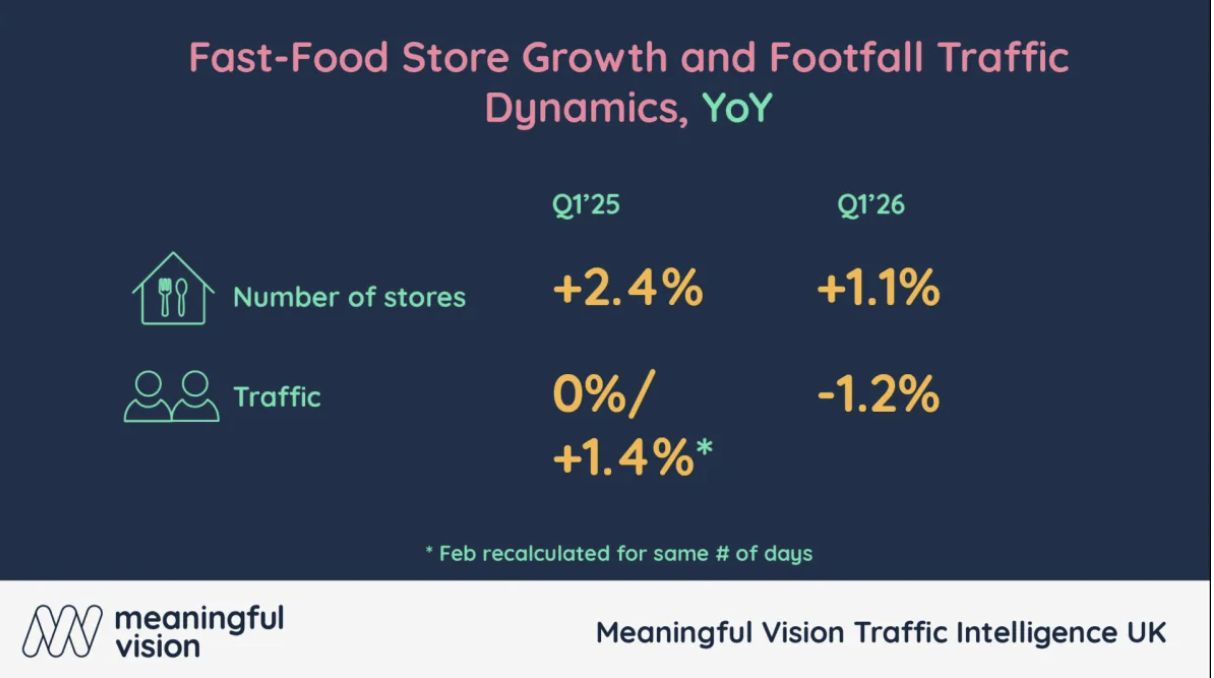
According to The Caterer, almost three-quarters of small food and beverage operators have increased prices in response to ongoing cost inflation, while separate QSR Media research reports the biggest decline in UK foodservice footfall in two years.
The figures underline the challenging commercial backdrop facing many operators as businesses continue to manage higher wage costs, energy prices, ingredient inflation, rents and broader economic uncertainty.
The data provides important context for ongoing debates around the cumulative impact of regulation and compliance costs across foodservice supply chains. Plastic Packaging Tax, pEPR and wider sustainability obligations are all arriving at a time when many operators remain highly cost-sensitive.
The research also reinforces growing concern across hospitality and foodservice markets that consumer spending remains fragile, with businesses increasingly balancing affordability pressures against rising operational and compliance demands.
FPA comment: "The policy challenge here is to maintain momentum towards better environmental outcomes while recognising the commercial reality facing operators and suppliers".
Government consults on certification for recycled plastic claims
As reported in last week's FPA Friday Digest, government has opened a consultation on whether certification should be required for mechanically recycled plastic content claimed under the Plastic Packaging Tax (PPT).
For responsible businesses, stronger evidence standards could help create a more level playing field. However, any new certification requirement must be practical, proportionate and workable across complex packaging supply chains, including imported materials and multi-stage production processes.
The consultation, which runs up to 10 August 2026, also underlines the growing overlap between EPR, Plastic Packaging Tax, recycled content policy and environmental claims scrutiny. Businesses will need to ensure that technical, procurement, finance and compliance teams are working from the same evidence base.
Government would like to hear from businesses within the plastics supply chain including mechanical plastic recyclers, tax advisers, trade and professional bodies, waste management companies and local authorities, and other interested parties. Meetings will also be arranged with key stakeholders and interested parties who may be affected by the proposals in this consultation. If you would like to be included in a consultative meeting, please contact HMRC at teamindirecttaxdesign@hmrc.gov.uk.
FPA comment: "This is another example of packaging compliance becoming more evidence-led. Businesses will increasingly need to demonstrate not only that they are using recycled content, but that claims can be verified through robust and consistent documentation".
NEWS FROM EUROPE
UN report calls for stricter safety standards for recycled food packaging
A new report from the UN Food and Agriculture Organization (FAO) has called for stricter safety standards and improved oversight for recycled materials used in food-contact packaging.
The report highlights growing concern around contamination risks, chemical migration and traceability as governments and industry continue to increase the use of recycled content within packaging systems.
The issue is becoming increasingly significant as packaging regulations across the UK, EU and other international markets place greater emphasis on circular economy targets, recycled content obligations and material recovery.
While the use of recycled material is widely recognised as an important part of reducing waste and lowering carbon impacts, the report underlines the importance of ensuring that food safety, material quality and consumer confidence remain central to packaging policy development.
The report also reinforces the growing importance of traceability, testing standards and high-quality collection and sorting systems as demand for food-grade recycled materials continues to increase globally.
FPA comment: "This discussion reflects a broader challenge emerging across the sector: balancing sustainability ambition with the technical and operational realities of food-contact compliance and recycling infrastructure capability".
Ireland’s single-use and DRS experience offers lessons for UK policymakers
Several Irish stories this week offered useful lessons for the UK as it continues to implement packaging and waste reforms.
TheJournal.ie reported criticism that the Irish Government has been slow to act on single-use plastics, including takeaway cups and wet wipes, while also noting European Commission pressure over producer responsibility for litter-related costs.
Separately, Dublin City Council said 'bin-raiding' linked to Ireland’s Deposit Return Scheme had created significant clean-up costs, with reports citing around €500,000 in additional costs. The issue appears to stem from the monetary value attached to bottles and cans, which has encouraged some people to search through public bins for returnable containers.
These stories do not undermine the environmental objectives of deposit return or single-use reduction policies. They do, however, highlight the importance of designing schemes around real-world behaviour.
The UK’s DRS is due to launch in October 2027. As implementation progresses, policymakers will need to consider operational impacts on public spaces, local authorities, retailers, small businesses and consumers.
FPA comment: "The lesson here is clear – successful reform requires more than good policy intent. It requires practical delivery planning, clear communication and early action to address unintended consequences".
EU industry calls for digital one-stop-shop for EPR
A coalition of industry organisations has called for a digital one-stop-shop for EPR in EU legislation, arguing that businesses need more harmonised, efficient and user-friendly reporting systems.
The proposal is significant because companies operating across multiple markets currently face fragmented EPR requirements, different registration systems and overlapping reporting obligations. A more joined-up digital approach could reduce administrative burden and improve the quality of data available to policymakers and regulators.
For UK businesses trading with the EU, the issue is highly relevant. Packaging compliance is increasingly becoming a cross-border data challenge. PPWR, EPR, digital product information, recycled content rules and national reporting requirements are all adding complexity.
The call for an EU-wide digital one-stop-shop also has relevance for the UK. As domestic systems evolve, there is a strong argument for ensuring that reporting requirements are designed around user experience, interoperability and proportionality.
FPA comment: "Simpler systems are not weaker systems. Done well, digital reporting can improve compliance, reduce duplication and make enforcement more effective".
Irish delay on 'latte levy' highlights wider policy challenges
Debate around Ireland’s proposed 'latte levy' intensified this week amid criticism that progress on further single-use plastics measures has stalled.
The proposed levy, which would apply to disposable coffee cups, has faced repeated delays as policymakers continue to assess implementation challenges, consumer behaviour impacts and operational practicalities for businesses.
The discussion reflects a wider international trend in which governments are finding that consumer-facing environmental measures can become significantly more politically and commercially sensitive once questions around cost, convenience and delivery move into sharper focus.
FPA comment: "This story is yet another reminder that packaging reform increasingly needs to be shaped not only by environmental ambition, but also affordability, public acceptance and real-world operational considerations".
EU hardens trade stance towards China amid competitiveness concerns
The European Union is reportedly preparing to take a tougher stance on Chinese trade practices as concern grows over industrial competitiveness, manufacturing resilience and market imbalance across Europe.
The College of Commissioners is set to discuss the bloc’s approach to China on Friday, but countries are already moving to sharpen the EU’s trade posture. In a French-led non-paper – also signed by the Netherlands, Italy and previously Beijing-friendly Spain – the group called for a “broader, cross-sector trade defence tool” to counter China’s economic practices.
Although Poland and Germany didn’t sign the paper, Berlin has repeatedly warned about Chinese industrial overcapacity. German Chancellor Friedrich Merz recently described Germany’s €80 billion trade deficit with China – and the EU’s €360 billion deficit overall – as “not healthy.” The coalition also points to the loss of one million industrial jobs over the past year and calls for a broader strengthening of the bloc’s trade defences, from expanding DG Trade staffing to creating a new economy-wide instrument.
INTERNATIONAL STORIES
Global approaches to polystyrene continue to diverge
Recent international developments have highlighted the increasingly fragmented global debate around packaging materials and recyclability.
In the United States, the US Plastics Pact has removed polystyrene from its list of 'problematic and unnecessary' materials following a review of recycling access and processing capability. Supporters of the move argued that improved recycling infrastructure and expanded acceptance justified a reassessment of the material’s status.
In contrast, Ghana has announced plans to ban Styrofoam food packaging from 2027 as part of wider efforts to address plastic pollution and improve waste management outcomes.
Taken together, the two developments underline the extent to which packaging policy is becoming increasingly dependent on local infrastructure capability, waste management systems and national environmental priorities.
For international packaging businesses, the divergence presents a growing challenge. Materials considered acceptable or recyclable in one market may face restrictions or outright bans in another, adding further complexity to product design, compliance and supply chain management.
FPA comment: "The contrasting approaches reinforce a wider industry debate around whether packaging policy should focus primarily on material elimination or on improving the systems needed to collect, sort and recycle materials effectively".
EPR fees increasingly shaping packaging strategy
Packaging reform is increasingly influencing not just compliance activity, but wider commercial and sustainability strategy across the global supply chain.
New analysis from consultancy AlixPartners suggests growing EPR costs are placing increased pressure on retailers and private-label packaging strategies, particularly as EPR programmes expand across multiple US states. The report highlights how packaging costs are becoming a more significant commercial consideration for brands and retailers alike.
At the same time, a separate Packaging Gateway feature highlights how major brands are continuing to invest in packaging decarbonisation, reuse models, lightweighting and material optimisation as they respond to evolving regulation, carbon reduction targets and changing consumer expectations.
Taken together, the two reports underline the extent to which packaging decisions are now being shaped by a combination of environmental ambition, regulatory compliance and economic reality.
For businesses across the packaging value chain, packaging is no longer simply a product protection or branding exercise. It is becoming increasingly tied to cost exposure, recyclability requirements, carbon reduction strategies, operational efficiency and future regulatory risk.
The wider challenge for both industry and policymakers will be ensuring that packaging reforms support innovation and long-term sustainability improvements without creating unintended commercial pressures or conflicting policy incentives.
FPA comment: "The developments are also highly relevant for UK businesses as pEPR implementation accelerates and pressure grows to balance environmental objectives with affordability, practicality and supply-chain resilience".
EXTERNAL EVENTS AND PARTNER NEWS
Complimentary Surrey Cricket Tickets for Summit delegates
Delegates booking their place before close of business today (Friday 29 May) will also receive access to complimentary Surrey Cricket match tickets at the Kia Oval, with a range of fixtures available throughout the season.
Bringing together packaging manufacturers, brands, retailers, recyclers, policymakers and sustainability leaders, the event will explore many of the key issues currently shaping the sector – including EPR, packaging innovation, recyclability, reuse systems, carbon reduction, material choices and the future direction of packaging regulation.
With businesses across the supply chain continuing to navigate significant environmental and commercial change, the conference provides an excellent opportunity to hear from industry experts, gain insight into emerging policy developments and discuss the practical challenges and opportunities facing the sector.
LPW takes place on 16 and 17 September in Halls S2 and S3 at the Excel. FPA members interested in attending can register online for free via the button below.
Stakeholder Engagement Forums – June and July dates
Dates and links to the next tranche of Circular Economy Stakeholder Forum meetings. No registration is required, the Microsoft Teams link accompanying each forum will provide direct access to that meeting.
Defra recommends individuals wishing to attend save each link to their calendars. No reminders will be sent.
June Forum – Tuesday 2 June: 14:30 to 16:00 Link to access forum
July Forum – Tuesday 7 July: 14:30 to 16:00 Link to access forum
FPA NEWS AND EVENTS
Confidential input requested
Businesses with concerns about how pEPR is operating in practice – including issues relating to scope, competition, enforcement or unintended consequences, are invited to share their experiences in confidence with the FPA. We also welcome intelligence on potential gaps in scope, market distortions or suspected avoidance behaviours, which can be shared in confidence.
This insight is invaluable in helping us build an accurate picture of how the system is functioning on the ground and in ensuring that industry concerns are effectively represented in our ongoing engagement with Defra, PackUK and the Environment Agency.
Please contact the compliance team directly via compliance@foodservicepackaging.org.uk. All information will be handled sensitively and used to inform our evidence base and policy discussions.
FPA Golf and Activities Day – only a few places remaining ...
FPA members, colleagues and customers are invited to join us on Thursday 11 June for the FPA’s ever-popular annual Golf and Activities Day, taking place at the stunning Breadsall Priory Country Club, just outside Derby.
Many members have already secured their places for what promises to be another excellent day of business networking, entertainment and informal industry engagement. Accommodation at Breadsall Priory is limited and only four rooms remain, so grab yours quickly if you haven't already!
Whether you choose to take part in the Golf Day or the fun-filled ‘Quintessentially English’ Activities Day, the event offers a fantastic opportunity to strengthen existing relationships, make new industry connections and spend time with fellow FPA members, colleagues and customers in a relaxed setting.
Golf Day
Participants will enjoy 18 holes of golf within the beautiful grounds of Breadsall Priory Country Club. The competition will follow the four-ball-better-ball Stableford handicap allowance format, although guests who are not part of a full team can be paired with others on the day.
Following member feedback, there is also the option this year to be placed into mixed-company teams to maximise networking opportunities across the sector.
Prizes will include the FPA Golf Winner’s Cup for the highest individual score, the FPA Golf Champions Shield for the winning team, along with competitions for longest drive and nearest the pin.
Activities Day
For those preferring something a little different, the Activities Day promises plenty of entertainment and friendly competition, with teams taking part in a series of light-hearted challenges including axe-throwing, splat-the-rat, welly wanging, tug-of-war, croquet, boules, races and even duck herding.
Teams consist of five participants, with guests able either to enter as a full team or join mixed-company teams — another excellent way to meet and network with industry colleagues.
The day concludes with prize-giving and an evening barbecue, providing further opportunities to continue conversations and build valuable new business relationships in an informal atmosphere.
To help attendees maximise networking opportunities ahead of the event, the guest list is available to view online.
We are grateful to our sponsors for supporting this year’s event: South Staffordshire Paper Products Ltd (Longest Drive), Conglom International (Nearest the Pin), and Paranova (Activities).
Pricing, the full itinerary and booking details can be accessed via this link
Essential reading
GOV.UK: Packaging producer responsibility monitoring plan 2025. Read more here
The Times: Taxpayers hit by €500k bill as council battles 'bin interference'. Read more here
Packaging News: Importance of sustainable packaging to consumers undiminished, survey shows. Read more here
Civil Service World: Environment secretary confirms ex-Defra permanent secretary Helen Ghosh as the new chair of the Office for Environmental Protection. Read more here
Plastics News: Entries open for 25th anniversary Plastics Industry Awards. Read more here
TheJournal: Whatever happened to the 'latte levy'? Government dragging its feet on single-use plastics. Read more here
letsrecycle.com: Opinion piece by the chair of The Packaging Scheme Forum – "Don't believe the EPR 'stealth tax' myth". Read more here
Packaging Europe: Joint statement calls for digital one-stop-shop for EPR in EU legislation. Read more here
Packaging Dive: US Plastics Pact urged to remove two polystyrene items from 'problematic' list. Read more here
Packaging News: Universal recycling label 'not always helpful' says bins.co.uk. Read more here
Recycling Today: Beyond the deadline – how EPR is rewriting the packaging playbook. Read more here
Packaging Insights: Scaling safe, user-friendly reusable packaging through tech and innovation. Read more here
Packaging Gateway: Food packaging shifts towards AI and real-time monitoring. Read more here
Quote of the week and post of the week
Karen Graley, UK Packaging PRO head interviewed by The Grocer
“With anything new there are always going to be hiccups. Do we have all the answers right now? I don't think we do. Not everything has gone smoothly, but I think what we've seen is a vast improvement since PackUK was formed. Yes, there have been mistakes, but they ave put them right very quickly".
Kevin Vyse FIMMM MIS4CE, director of sustainability EU at ProAmpac on LinkedIn | @kevinvyse
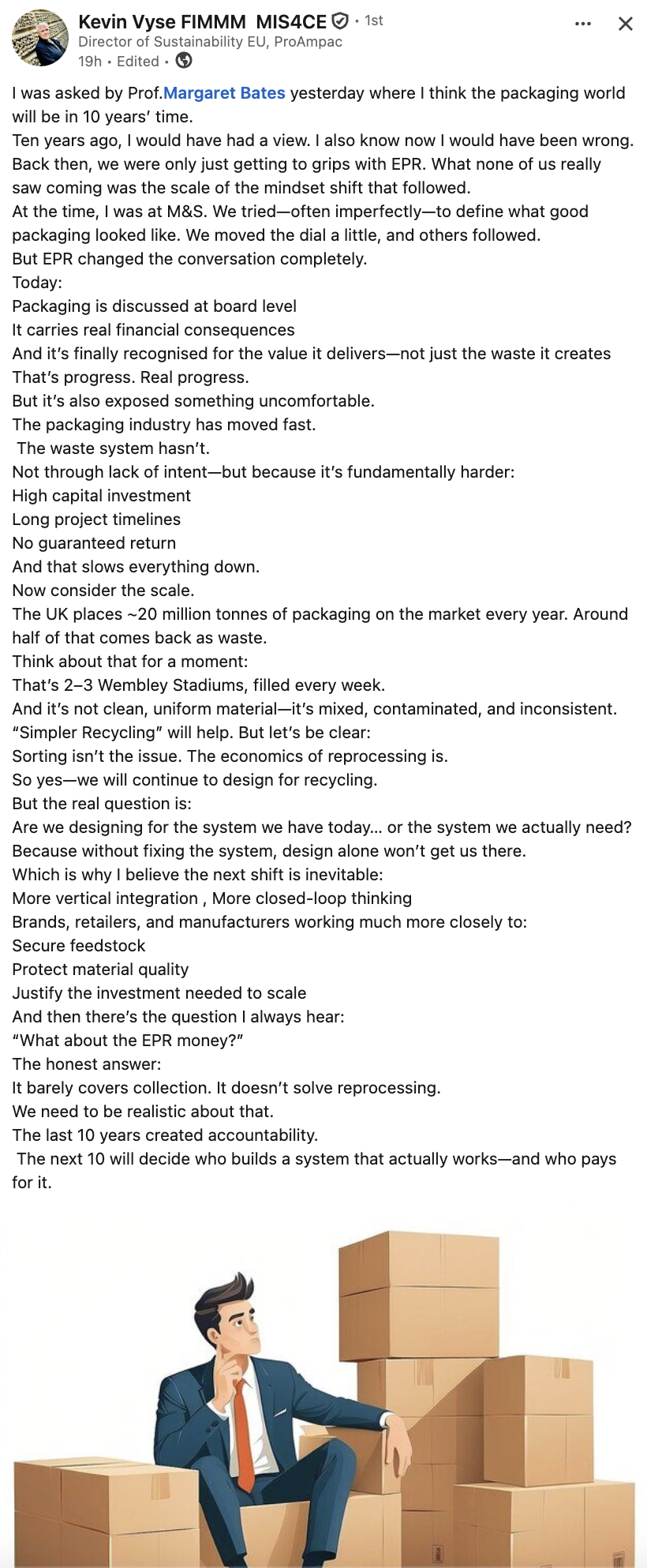
Click on the image above to access and / or comment on this post
Do you know a business that should join the FPA?
The Foodservice Packaging Association represents the interests of its members at all levels and works hard to ensure its members are better represented, better informed and better connected.
FPA members receive early sight of this Digest on Thursday evenings, prior to distribution each Friday morning, and can view an archive of previous Digests within their FPA Dashboards or via this link