The FPA Friday Digest
30 January 2026
This week's quote of the week from Mary Creagh refers to pEPR as having " ... some of the most generous support measures for small businesses across any packaging scheme globally", which must beg the question why other countries neglected to go down the same route.
For those waiting with baited breath for details of the letters the FPA is drafting to Defra, PackUK and the Environment Agency – while we originally intended to send these out earlier this week, we have deferred in order for the Packaging Federation to make initial contact with Chris Bloore, chair of the APPG group for packaging, as was agreed when Martin Kersh and I met with him separately.
As I mentioned last week, in the meantime, please keep the evidence coming and continue to get in touch with me directly with your real-world stories about the impact of EPR on your businesses. My contact details can be found at the foot of this Digest.
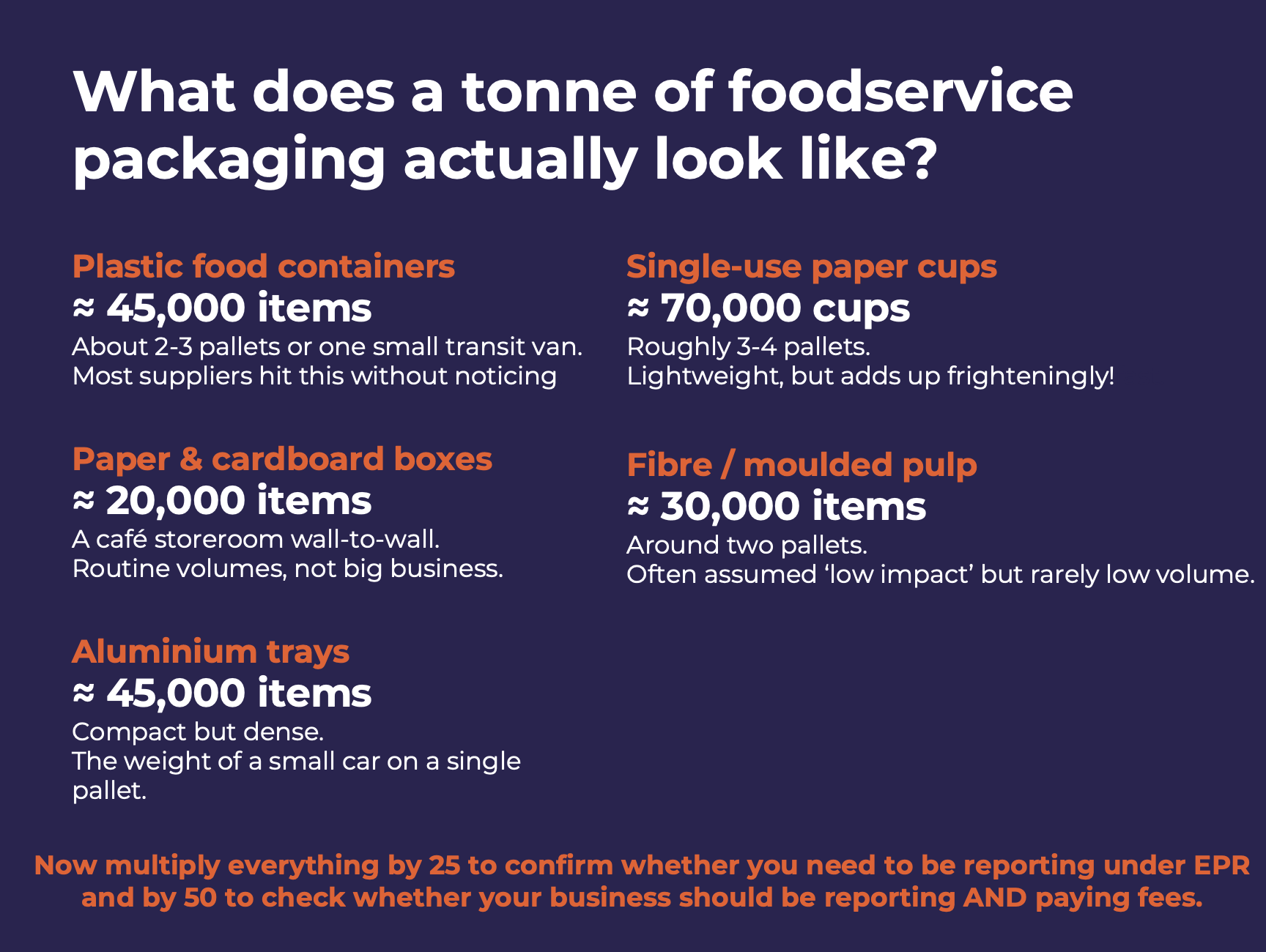
With the impending increase in PPT, coupled with the reality of EPR fees, we ask, what constitutes a tonne of foodservice packaging?
“The PPT increase reinforces that recycled content needs to be a business priority. But without robust certification, the policy risks rewarding claims rather than actual circular material use”.
As previously reported in the Friday Digest, UK government guidance confirms that the Plastic Packaging Tax (PPT) will rise to £228.82 per tonne from 1 April 2026, continuing to apply to finished plastic packaging with less than 30% recycled content. The government is also consulting on mandatory certification for recycled content claims, aimed at tightening the reliability of recycled content data and reducing fraud – a high-priority compliance issue for businesses importing or manufacturing above the 10-tonne threshold.
This, together with the de minimus EPR threshold, led us to wonder, what exactly does a tonne of packaging look like? We've had a go at working this out, but would welcome feedback and comments from member companies as to what reality means to them in terms of tonnage.
UK Deposit Return scheme gets a new identity as 'Exchange for Change'
"The launch of ‘Exchange for Change’ gives the UK’s Deposit Return Scheme a clear, consumer-friendly identity that the FPA hopes will help drive participation, improve recycling quality and support the government's circular-economy goals ahead of the 2027 rollout”.
The UK’s long-awaited Deposit Return Scheme (DRS), due to launch in October 2027, has been officially rebranded as 'Exchange for Change'. The scheme administrator, formerly the UK Deposit Management Organisation (UK DMO), has adopted this new trading name alongside a distinct brand icon that will be mandatory on all in-scope drinks containers and return points.
The identity is designed to communicate the core mechanism of the scheme – where consumers return empty drinks containers and reclaim a refundable deposit – while signalling its wider environmental purpose: reducing litter and improving recycling rates.
The scheme will operate across England, Scotland and Northern Ireland, covering PET plastic, aluminium and steel containers between 150 ml and three litres, with detailed logo guidance to be issued to producers and retailers to support compliance ahead of launch.
Business rates u-turn leaves hospitality divided
“Supporting pubs while excluding the rest of hospitality risks creating winners and losers in a sector that is already under immense pressure. A more joined-up approach would recognise that restaurants, cafés and pubs are facing many of the same cost and regulatory challenges”.
The government’s decision to limit business rates relief to pubs, while excluding restaurants, cafés and wider hospitality, has drawn strong criticism from across the sector. Commentators argue the move unfairly divides hospitality businesses that face similar cost pressures, including labour, energy and regulatory compliance.
The decision by Chancellor Rachel Reeves has been described as arbitrary, with industry warning it risks distorting competition and accelerating closures among food-led venues.
Concerns are also being raised in Wales, where hospitality representatives have highlighted the cumulative burden of costs and uneven policy support, echoing wider frustration across the UK hospitality sector.
For foodservice packaging manufacturers and distributors, the decision adds another layer of uncertainty. If restaurant closures accelerate or margins tighten further, investment in innovation, sustainability and compliance, including packaging redesign and EPR readiness, may be delayed or deprioritised.
The issue also highlights a broader concern – policy made in silos risks unintended consequences across interconnected sectors.
Emma Bourne to leave Defra
“While changes in leadership don’t alter the direction of travel, they can affect delivery. The message for businesses is to prepare on the assumption that things are proceeding, and not wait for perfect clarity before acting”.
Emma Bourne’s departure from Defra comes at a critical point in the rollout of EPR, DRS and recycling reforms. While overall policy direction is unlikely to change, there may be short-term impacts on pace and clarity.
This may lead to a possible slower release of guidance on pEPR, RAM interpretation and PRN/PERN arrangements; uncertainty around delivery timelines, particularly for secondary guidance rather than core policy; and a greater reliance on already pressured PackUK and Defra officials to drive day-to-day delivery during the transition.
The DRS rebrand to Exchange for Change is already locked in and the October 2027 launch date remains unchanged, but businesses will be watching closely for timely guidance on logo use and packaging artwork requirements.
Letsrecycle.com reports that Bourne will take up a new role as director general for EU Reset and Trade from February. The official Defra announcement can be viewed here
De minimis thresholds under fire
“The de minimis debate is not unique to packaging. In whatever sector, exemptions risk shifting cost onto compliant businesses while allowing significant volumes to sit outside the system, impacting both on fairness and on the desired environmental outcomes”.
An article from outside the packaging sector is adding to the debate over de minimis thresholds, highlighting how small consignments can bypass environmental and regulatory obligations. Within the article, published by Innovation in Textiles, the founder of Beyond Retro argues that current de minimis rules allow large volumes of imported goods to avoid scrutiny, undermining sustainability goals and disadvantaging compliant businesses.
While the article focuses on textiles, the issue strongly mirrors concerns in the packaging sector, where de minimis thresholds under EPR, recycling obligations and associated reporting requirements risk creating loopholes. Businesses operating just below thresholds may escape responsibility, while compliant producers face rising costs and administrative burden – distorting competition and weakening the effectiveness of environmental policy.
For those interested, an article about the the call for a mandatory EPR scheme for textiles can be reviewed here
NEWS FROM EUROPE
Investigation highlights misleading 'recycled content' claims in Europe
“If recycled content claims are to drive real change, they must be clear, verifiable and meaningful. Vague labelling highlights the gap between policy ambition and on-pack communication and undermines consumer trust".
A Guardian investigation has raised concerns that many plastic packaging products marketed as 'recycled' or 'more sustainable' contain very low levels of genuine recycled plastic, sometimes as little as a few per cent. Experts warn that vague labelling, limited disclosure and the use of complex accounting approaches risk misleading consumers and undermining trust in recycling claims.
The article highlights growing concern that current rules allow packaging to be presented as environmentally improved without clearly stating how much recycled content is actually used, or whether claims relate to physical material or accounting mechanisms. As scrutiny of environmental claims increases, the findings underline the risk for businesses making imprecise or poorly substantiated statements.
The story reinforces pressure for greater transparency on recycled content, directly relevant to the Plastic Packaging Tax, EPR reporting and future enforcement, and strengthens the case for robust verification and evidence.
Plastic packaging market growth and sustainability trends
A recent market forecast shows the European plastic packaging market continuing to grow through the 2025–35 period, driven by demand in food, beverage, pharmaceutical and personal care segments.
Sustainability initiatives including lightweighting and recyclable materials are increasingly shaping industry innovation, albeit against the backdrop of regulatory pressure to improve circularity.
EU moves to eliminate single-use condiment sachets under packaging reforms
“This announcement underlines the growing policy focus on waste prevention rather than recycling alone. For foodservice packaging, it reinforces the need to think carefully about which formats genuinely add value, and which may increasingly be viewed as unnecessary".
The European Union has confirmed plans to phase out single-use condiment sachets, including ketchup, mayonnaise, salt and similar portion packs, as part of its wider drive to reduce packaging waste and unnecessary plastic use.
The measure forms part of the EU’s broader packaging reform agenda under the European Union’s waste reduction and circular economy policies, targeting items considered avoidable, non-essential packaging in foodservice and hospitality settings. The intention is to shift consumption away from disposable single-use packs towards reusable, refillable or alternative dispensing systems.
The proposals focus on small, single-portion packaging formats and align with the EU’s tightening stance on waste prevention, rather than downstream recycling; eliminating packaging where reuse is considered feasible; and reducing formats that are difficult or uneconomic to collect and recycle.
Although implementation details and timelines will vary by member state, the direction of travel is clear: single-use convenience formats are increasingly at risk under European policy.
While the measures apply within the EU, suppliers serving EU markets may need to redesign product ranges. The move may also influence UK thinking on sachets and portion packs as EPR, Simpler Recycling and waste prevention measures evolve.
The announcement reinforces a wider trend away from disposable 'just-in-case' packaging and towards reuse, bulk dispensing and alternative service models.
For foodservice operators, the shift raises practical questions around hygiene, food waste, portion control and customer experience, alongside sustainability objectives.
Further clarification on scope, exemptions and timelines is required, and it will be interesting to learn how enforcement will distinguish between plastic and non-plastic sachets.
CEAMSA joins EU project to develop plastic-free coffee cups
“The pressure to act is real, but rushing poorly thought-through alternatives helps no one. This kind of collaborative innovation is exactly what’s needed”.
CEAMSA has joined a €4 million European innovation project, led by Notpla and supported by Horizon Europe, to develop plastic-free, home-compostable coffee cups capable of meeting real-world performance requirements. CEAMSA is contributing its expertise in bio-based materials, focusing on solutions that avoid plastic coatings while remaining viable for industrial manufacture.
Working alongside a consortium of 14 partners – including materials specialists, research institutes, universities and end users, such as AIMPLAS, Walki Group, Compass Group UK & Ireland, University College London and Plymouth Marine Laboratory – the project aims to replace plastic-lined paper cups with natural, scalable materials suitable for food contact and circular end-of-life outcomes.
Plastic-lined paper cups remain difficult to recycle in practice and are excluded from household recycling under Simpler Recycling. As EPR costs rise and scrutiny of cup recyclability increases, including through the National Cup Recycling Scheme, this project highlights a longer-term route toward genuinely circular alternatives.
INTERNATIONAL NEWS
California hits the pause button on packaging reform
“California’s decision to pause SB 54 is a reminder that effective packaging policy depends on good design, not just speed. Taking time to get the detail right ultimately delivers better environmental outcomes and greater certainty for businesses”.
California has taken the decision to pause and rework the implementation of SB 54, its landmark packaging Extended Producer Responsibility and plastics reduction law, in a move that is drawing close attention from policymakers and industry alike.
SB 54, often described as one of the most ambitious packaging laws in the world, is intended to overhaul how packaging is designed, financed and recovered across the state. However, regulators have now stepped back from elements of the original implementation timetable, acknowledging that complexity, cost modelling and practical delivery concerns need further work before the scheme is finalised.
There is growing awareness that poorly designed EPR schemes can undermine recycling markets rather than strengthen them and rather than pushing ahead regardless, California has opted to slow the process to get the framework right – a decision that stands in contrast to jurisdictions where legislation has moved faster than the supporting infrastructure, guidance and economic modelling.
California is not alone in taking a more measured approach. Across several jurisdictions governments are revisiting timelines for complex packaging reforms and regulators are recognising the need for clear definitions, robust data and realistic delivery mechanisms.
This is in contrast to faster-moving frameworks elsewhere, where businesses have faced shifting rules, late guidance and rising compliance costs, with limited visibility of environmental outcomes ...
International Paper to split into two regionally focused packaging companies
International Paper has announced plans to split into two independent, publicly traded companies, organised by geography, following its acquisition of DS Smith in January 2025.
The move will create a North American business and a separate Europe, Middle East and Africa (EMEA) packaging company operating across 30 countries. The EMEA business will be spun off, with International Paper retaining a meaningful ownership stake, and is expected to be listed in both London and New York. The separation is targeted for completion within 12–15 months, subject to regulatory approval.
International Paper said the split will allow both businesses to pursue more focused strategies and investment decisions, reflecting differing regional market needs and stages of transformation.
Andy Silvernail will remain CEO of International Paper, alongside the existing senior leadership team. Tim Nicholls has been named CEO of the new EMEA packaging company, having been appointed earlier this year to lead DS Smith within the IP group.
EXTERNAL EVENTS
Packaging Innovations & Empack confirm final speaker lineup
The full conference programme is now live for Packaging Innovations & Empack, bringing together brand owners, designers, policymakers and supply-chain specialists to tackle the real challenges facing the sector.
The FPA will be based in the Foodservice Packaging Zone, where you can find the FPA team and board members at stand H70 throughout the event. We’re very much looking forward to catching up with members – both long-standing and new – and discussing the issues shaping foodservice packaging in 2026 and beyond.
Dr Alan Campbell, director of The LCA Centre and expert on all things policy focused, will once again be making himself available on the FPA stand at designated times to answer informal 'walk-on' questions.
Dr Campbell will also be providing practical guidance to FPA members through pre-booked one-to-one appointments. Please email Lisa to book your slot.
A number of sessions are expected to generate particularly lively debate, including Talking Rubbish podcast hosts James Piper and Robbie Staniforth discussing the legal and practical challenges in recyclable packaging collaboration and The Big Debate, chaired by former FPA executive director Martin Kersh, now co-CEO at the Packaging Federation, where the topic will be: ‘AI will do far more to improve packaging waste management than the government’s packaging reforms'. If you’re attending, do come and see us – we'd be delighted to continue the conversation.
And if you haven't booked your ticket yet, please do so as our guests using the link in the button below.
Stakeholder Engagement Forums – February to July dates
Dates and links to the next tranche of Circular Economy Stakeholder Forum meetings. No registration is required, the Microsoft Teams link accompanying each forum will provide direct access to that meeting.
Defra recommends individuals wishing to attend save each link to their calendars. No reminders will be sent.
February Forum – Tuesday 3 February: 14:30 to 16:00 Link to access forum
March Forum – Tuesday 3 March: 14:30 to 16:00 Link to access forum
April Forum – Tuesday 7 April: 14:30 to 16:00 Link to access forum
May Forum – Tuesday 5 May 14:30 to 16:00 Link to access forum
June Forum – Tuesday 2 June: 14:30 to 16:00 Link to access forum
July Forum – Tuesday 7 July: 14:30 to 16:00 Link to access forum
FPA NEWS
Compliance update on FPA Accreditation scheme progress and environmental claims review
The FPA Compliance Team is close to completing site visits to UK facilities operated by all participants in the FPA Accreditation Scheme, marking a significant milestone in the scheme’s development. A proposed scheme trust mark has now been approved by the FPA Board, and work is underway on drafting the formal Accreditation Scheme Standard.
A meeting of scheme participants is scheduled for April, at which the independent testing company appointed to assess products will be formally introduced. Subject to final approvals, the FPA is aiming to launch the scheme in Q2 2026, covering cling film, pallet wrap, foil and baking paper.
Alongside this work, and following the earlier letter advising members to review their websites for compliance with environmental claims, the Compliance team has now completed a review of all FPA member websites. This has been a substantial piece of work, and particular thanks are due to Karen Neal, who joined the team in May 2025 and has undertaken much of this detailed review.
While responsibility for compliance ultimately rests with individual members, the review highlighted a number of recurring issues that Trading Standards Officers and the Advertising Standards Authority (ASA) are likely to challenge. These are listed in full in the latest issue of the FPA Connect.
The compliance team remains available to support members and encourages early engagement on any environmental claims concerns via the compliance page in FPA Member Hub.
FPA 2026 Awards: finalists announced
We’re delighted to announce that the finalists for the 2026 Awards have now been confirmed, following an unprecedented number of entries across all categories.
The standard of submissions this year was exceptionally high, reflecting the innovation, resilience and commitment that continues to define the foodservice packaging sector.
Alongside the core product and business awards, we are particularly encouraged by the response to our individual recognition categories.
The Rising Star award once again attracted impressive entries, showcasing the next generation of talent coming through the sector.
We were equally delighted by the strong support for two new award categories introduced for 2026:
- Apprentice of the Year, recognising the vital role apprentices play in building future skills and capability.
- Unsung Hero, created to celebrate those individuals whose contribution is often behind the scenes, but fundamental to business success.
The volume and quality of nominations for both new categories underline the importance of recognising people at every level of the industry.
Our thanks to everyone who submitted an entry. The level of participation this year demonstrates the high value placed on recognising excellence.
The full list of finalists across all categories is now available on the FPA website.
New FPA Affiliate Member
A warm FPA welcome to our latest Affiliate Member Lavazza Professional UK. Visit the company's website via this link to learn more about what they do.
Essential reading
Packaging News: RECOUP appoints new vice chair to strengthen leadership and strategic direction. Read more here
Packaging Insights: World Economic Forum 2026 – collaboration launches US$2B next-gen packaging initiative. Read more here
Packaging Dive: The top four areas AI can benefit packaging circularity today (Consumer Goods Forum report). Read more here
Packaging News: Tetra-Pak invests £52m in Swedish plant to advance paper-based barrier tech. Read more here
Sustainable Packaging: PackUK welcomes pEPR funded recycling upgrade. Read more here
letsrecycle.com: EA has only used its enforcement powers six times in seven years. Read more here
Restaurant: Excluding restaurants and other hospitality venues from business rates support is as nonsensical as it is unfair. Read more here
The Grocer: Is Exchange for change a turning point in the UK's DRS drama? Read more here
Steptoe: Unpacking the overlap between the EU's PPWR and California's SB 54. Read more here
Quick Serve (formerly Ooh ..): Delivery sales increase by 4.1% in December. Read more here
QSR: Q4 site losses erase year of hospitality growth. Read more here
Quote of the week and post of the week
Response from Mary Creagh to a written question posed in the House of Commons asking the Secretary of State for Environment, Food and Rural Affairs what assessment she has made of the potential impact of EPR on small businesses in local communities:
“pEPR in the UK has some of the most generous support measures for small businesses across any packaging scheme globally. These are exemptions from disposal fee and recycling (PRN) obligations for producers with an annual turnover below £2 million and packaging tonnage below 50 tonnes; and an exemption from data collection and reporting obligations for small businesses with turnover below £1 million and packaging tonnage below 25 tonnes. These exemptions apply to approximately 70% of businesses supplying packaging in the UK.
We have made a full assessment of the impacts that implementing packaging extended producer responsibility will have. This includes assessment of the impacts on small businesses, which can be found in Section 8 of the impact assessment".
Join the FPA
The Foodservice Packaging Association represents the interests of its members at all levels and works hard to ensure its members are better represented, better informed and better connected.
FPA members receive early sight of this Digest at 6:15 a.m. each Friday morning.
Interested in joining the FPA?